
Iowa House approves arrest-based DNA collection bill after heated privacy debate
Get AI-powered insights, summaries, and transcripts
Subscribe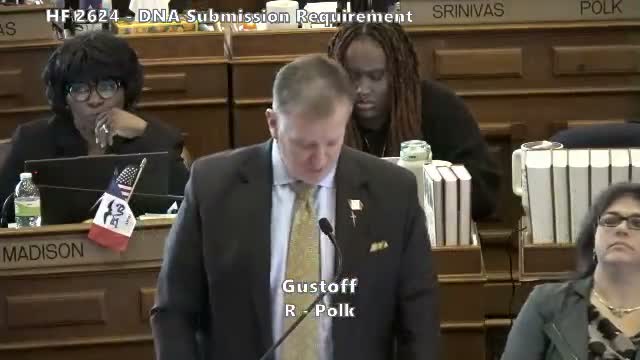
Summary
The Iowa House passed House File 2624 as amended, allowing law enforcement to collect limited DNA samples by cheek swab from people arrested for felonies and certain violent aggravated misdemeanors; supporters cited cold-case closures while opponents warned of Fourth Amendment and privacy risks, particularly for minors. Vote: 57-29 (14 absent).
The Iowa House on Wednesday approved House File 2624, allowing law enforcement to take a limited buccal swab for DNA from people arrested for a felony or an aggravated misdemeanor with a violent element. The bill, described by sponsor Representative Frank Polk as a way to add a "21st-century fingerprint" to investigators' tools, passed the chamber after amendment and debate by a 57-29 voice-to-machine vote, with 14 members absent.
Polk, the bill sponsor, said the measure is narrowly tailored, that the laboratory indices used (CODIS) store a set of forensic markers rather than whole-genome data, and that the law includes automatic expungement procedures for samples if charges are dropped or a defendant is acquitted. "This is not your 23 and me, whole genome panel," Polk said, arguing the 20 loci used in CODIS are comparable to fingerprints and have been used in other states to close cases.
The bill was amended on the floor to ensure the aggravated-misdemeanor category applies to those with a violent-crime element and to add cleanup language before final passage. Polk cited out-of-state examples for his case: Texas, Virginia, Indiana and California each reported hundreds of arrestee matches and cold-case closures after adopting arrest-based collection.
Opponents pressed privacy and constitutional concerns. Representative Ramirez said the bill would extend collection to people who have been arrested but not convicted and warned of the risks to juveniles: "We should be especially reluctant to build a system that permanently tags our children with genetic data before they've had their day in [court]," Ramirez said, and declared, "I will be a no vote." Ramirez also cited a fiscal note estimating startup costs for the criminalistics laboratory at about $1,400,000 in fiscal year 2027 and about $473,000 annually thereafter.
Representative Crooket described the proposal as a potential Fourth Amendment violation, calling it a "flagrant violation of Fourth Amendment protection from unreasonable searches and seizures." Representative Thompson likewise warned of a slippery slope and read the Fourth Amendment aloud to the chamber, urging colleagues to consider civil-liberty implications.
Supporters and sponsors said automatic expungement language in the amendment and the evidentiary utility for solving violent crimes weigh in favor of the law. The sponsor moved the bill to final passage after closing remarks that emphasized victims and cold-case resolution.
The House-approved measure will be messaged to the Senate for consideration. The chamber's action follows debate that centered on balancing investigative benefits and privacy protections, with particular attention to minors, the bill's fiscal impact, and the limits on the DNA information stored in federal and state systems such as CODIS.
Next steps: The House sent the passed, amended bill to the Senate; the chamber adjourned until its next scheduled session on Wednesday, March 11, at 8:30 a.m.