
Committee backs extension of Georgia's universal access fund to keep landline 911 coverage in rural areas
Get AI-powered insights, summaries, and transcripts
Subscribe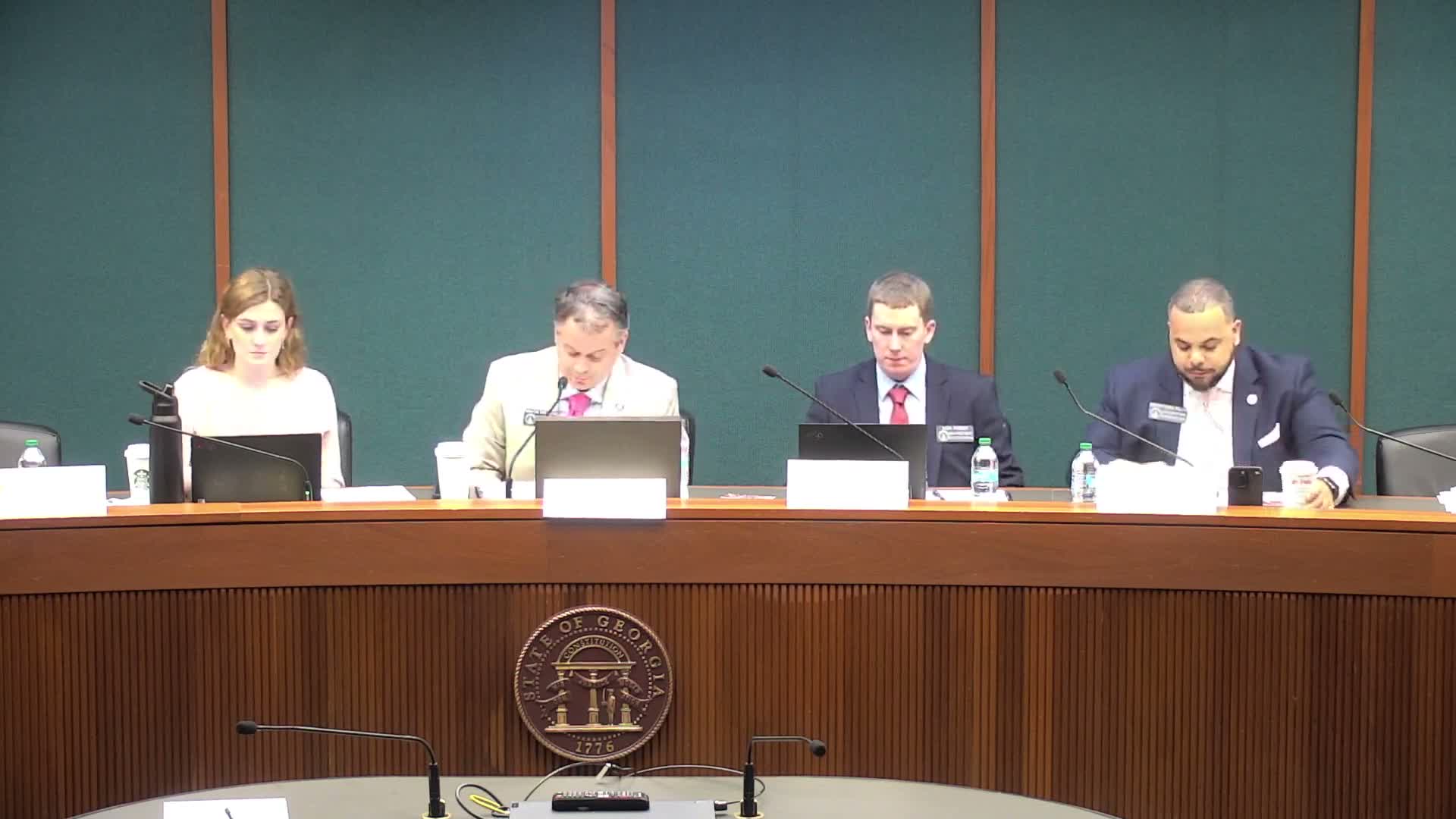
Summary
The Senate Economic Development and Tourism Committee recommended do-pass on HB 998, which would extend Georgia's universal access program and fund through Dec. 31, 2040, allow certain small local exchange carriers to opt in, and add statutory audits, PSC reporting and a $50 million annual disbursement cap.
Representative Leverett presented House Bill 998 and told the committee the measure would extend the state's universal access program and universal access fund, created by the General Assembly in 1995, from its current scheduled expiration (disbursements through 2030) to Dec. 31, 2040 and allow some smaller tier-2 local exchange companies to elect to participate.
The sponsor said the fund's purpose is to preserve affordable basic voice service in rural areas that 'might not be served if left to market forces' and to ensure residents can reach 911 where cell coverage is unreliable. Leverett said the bill does not change the fund's eligibility for reimbursement (landline voice-service costs only) but adds guardrails: an explicit statutory audit requirement, a biennial Public Service Commission report to the General Assembly about collections and disbursements, and a $50,000,000 annual disbursement cap (current annual dispersals are roughly $40,000,000, the sponsor said).
During questioning, committee members pressed on how the measure treats new technologies. Rhonda Chatham, executive director of the GTBA, told the committee that 'landline' in statute describes how voice service is delivered rather than the physical medium, and that service can be delivered over fiber as well as copper. She said participating companies may only seek reimbursement for the voice portion of service, not broadband or ancillary services.
Members also asked about the number and participation of tier-2 companies. Testimony indicated roughly 22 smaller companies operate in the state and about 19 currently participate in the program; aggregate reimbursements last year were cited at about $43,000,000. The bill will require the PSC to include specific balance and disbursement information in its reports so the legislature can better track the fund.
A committee member moved a do-pass recommendation and the committee approved the motion by voice/hand vote; the chair recorded a unanimous recommendation in the transcript. The committee recorded the do-pass recommendation seeking further consideration in the legislative process.
The committee's action advances the bill to the next procedural step; the transcript shows the committee recommendation but does not list roll-call tallies or the names of all members who voted.