San Antonio council hears joint briefing on rapid data‑center growth, water and power impacts and next policy steps
Loading...
Summary
Council received a joint briefing from CPS Energy, SAWS and Development Services on data-center growth: CPS outlined hundreds of megawatts in the pipeline and cost‑recovery safeguards; SAWS described recycled-water capacity constraints and options to limit potable use; staff and council discussed zoning amendments, a CPS pilot tariff for behind‑the‑meter generation, and a recycled‑water master plan.
The San Antonio City Council on March 4 received a three-part briefing—CPS Energy, San Antonio Water System (SAWS) and Development Services—focused on the city’s authority and tools for managing rapid data‑center growth.
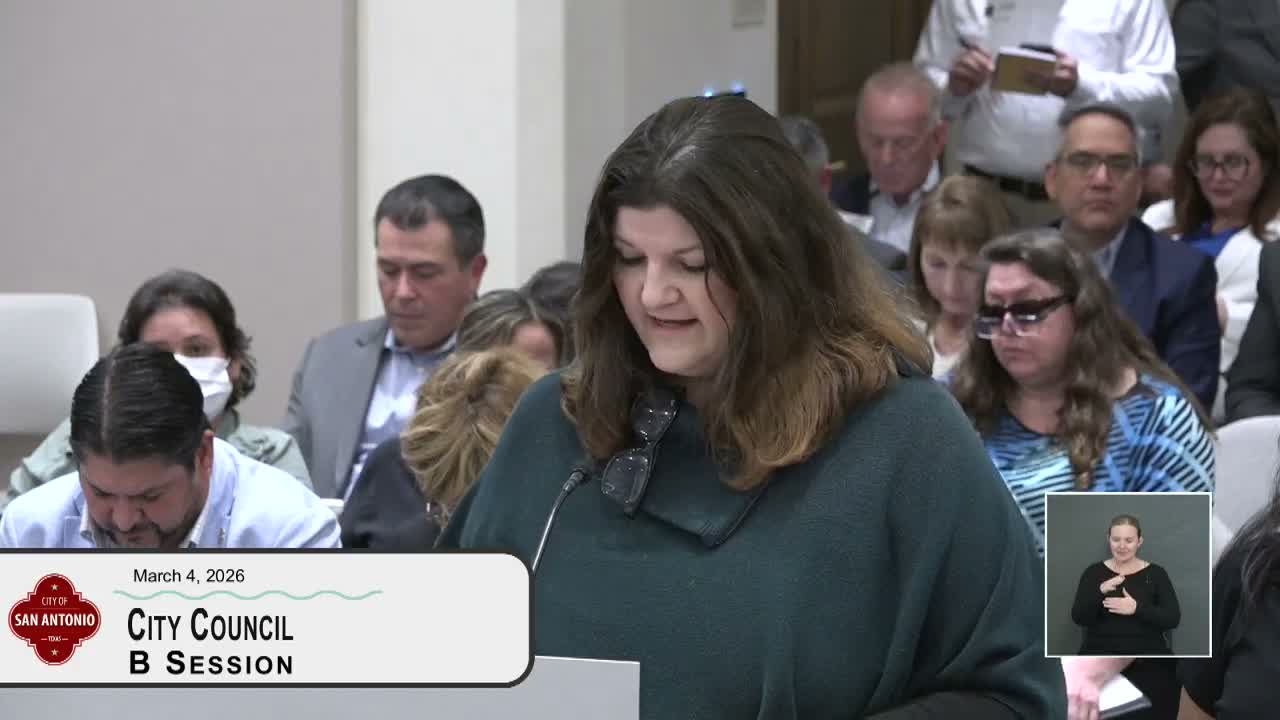
Elena Ball, CPS chief strategy officer, said the utility currently tracks 59 large‑load projects in various phases and defines “large load” at 40 megawatts (about the consumption of 10,000 homes). She told council that 335 megawatts are contracted and that roughly 1,700 megawatts were in the pipeline across feasibility and contracting stages. “Not all of these projects are going to be built, and we are being very thoughtful,” Ball said, emphasizing preconstruction surety, engineering study fees and contributions in aid of construction that require large users to bear the upfront cost of specialized infrastructure.
CPS also described a time‑limited pilot new‑service offering for behind‑the‑meter generation to study how backup generation, storage and customer‑sited resources can meet expected state requirements (Senate Bill 6) for firm backup during emergency grid events. CPS said the pilot would be limited in size and duration (draft language cited a two‑year pilot and a cap on participating customers) and is intended to inform any subsequent tariff filing.
Donovan, a SAWS official, described water considerations and the utility’s purple‑pipe recycled‑water network. He said existing data centers today use a small share of potable water, but prospective projects could move recycled‑water demand from a current baseline to materially higher levels. SAWS estimates the city has about 20,000 acre‑feet of recycled‑water pipeline demand in use, with roughly 10,000 acre‑feet of distributable capacity in the near term without major expansion; meeting larger demand would require infrastructure buildout. “We want to maximize the use of recycled water, particularly with high‑demand customers,” Donovan said, while warning that site‑specific hydraulic capacity and redundancy must be addressed.
Development Services (Thomas) reviewed zoning tools under the Unified Development Code (UDC). The city currently treats data centers as an office/data‑processing land use; options discussed include limiting data centers to certain industrial zones (C3/I1), setting buffers (e.g., 1,000 feet from residential properties, parks or hospitals), updating screening and landscape standards, and exploring impact or connection fees for recycled‑water expansion.
Council members pressed for greater transparency and cross‑agency coordination. Several members supported an expedited process to begin UDC review (with stakeholder engagement) rather than waiting for the regular five‑year cycle. Members also asked staff to return with specifics: how much of the proposed CPS capital budget is tied to prospective data‑center growth, the pilot’s eligibility and limits, recycled‑water master‑plan timing, and public‑facing materials to explain tradeoffs to residents.
Staff response and next steps: Maria (city staff) said the city will work with CPS, SAWS and Development Services to assemble a coordinated follow‑up and will bring a UDC amendment process plan to the Planning & Community Development Commission. SAWS said a recycled‑water master plan and related RFP are scheduled and that pipeline expansion projects would be scoped and prioritized through that process; CPS offered to share pilot success criteria and constraints.
No formal policy vote occurred; council directed staff to return with more detail on zoning options, pilot design and the recycled‑water master plan.