Get Full Government Meeting Transcripts, Videos, & Alerts Forever!
Get email alerts on the Land Use topic
No spam. Unsubscribe anytime.
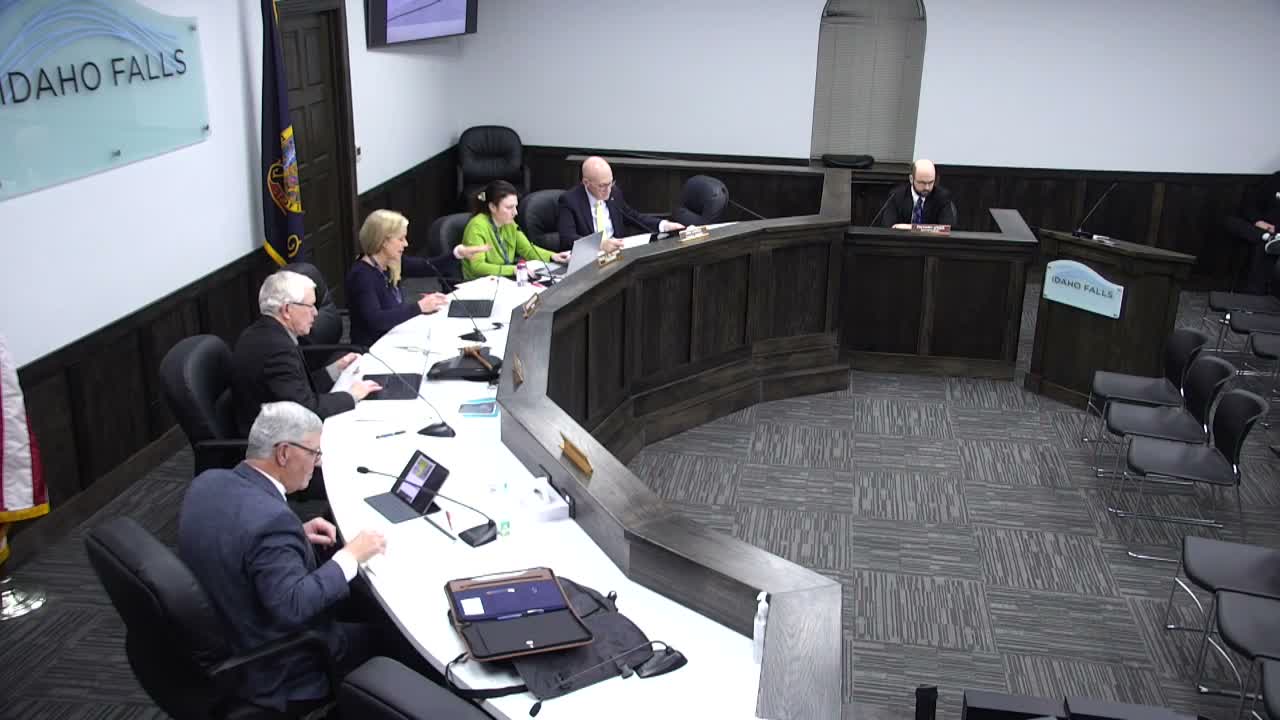
Idaho Falls City Council denies Willow Place PUD after extensive neighborhood opposition
Summary
After a three‑hour hearing with dozens of neighborhood speakers, the Idaho Falls City Council voted to deny the Willow Place planned unit development — a 14‑unit townhome proposal on about 1.8 acres — citing concerns about a private street, density and compatibility with the surrounding single‑family neighborhood.
The Idaho Falls City Council on Jan. 22 denied a planned unit development (PUD) to build 14 attached single‑family townhome units on a roughly 1.815‑acre site known as Willow Place.
The proposal would have used the city’s PUD rules to allow an 8‑units‑per‑acre density, a private street and a reduced front setback. Brad Kramer, a planning consultant for the applicant, said the project met applicable code standards, exceeds parking requirements (42 spaces provided vs. 28 required) and included more than the minimum open space and amenity commitments. “I am an unapologetic advocate for housing,” Kramer told the council while presenting the design and neighborhood outreach materials.
Neighbors, however, disagreed. More than two dozen residents testified in person, raising repeated concerns about emergency access, drainage and compatibility with the long‑established single‑family character of the surrounding subdivision. Rodney (last name on file) told the council he was worried about conflicts of interest and asked, “Could staff clarify what guidance exists regarding communications between individual council members and contractors or developers prior to council consideration?” Several neighbors asked the council to postpone or deny the item until impact fee allocations and ties to specific capital projects were spelled out.
City staff said that city divisions had reviewed utilities and circulation for the project. Public Works staff testified the proposed development did not trigger a formal traffic study threshold (100 new daily trips), and that sanitary and potable water capacity had been evaluated; the department said it was comfortable with the development's impacts on the city’s systems as proposed.
Council members spent more than an hour debating whether the PUD met the code’s “compatibility” and public‑benefit tests for a sub‑2‑acre PUD that requests variances from dimensional standards. Several councilors expressed that a private street and the reduced setbacks made the project feel more like a gated enclave than a neighborhood amenity and that residents had not received enforceable, written commitments that amenities would be public. One council member said the plan, “as presented, does not provide sufficient public benefit to justify the variances requested.”
A motion to deny the PUD carried. The council directed staff and the legal department to draft a formal “reason statement of relevant criteria and standards” explaining the denial; the draft will be returned for council review at a Feb. 9 work session. Council members and staff noted that the property owner retains the right to develop the site under the baseline R‑1 standards (public street, 6 units per acre) and that denial of the PUD does not prevent future development proposals that comply with the code.
The council’s action closes the current PUD application; next steps are a staff‑drafted reason statement and the Feb. 9 work session review.