
House advances study on Arizona refinery feasibility after heated debate
Get AI-powered insights, summaries, and transcripts
Subscribe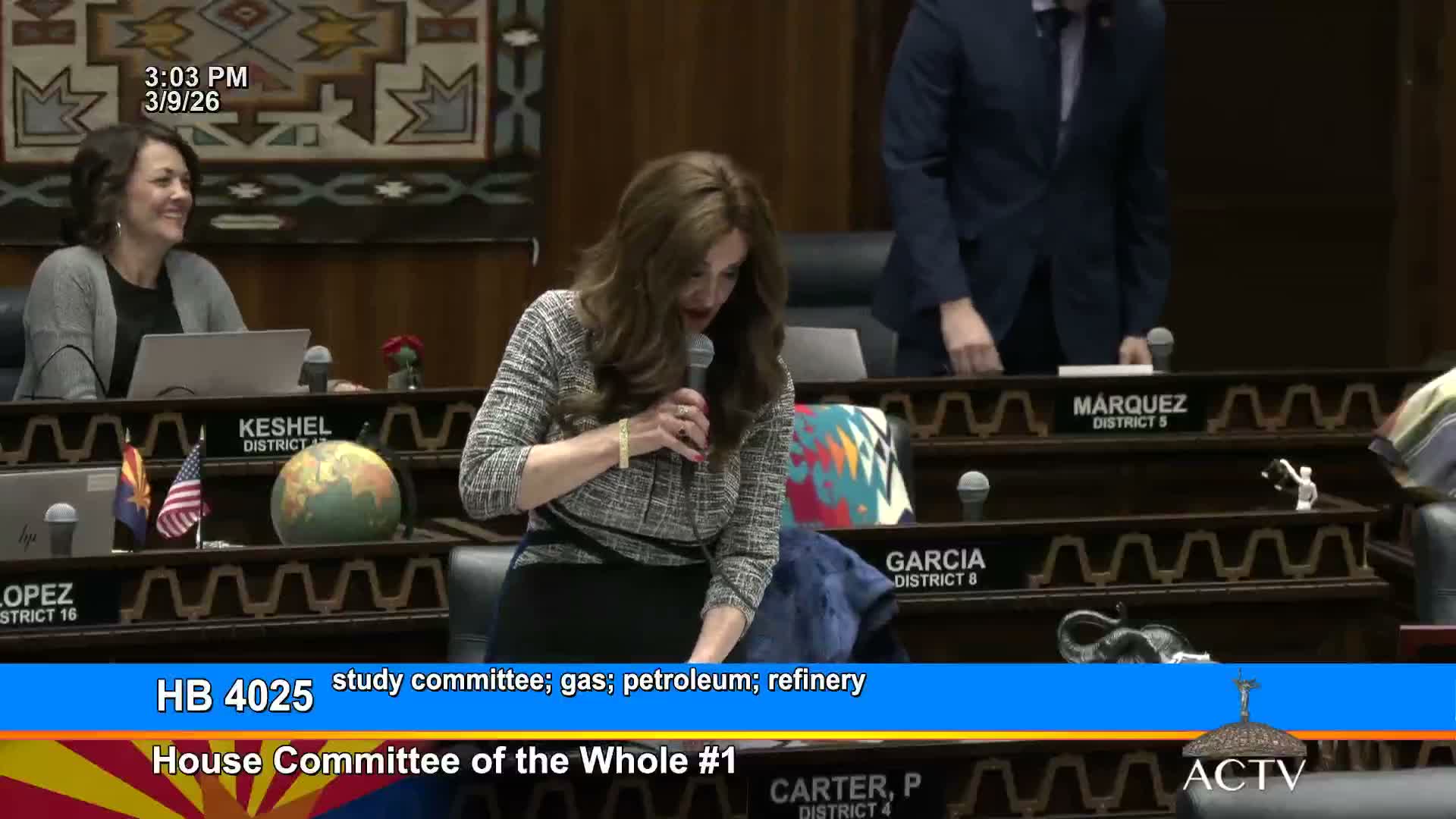
Summary
A study bill to examine the feasibility of building an oil refinery in Arizona won a narrow committee recommendation after lengthy floor debate that centered on feasibility, prior studies, tribal jurisdiction and environmental concerns; the Committee of the Whole reported HB 4025 as do-pass after a 29-19 division.
House members on March 9 gave a due-pass recommendation to House Bill 4025, which creates a study committee to examine whether Arizona should pursue building an oil refinery and related infrastructure. Representative Pamela Carter, the bill sponsor, said the state currently has no refineries (she noted that Arizona imports all gasoline blends and cited refinery closures in California), and described the study as a way to evaluate options to secure fuel supply chains and produce gasoline blends suitable for Arizona.
Representatives on both sides questioned the need for a new study committee. Representative Marquez and others pointed out that a prior state Oil and Gas Commission had studied refinery feasibility and found no viability for additional refineries in Arizona. Several speakers also noted that one deposit and refinery operation exist on the Navajo Nation, which the state does not control.
Environmental and public-health concerns were raised by Representative Aguilar and others, who said Arizona’s air‑quality challenges make new refining activity complicated. Representative Livingston and proponents emphasized supply-chain risks and volatility in crude markets as reasons to study options.
After extended debate, the House recorded a division and the transcript reports the Committee of the Whole recommendation as passing 29 ayes to 19 nays. Proponents said the study is unfunded and intended to examine the question; opponents characterized it as a distraction from proven policy options such as seeking EPA waivers for gasoline blends that would reduce costs.
What happens next: HB 4025 was reported as a do-pass recommendation and advanced on the calendar; final action in the Senate is expected to determine whether the study moves forward.