Orinda council limits ADU rights on Starter‑Home subdivisions, asks staff to use safety exception for wildfire risk
Loading...
Summary
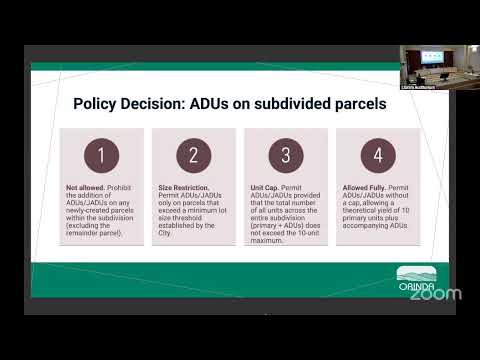
The council told staff to prohibit accessory dwelling units on parcels created under the new state Starter Home Revitalization Act (SB 1123), to bar subsequent SB 9 lot splits on those parcels, and to prepare objective design standards and a staff process to evaluate and, when justified, invoke the law's safety exception for wildfire/evacuation risk.
The Orinda City Council on March 3 gave staff direction on how to respond locally to SB 1123 (the Starter Home Revitalization Act), narrowing the city’s approach to protect public safety and local character while assigning staff to draft an ordinance that implements that approach.
Planning staff summarized the statutory framework and two policy questions for the council: whether accessory dwelling units (ADUs and junior ADUs) should be allowed on lots created under SB 1123, and whether lots created under SB 1123 should remain eligible for subsequent ministerial SB 9 lot splits. Staff noted the act permits ministerial subdivision into up to 10 parcels or development of up to 10 residential units, with size, density and fire‑safety limits, and highlighted the law’s ‘‘designated remainder’’ mechanism that can make portions of developed parcels eligible.
Residents urged caution. Nick Warrenoff asked the council to direct staff to use SB 1123’s safety exception for parcels near evacuation routes and to deny applications that would imperil evacuation access: “I would urge you to act responsibly and direct staff to invoke the safety exception and deny 11 23 applications along or within a 100 feet of an evacuation route,” he said.
After questions and debate, the council coalesced around a more conservative local approach. Members indicated a preference for prohibiting ADUs on lots created under SB 1123 (staff’s Option 1), and for preventing a subsequent round of SB 9 ministerial splits on those same parcels. Several councilors said they are concerned SB 1123 could enable higher densities on small, fire‑prone or steep lots in Orinda and that the city should use all available statutory tools to protect evacuation routes and public safety.
Staff will draft implementing ordinance language consistent with council direction, accelerate the adoption of citywide objective design standards that can be applied ministerially, and report back on practical ways to identify and apply the law’s safety exception on an application‑by‑application basis (including recommended objective standards and procedural checks to flag high‑risk locations). The council asked staff to return with ordinance language and supporting findings for planning commission and later council consideration.
The council also extended the meeting to allow the discussion, and requested that staff evaluate the expected number of eligible parcels and the implications of designated remainder provisions, particularly where topography and fire‑hazard severity zones might make development impractical or unsafe.