Lifetime Citizen Portal Access — AI Briefings, Alerts & Unlimited Follows
Hearing examiner closes record on Clallam County variance to cross Category 3 wetland; decision due in 10 business days
Loading...
Summary
At a March 5 hearing, Clallam County planning staff recommended approval of a variance to cross a Category 3 wetland for driveway and utility access to a proposed single‑family dwelling; staff and the applicant described mitigation and agency consultations, the public offered no testimony, and the hearing examiner closed the record and will issue a written decision within 10 business days.
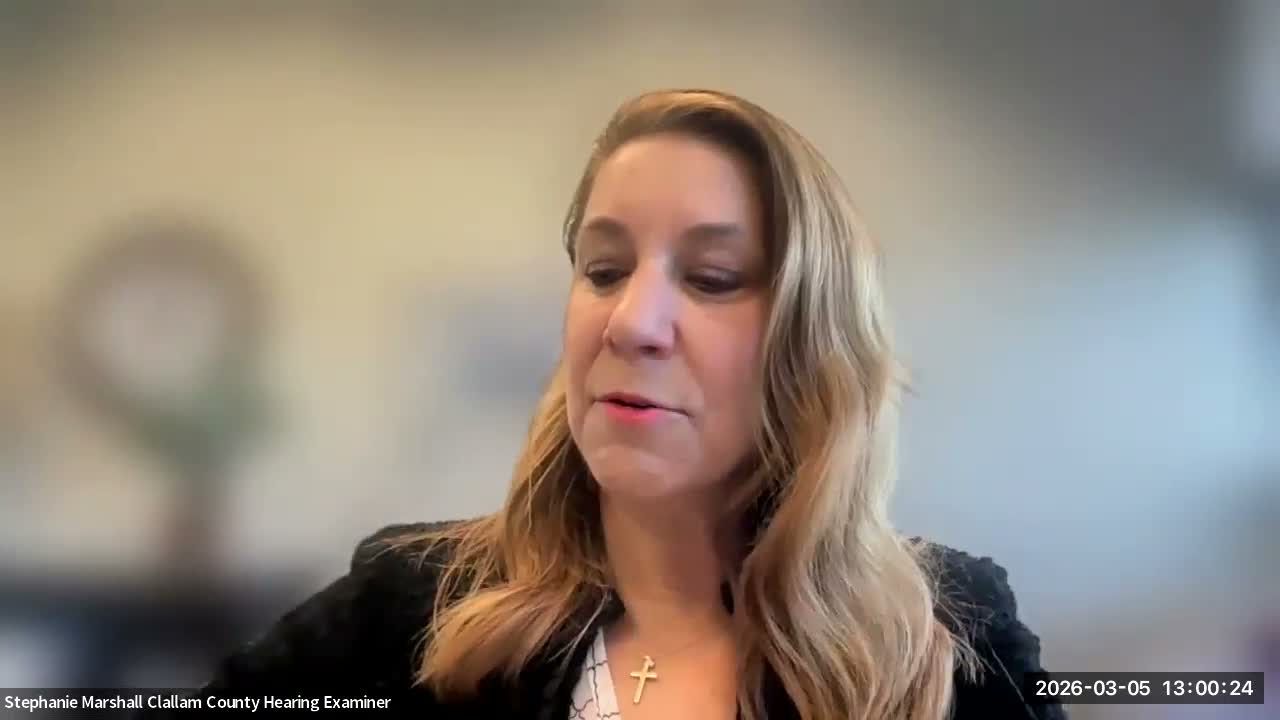
Clallam County Hearing Examiner Stephanie Marshall closed the public hearing on March 5, 2026, for application PVAR2025-00010, a request to cross a Category 3 wetland and its 50‑foot buffer to provide driveway and utility access to a proposed single‑family dwelling on a 9.85‑acre parcel.
Todd Coward, planning staff with the county Department of Community Development (DCD), summarized the Parthenicus variance and recommended approval with conditions. Coward said the crossing would occur at the wetland’s narrowest point and would use a bottomless culvert. "The crossing will permanently impact 144 square feet of wetland and 1,200 square feet of wetland buffer," Coward said, and noted the application is accompanied by a mitigation plan prepared by Westech Consulting that DCD reviewed and approved in January 2026.
Coward outlined agency input: the county issued a SEPA determination of nonsignificance (Jan. 5); the Washington Department of Ecology (DOE) indicated a pre‑filing meeting would be required before any Section 401 review; the U.S. Army Corps of Engineers advised the applicant to contact the Corps regarding possible federal permitting; and the Jamestown S'Klallam Tribe requested an inadvertent discovery plan. Coward said the county would require consultation with the Department of Natural Resources regarding any needed forest practices/land‑conversion permits. He also said the local fire district expressed concern about whether the proposed culvert would support engines and water tenders and that providing culvert design specifications to the fire district would be a condition of approval.
Coward said DCD concluded avoidance of the wetland was not practicable because applicants were unsuccessful obtaining easements from adjacent owners; moving development to the parcel’s north side would require more tree removal and place a house closer to wetland edges. "The proposal to cross the wetland at its narrowest point using a bottomless culvert would be considered the minimum necessary to gain access," he said.
Applicants Matthew Kyle Bartinicas and Ashley Bartinicas testified that they approached three neighboring property owners and offered payment for easement access but were refused. The applicants emphasized minimizing disturbance during construction and long‑term maintenance; they told the examiner they had provided the Jamestown S'Klallam Tribe with an inadvertent discovery plan.
Trevor Shea, senior biologist with Westech Consulting, said DOE’s recent pre‑application meeting was "very positive" and confirmed the mitigation approach. Shea said the mitigation plan includes buffer restoration at roughly a 2:1 ratio and described plans for wetland creation and planting (he described about 2,700 square feet of wetland creation and nearly 400 plants in the restoration plan). "We are going above and beyond the minimum standards necessary," Shea said, adding the consultant’s calculations show credit/debit mitigation amounts intended to address water quality, hydrology and habitat functions.
Marshall asked whether minor design changes would require a new hearing; Coward said design changes in "substantial conformance" with the approved plan likely would not require another variance hearing, but moving the crossing location would require an amendment and could trigger additional mitigation or tree removal. Marshall also asked whether DOE and Corps meeting summaries would be part of the record; Coward said the documents would be received and placed in the project file as part of a condition but not added to the open record for decision.
No members of the public offered testimony in person or online. After the county stated it had no rebuttal, Marshall closed the record. She told attendees she did not need follow‑up agency correspondence to decide the application and that she would issue a written decision within 10 business days.
The hearing record includes DCD’s staff report and exhibits, the applicants’ mitigation plan from Westech Consulting, agency comments (DOE, Army Corps), and the Jamestown S'Klallam Tribe’s inadvertent discovery plan. The examiner’s forthcoming written decision will determine whether the variance is granted and under what final conditions.