
Lawmakers hear bill to require Medicaid shared-services premium be passed to direct-care workers
Get AI-powered insights, summaries, and transcripts
Subscribe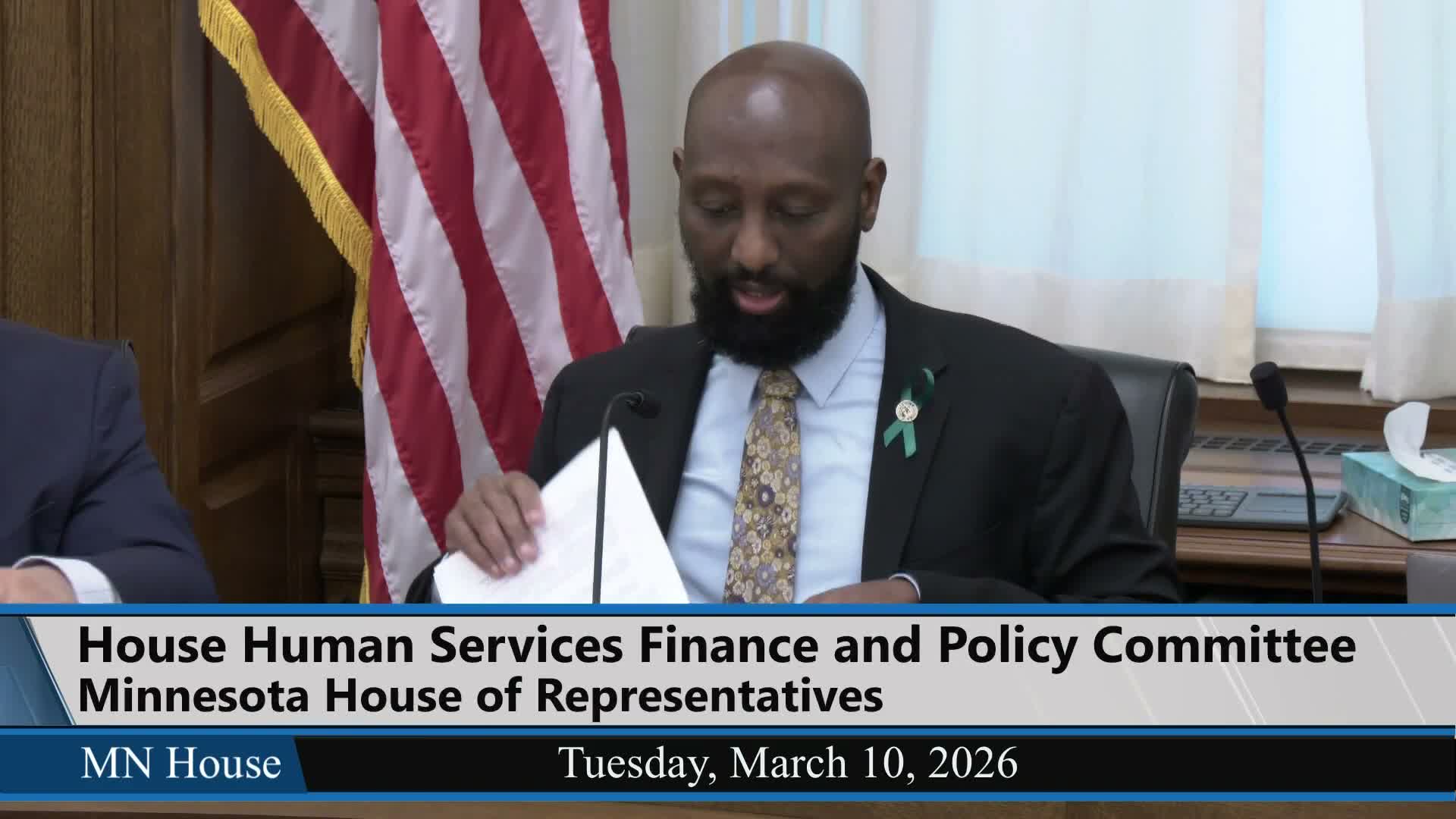
Summary
Rep. Hicks told the Human Services Finance and Policy Committee HF 3780 would require providers to pass some portion of higher Medicaid reimbursement for shared services to direct-care staff; union and family advocates testified; the bill was laid over for further stakeholder and fiscal work.
Representative Hicks introduced House File 3780 to require that additional state reimbursement for "shared services" — situations where one personal-care attendant or home-care worker serves two or more clients at the same time — be passed through to the direct-care worker at a percentage to be negotiated with providers.
Hicks said the shared-services reimbursement already exists in statute and the bill does not increase the Medicaid rate; it sets a statutory pass-through mechanism so that when a provider receives 150% of the base rate for serving two clients (or 200% for three), a defined share of that premium must go to the worker. "If you're getting more rate, more money to provide this service, you need to be passing that on to the worker," Hicks said.
Tavanna Johnson, a home-care worker and organizer with SEIU Healthcare Minnesota, told the committee the absence of a statutory requirement has allowed some providers to keep the premium. Johnson described a case in which a worker receiving $27.30 per hour for shared care would have earned roughly $32.25 per hour if the premium had been passed through; she said the worker collected about $3,000 in back pay after initial pressure on the provider. "There is no law or rule in Minnesota that requires that any of the higher shared-service rate go to workers," Johnson said.
Bridal Abdul, an autism policy advocate, testified remotely that the bill did not address systemic CFSS rollout problems and said people with high, one-to-one needs may be left out if the program's rules are not clarified and training is not embedded alongside statutory changes. "CFSS needs a complete overhaul that addresses the needs of people with autism and other developmental disabilities," Abdul said.
Members asked technical questions about how shared services are authorized and billed. Hicks and staff explained the process: a MnCHOICES assessment establishes eligibility; a consultation provider helps set a CFSS plan; counties authorize services and providers bill against those authorizations; EVV (electronic visit verification) is used to confirm visits. Hicks said those layers provide multiple checks and that the bill focuses on requiring that any existing enhanced reimbursement be allocated to the worker.
Lawmakers also debated the fiscal picture and the pass-through percentage, which Hicks left blank in the draft while she consults with stakeholders. Some members warned that requiring a fixed pass-through could increase operating costs for providers (insurance and overhead) or shift costs to consumers in some settings. Others, speaking from provider experience, supported statutory clarity to ensure that state increases intended for wages actually reach direct-care staff.
Hicks renewed her motion to "lay over for possible inclusion" so the bill can be refined with providers and stakeholders and to allow staff to produce a fiscal note on any cost implications. Chair Noor laid the bill over for further work.