Get Full Government Meeting Transcripts, Videos, & Alerts Forever!
Get email alerts on the Land Use Rezoning topic
No spam. Unsubscribe anytime.
Round Rock council annexes, rezones roughly 9.4 acres near Gattis School Road over resident objections
Summary
After a lengthy public hearing marked by dozens of residents’ safety and flooding concerns, the Round Rock City Council voted unanimously to accept a services agreement, annex 2.19 acres and zone about 9.41 acres to C2 (local commercial). Developers and staff said only ~4.5 acres are developable because of floodplain limits.
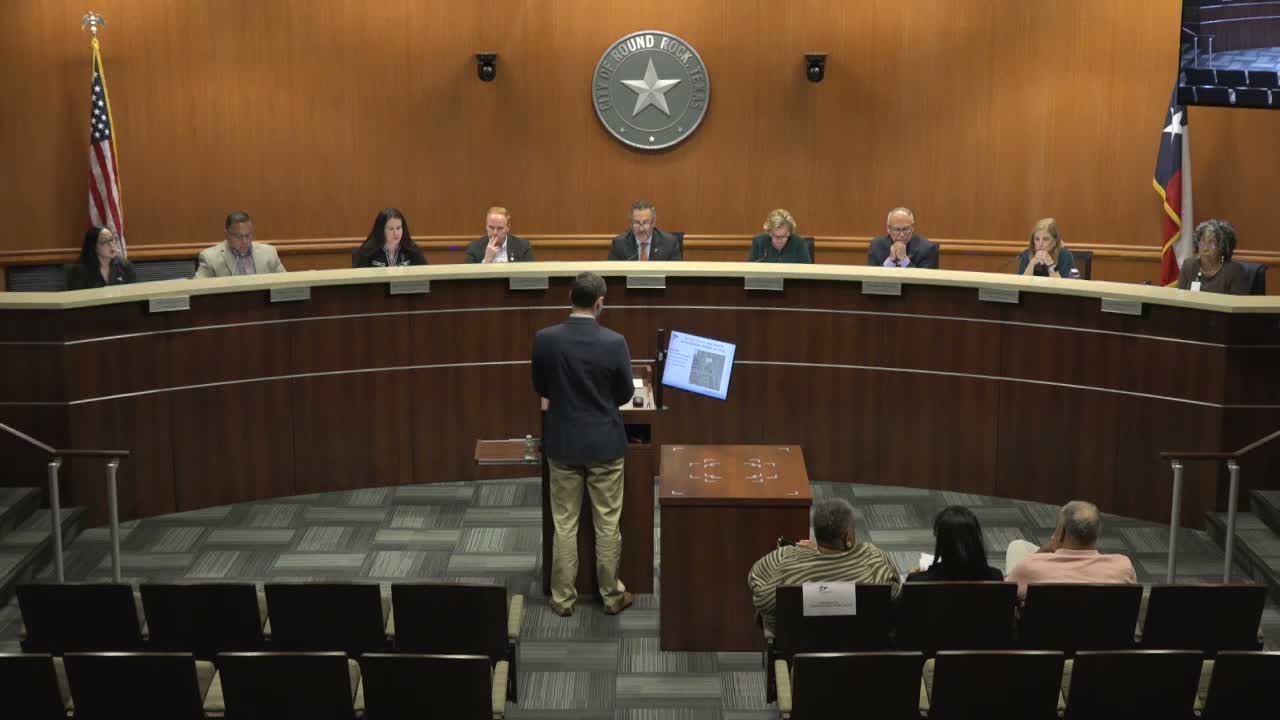
The Round Rock City Council on a unanimous vote approved a municipal services agreement, annexation and zoning that clears the way for a proposed local commercial center on roughly 9.41 acres near the intersection of Gattis School Road and South Kenney/Kinney Fort Boulevard.
City staff told the council the project is effectively constrained by floodplain and other site limits so only about 4.5 acres are developable. The application brought forward three linked items: a municipal services agreement for 2.19 acres seeking annexation, original/rezoning for the 2.19 acres and rezoning of the remaining 7.22 acres already in the city to the C2 local commercial district. The council approved the service agreement, the annexation ordinance and both zoning ordinances after public hearings and discussion.
Brad (city staff) summarized the technical work behind staff’s recommendation: large portions of the tract lie in FEMA flood zones and city floodplain rules reduce buildable area; the C2 designation was chosen because it limits building height and intensity and excludes several higher-intensity uses, including event centers. Staff described design checks the developer must complete before any building permit, including floodplain/detention design stamped by a licensed professional engineer and cross‑departmental review for drainage, emergency access, parking, tree protections and lighting.
Ethan Harwell, a planner with Kimley-Horn representing the applicant Texas Parks Development, said the conceptual plan envisions roughly 40,000 square feet of neighborhood‑serving retail and office space split among smaller tenant spaces (no single tenant exceeding the zoning’s per‑use limit). Harwell said the developer will not propose gas stations, bars or drive‑thru restaurants, that covenants and deed restrictions are planned, and that developers had met with the adjacent Round Rock Ranch HOA and mailed notice to residents within 200 feet.
Residents packed the council chambers during the public hearing and asked dozens of questions focused on pedestrian safety, school‑related peak traffic, queue spillback, and the site’s floodplain. Multiple speakers who live in the adjacent Round Rock Ranch enclave said the proposed commercial driveway would sit directly across the enclave’s single gated entrance and that regular school drop‑off and pick‑up already cause backups that can reach the enclave entrance.
"None of the residents want this in the entrance of our neighborhood," Andrea Franklin said during public comment, calling the intersection "a mess" and urging the council to reject rezoning. Student speakers and parents said they regularly witness near‑misses between students and cars along the route children use to walk to schools.
Residents also pressed whether promised covenants would be enforceable. City staff and the applicant said covenants are private restrictions recorded with the deed; the city noted that covenants are not enforced by the city but can be enforced by private parties and provide standing for legal challenge if they are violated. City staff emphasized that engineering plans (drainage/detention) must be designed, peer‑reviewed and approved and that the city’s engineers would verify compliance before permitting.
Council members asked about alternative uses. Staff said residential options (townhomes or multifamily) were possible but would likely produce similar peak‑hour traffic impacts; staff estimated a townhome layout could yield roughly 50–60 units given the developable acreage. Transportation staff said Gattis School corridor widening projects and signal timing work are planned over the next several years and that intersection improvements associated with those projects would be monitored and retimed as needed.
Motion and vote records: the council recorded motions and roll‑call votes for each ordinance and resolution. For the municipal services agreement (G2) the council voted to authorize the mayor to execute the services agreement; for the annexation ordinance (H4) the council adopted the annexation; for the two zoning matters (H2 for the 2.19‑acre original zoning and H3 for the 7.22‑acre rezoning) the council adopted the ordinances on first reading and dispensed with second reading. All votes on those items were recorded as unanimous (all present council members voting yes). The motions were made and seconded on the record by council members listed in the proceedings.
What’s next: staff and the applicant said several technical approvals remain before vertical construction can begin, including subdivision planning, the floodplain/detention engineering submittal, and site development permit review. If those studies or engineering show less developable land than projected, the final site plan and entrances could change.
The council and staff invited continued neighborhood engagement as the site plan and private covenants are finalized. The developer agreed to continue outreach to the Round Rock Ranch HOA and to provide covenants for residents to review as they are drafted.
Votes at a glance: the service agreement, annexation and both zoning ordinances all passed on recorded roll‑call votes with the council in favor; the council also dispensed with second readings where allowed, advancing the ordinances on the city’s approved timeline.