Get Full Government Meeting Transcripts, Videos, & Alerts Forever!
Get email alerts on the Land Use Rezoning topic
No spam. Unsubscribe anytime.
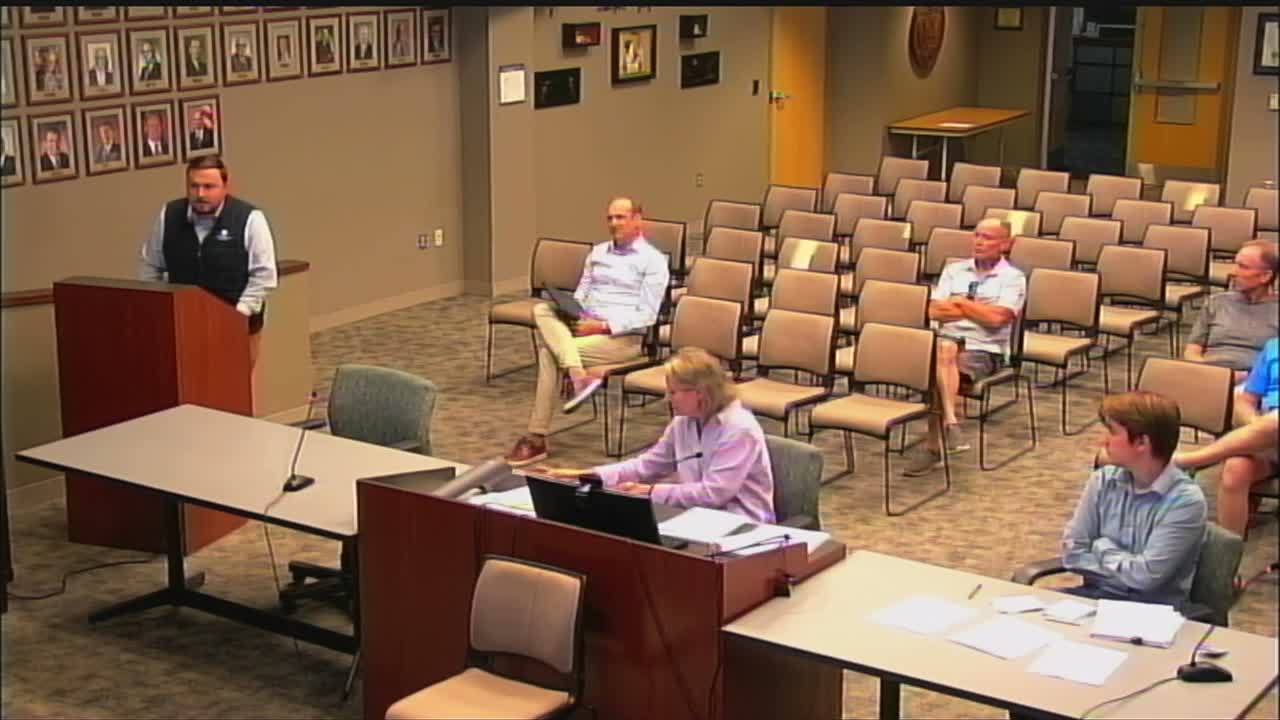
Menomonee Falls planning commission tables Hilltop Grove rezoning after debate over lot sizes, traffic and tree protections
Summary
The Menomonee Falls Planning Commission on Aug. 5 tabled a rezoning and PRD request for the Hilltop Grove subdivision after a lengthy developer presentation and commission debate over minimum lot sizes, a required bypass lane and a condition to protect mature trees. Commissioners asked the developer to return with more detailed lot-by-lot data and clarifications from engineering.
The Menomonee Falls Planning Commission on Tuesday tabled a rezoning and planned residential development (PRD) request for the proposed Hilltop Grove subdivision, citing unresolved issues about lot sizes, traffic mitigation and protection of mature trees.
Planner Amy Bennett and developer representatives from Veridian Homes presented the rezoning/PRD and preliminary plat for roughly 132 single-family lots on about 76 acres. Ben Lang of Veridian said the firm had refined the plan since a prior concept review and argued the layout responds to market demand: “the median lot size of all new homes listed on the MLS is 0.28 acres, and that median list price is $775,000,” Lang said, presenting a market rationale for a mix of lot sizes intended to produce a range of price points.
Brian Munson, the applicant’s urban designer, described design changes made to respond to earlier feedback: increased minimum lot size to roughly 9,000 square feet, additional open space (about 16 acres preserved outside stormwater areas), and revised street geometry and grading to preserve mature trees and make lots buildable. Munson said the team had prepared lot-fit analyses and grading plans to show how houses would sit on individual parcels.
Commissioners raised several recurring concerns. Multiple members said the plan included too many small lots and requested a clear count of how many lots fall under common thresholds (for example, under 10,000 sq. ft. and under 12,000 sq. ft.). One commissioner noted that 82 of the proposed lots were under 12,000 square feet and 44 under 10,000 (applicant data referenced by staff), and said that a substantially smaller lot profile could be out of character with adjacent neighborhoods.
Traffic and safety at Mill Road and Lannon Road were another sticking point. The developer’s traffic impact analysis (TIA) concluded a bypass lane was not warranted under typical warrants, Lang said, while village engineering continued to recommend investigation and possible construction of a bypass lane depending on feasibility. Commissioners asked that village engineering and the applicant reconcile the TIA findings and right-of-way constraints before the commission takes final action.
The commission also debated a staff condition (Condition 37) requiring a turnaround or stub-road resolution at an existing northern road stub. The applicant warned that a full turnaround or cul-de-sac could require cutting specimen trees; commissioners and staff negotiated the condition wording and voted to amend the language from “minimal impact to existing trees” to “no impact to existing trees.” That amendment carried on a 3–2 voice vote.
After extended discussion, including requests for a color-coded lot map showing which smaller lots back preserved open space, the commission retracted an earlier motion to approve and instead voted to table both the PRD ordinance/rezoning and the preliminary plat so the applicant could provide more precise lot-by-lot data, a clearer explanation of lot type rationale, and further coordination with village engineering on utilities and any bypass-lane requirements.
The developer said the team would return with the additional materials and analyses; staff noted the matter will return on a future agenda once the applicant is ready. The commission scheduled the public hearing for the Village Board on Sept. 15, 2025 as part of the broader process, but reserved final recommendation until the supplemental materials are submitted.