
House committee advances transparency for domestic-violence grants, curbs public support for some detention contracts and passes several bills
Get AI-powered insights, summaries, and transcripts
Subscribe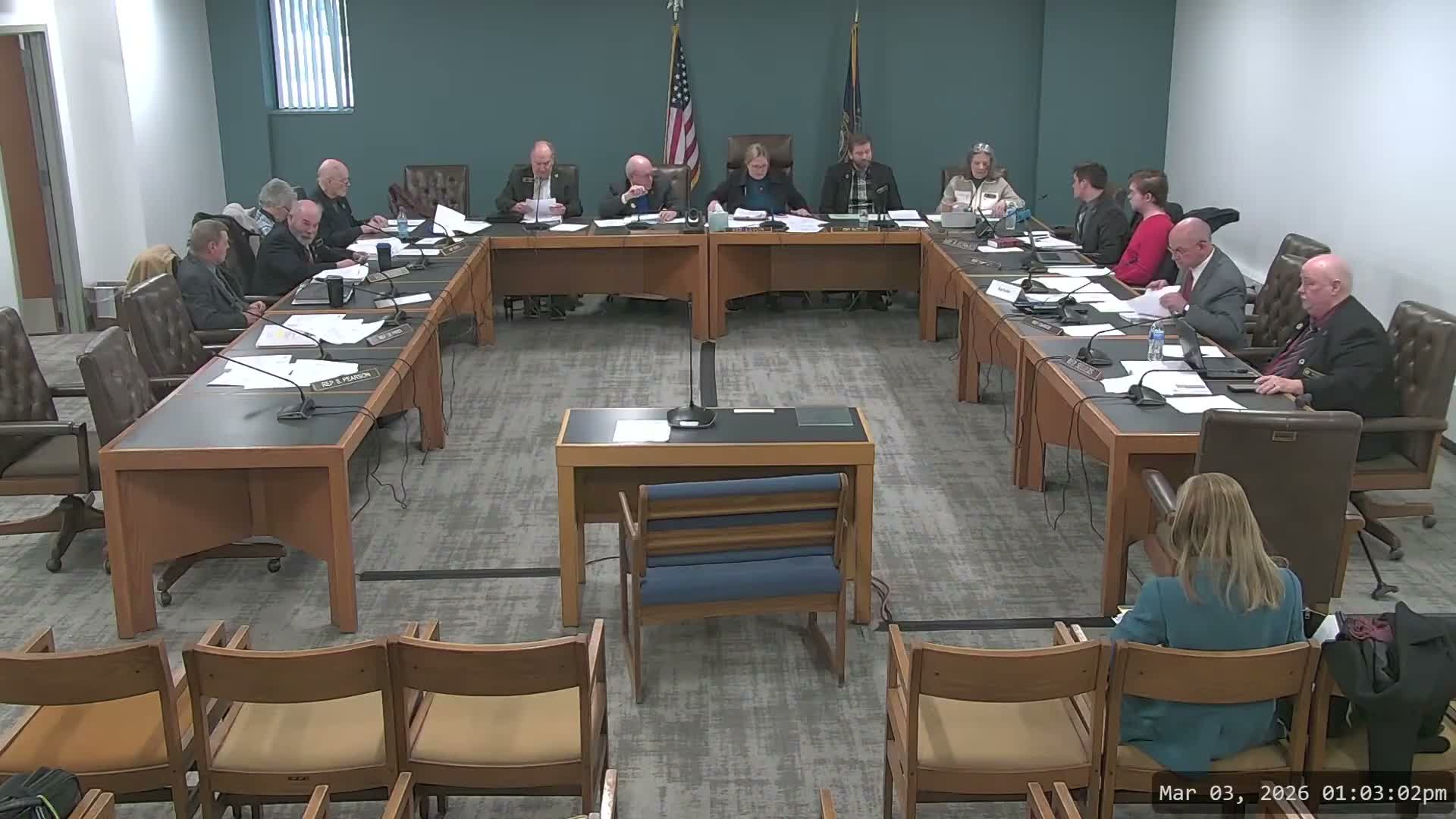
Summary
The House Executive Departments and Administration Committee approved a transparency amendment for domestic-violence grants, voted ITL on a proposal limiting public support for immigrant detention facilities, and passed measures on vaccine advertising limits, DEI contract restrictions, and animal-abuse reporting by mental-health workers. Several items were placed on the consent calendar.
The House Executive Departments and Administration Committee met in executive session and took action on a broad slate of bills, approving changes intended to increase transparency for domestic-violence grant spending, declining to advance a proposal restricting local participation in federal immigrant detention contracts, and moving several other measures forward.
The committee adopted a replace-all amendment (0946h) to House Bill 16-75 that clarifies that the coordinator for the state’s domestic-violence grant program and related direct-service grantees and subcontractors are subject to RSA 91-A (the state’s right-to-know law) and requires annual reports from the Department of Health and Human Services and the Department of Justice describing program activities, subrecipient oversight, allowable-cost verification and basic performance metrics. Chair (speaker 1) said the change is intended to “pierce through” confusion about whether contracted services match statutory requirements and to provide “sunlight and clarity” for victims’ services.
Representative Powers (speaker 7), who supported related bills earlier in the meeting, told the committee that local officials want assurance that federal contracts are not leaving counties to finance federal responsibilities: “We want to make sure that the federal government is paying for everything,” Powers said during debate on a separate bill.
On House Bill 16-09 — which would limit state, county and municipal use of funds, property or facilities for certain immigrant-detention operations — the committee voted to recommend ITL (inexpedient to legislate). The roll call on the ITL motion was 9–7 in favor of ITL, so the committee will not move the bill forward; members who opposed ITL stressed local control and the ability of counties to negotiate contracts, while supporters raised concerns about towns subsidizing federal detention operations.
The committee also considered HB 16-16, an amendment (0903h) that narrows what state agencies and political subdivisions may fund in vaccine advertising and requires educational materials produced by state entities to include risks and benefits. Proponents described the measure as preserving the state’s ability to produce factual education while preventing taxpayers from subsidizing commercial promotion. The committee approved the amendment and advanced the bill, with the recorded vote 9–7 in favor and a minority report expected.
Lawmakers adopted an amendment (0453h) and voted Ought to Pass on HB 17-88, which targets contract language related to diversity, equity and inclusion; the motion passed 9–7. The committee also considered CACR 26, a proposed constitutional amendment about National Guard deployment; the committee voted ITL, 13–3, and objected members kept the item on the regular calendar for fuller consideration.
After extended discussion, the committee resolved a contentious draft on HB 14-38, which would allow mental-health caseworkers to report instances of animal abuse by clients. Sponsors revised the bill so the reporting duty in certain circumstances reads as discretionary (“may” rather than “shall”) and added language clarifying handling of protected/confidential information. The amendment (1024h) was adopted 15–1 and the committee voted Ought to Pass as amended, 15–1.
Several other items were handled on unanimous or lopsided votes and set for the consent calendar or interim study: HB 12-11 (clarifying review of agency interpretations) passed 16–0 with amendment 0906h and will go on consent; HB 14-07 (allowing veterinary technicians to administer rabies vaccines under indirect supervision) passed 16–0; and the committee voted to interim-study HB 15-06 (narrowing an exemption process to parts of RSA 5-D that require a human in the loop for irreversible AI decisions) to gather technical expertise and bring in the Department of Information Technology.
The chair asked members writing reports to submit drafts promptly and closed the session after processing 15 bills in under three hours. Minority reports were announced where recorded votes produced opposition.
Votes at a glance
- HB 16-75 (domestic-violence grant transparency) — Adopted amendment 0946h; final committee recommendation Ought to Pass with amendment (reconsideration result): 9–7; minority report filed. - HB 16-09 (limits on public funding/property for immigrant detention facilities) — Motion: ITL; recorded vote 9–7 for ITL; motion carries, bill not advanced. - HB 12-11 (scope of review of agency interpretations) — Adopted amendment 0906h; committee vote: 16–0, placed on consent. - HB 16-16 (limits on state/local vaccine advertising; educational material requirements) — Adopted amendment 0903h; committee vote: 9–7; minority report expected. - HB 17-88 (DEI-related contract provisions) — Adopted amendment 0453h; committee vote: 9–7; minority report expected. - CACR 26 (National Guard deployment language) — Motion: ITL; recorded vote 13–3; objected to consent, placed on regular calendar. - HB 14-38 (mental-health workers and animal-abuse reporting) — Adopted amendment 1024h (changed mandatory reporting language to discretionary in defined circumstances); committee vote Ought to Pass as amended: 15–1. - HB 14-07 (veterinary technicians and rabies vaccinations) — Committee vote Ought to Pass: 16–0. - HB 15-06 (AI exemption procedure) — Committee voted to interim-study; recorded vote: 15–1 to interim study.
What to expect next
Several bills were placed on the consent calendar for expedited handling; others will proceed with minority reports or further committee action. The committee scheduled a hearing tomorrow at 1:00 p.m. for an outstanding bill and requested report drafts from authors that evening.