
EGLE air division details permitting, monitoring and new asbestos inspections to House subcommittee
Get AI-powered insights, summaries, and transcripts
Subscribe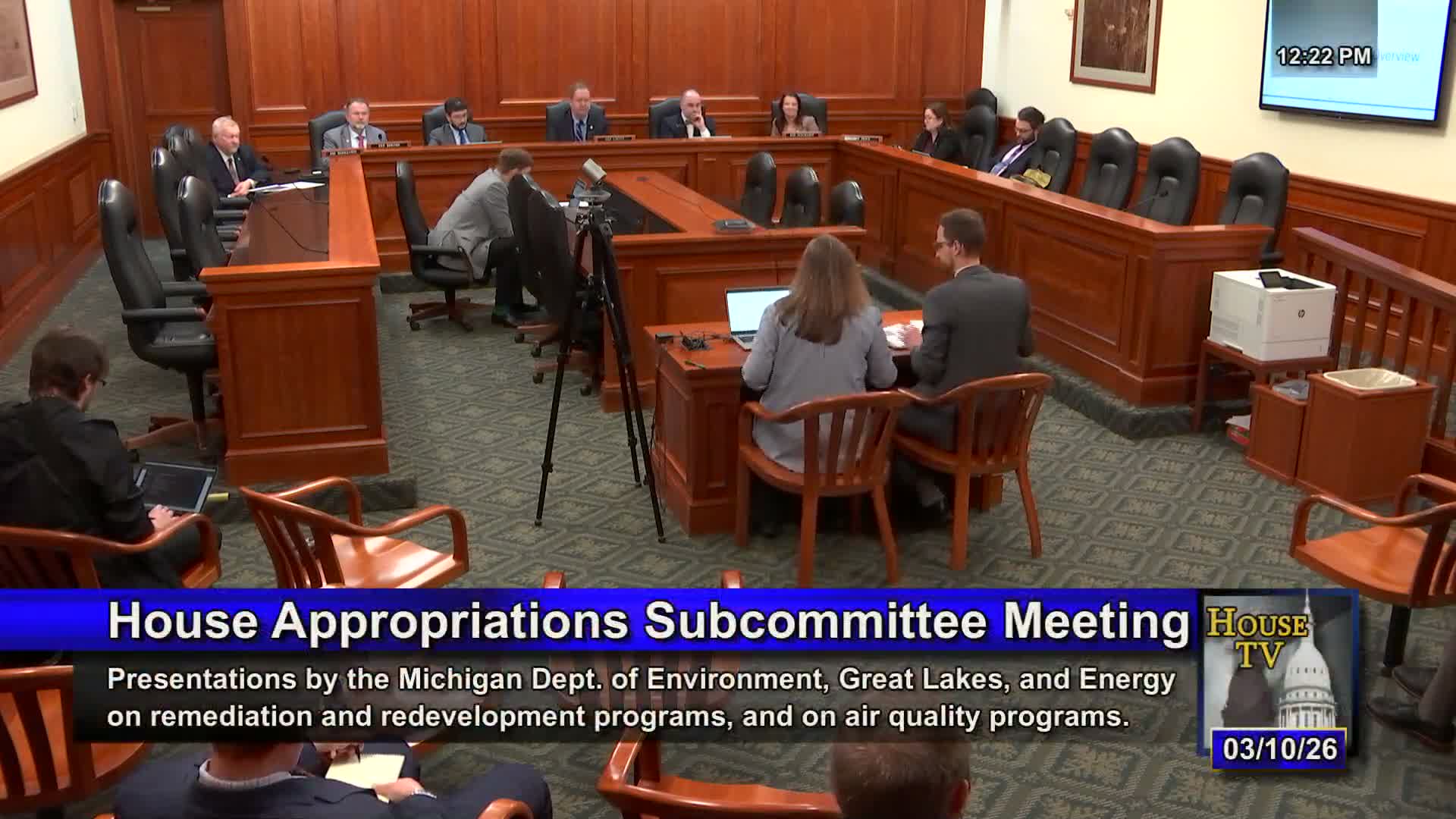
Summary
Annette Switzer, EGLE Air Quality Division director, told the committee the division processes permits for construction and modifications, manages a Title V operating permit program, uses a MyEnviroPortal system to speed reviews, and has formed a new asbestos unit funded by notification fees with a 2025 inspection metric target of about 20%.
Annette Switzer, director of EGLE's Air Quality Division, briefed the House Committee on Great Lakes and Energy on permitting, air quality planning and a recently created asbestos unit.
"I'm Annette Switzer, the air quality division director for EGLE," she said, describing the division's mission to protect air quality through industrial source regulation and implementation of federal clean air rules.
Switzer said the division has just over 200 full‑time employees and that the Permit to Install program processes roughly 300–400 permit applications per year from a broad array of sources, ranging from power plants and auto assembly facilities to smaller sources such as hospital emergency generators. She described a Title V or Operating Permit program for larger sources that includes an emissions‑based fee and said EGLE uses an internal benchmark of about 90 days as a target average for permit processing (with rule allowances extending longer when mutually agreed extensions are used).
Switzer highlighted workflow improvements that have sped reviews: the MyEnviroPortal electronic permitting system, targeted public participation staffing to offload permit engineers, additional permit section staff and enhanced internal and external training and peer review for new staff.
On air quality planning, Switzer discussed National Ambient Air Quality Standards and recent ozone work, saying EGLE has submitted designation requests that could move Muskegon and Berrien back to attainment. She also emphasized the role of air modeling and meteorologists in estimating impacts and supporting EPA submissions.
Switzer described a new asbestos unit created after recent asbestos legislation that established notification fees. "We receive roughly 9,000 asbestos notifications a year," she said, and reported that EGLE inspected about 19% of facilities tied to those notifications in 2024 and is aiming for a 20% inspection metric for 2025.
In questions, committee members asked what industries file permits; Switzer said most applications involve existing facilities seeking changes or expansions rather than only new greenfield projects. Representative Price asked about carbon sequestration; Switzer said EGLE has received one permit application and is reviewing equipment related to sequestration operations, while Travis Bosco added the department is tracking class VI primacy and a pending legislative package that would more fully define regulation for geological storage of carbon.
Switzer explained how Michigan implements federal EPA changes through its approved state permitting program and that significant federal shifts could require rule updates or other actions to align state implementation with federal standards.
The committee did not take formal votes on air program items during this session and adjourned after the presentations.