
BLM seeks comments on allowing Class 1 e-bikes on Crown Mountain trails as county urges site-by-site review
Get AI-powered insights, summaries, and transcripts
Subscribe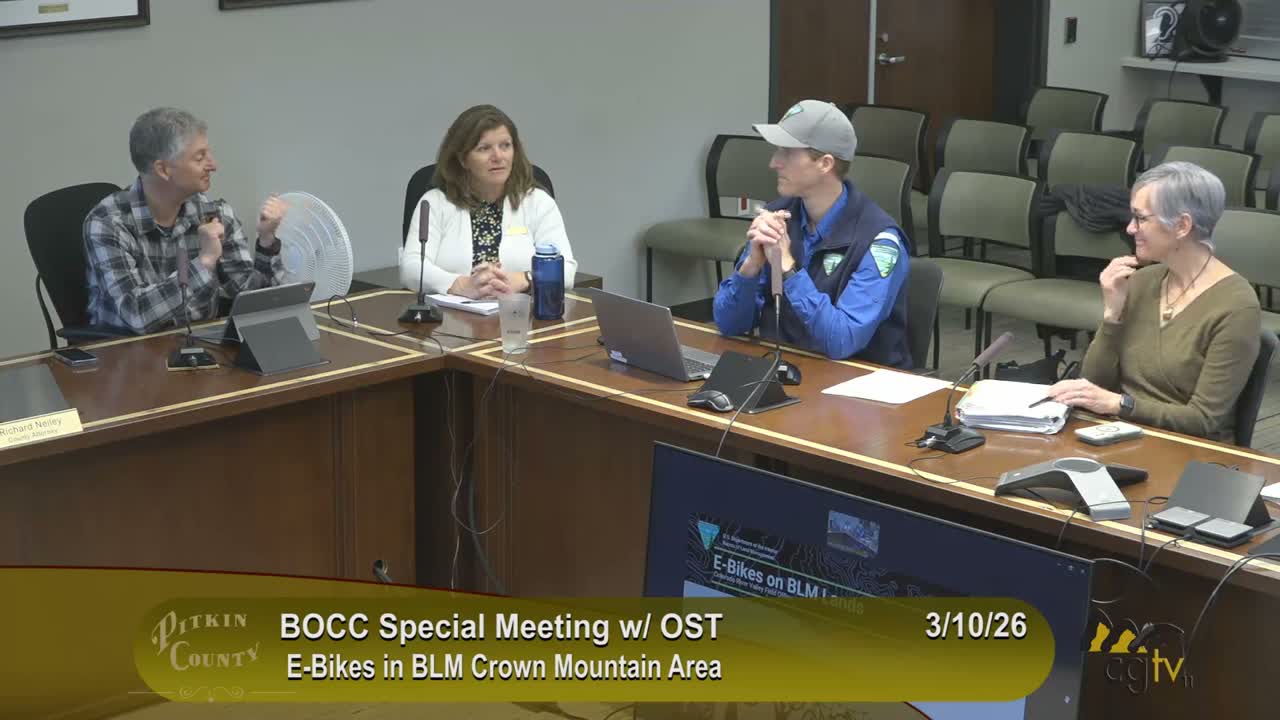
Summary
BLM field office staff told Pitkin County officials and the Open Space & Trails Board that a 30‑day public scoping period (opened Feb. 23) is under way to study allowing Class 1 e-bikes on designated singletrack trails across the CRVFO field office, including parts of the Crown; residents and commissioners urged site‑specific analysis, raised enforcement and wildlife concerns, and directed staff to prepare scoping comments for board review.
The Board of County Commissioners and the Open Space & Trails Board met jointly with Bureau of Land Management staff for a work session where the BLM described a proposal to authorize Class 1 electric bicycles on designated singletrack mountain‑bike trails across its Colorado River Valley Field Office, including parts of the Crown special recreation management area.
Alan Stepinski, the BLM outdoor recreation planner introduced during the session, said the BLM opened a 30‑day public scoping period beginning Feb. 23 and expects to develop alternatives through an environmental assessment (EA). He told the boards the field office manages roughly 570,000 acres, with several SRMAs focused on trail‑based recreation, and that the proposal would not create new trails but would analyze allowing Class 1 e‑bikes on existing designated mountain‑bike routes.
Stepinski summarized visitor‑use outreach on The Crown and said a user survey collected what he described on the slide as 354 responses, with the slide listing 212 respondents who would like e‑bikes authorized on The Crown and 165 opposed; the presentation also showed broad support among respondents for Class 1 (pedal‑assist to 20 mph) and opposition themes focused on safety, crowding and environmental impacts. BLM staff emphasized education and signage, volunteer trail ambassadors and coordination with partners such as the Roaring Fork Mountain Bike Association to reduce conflicts.
During question and answer, commissioners and several members of the Open Space & Trails Board pressed BLM staff on enforcement capacity and jurisdictional mismatches. BLM staff said formal law‑enforcement presence is limited in the field office and that their approach relies on rangers, seasonal staff, partnerships with local organizations and targeted enforcement where needed. County staff warned that if BLM opens most mechanized trails while county‑managed parcels remain closed, the difference in rules at parking areas and access points could create major enforcement and safety challenges.
Public commenters and several commissioners urged the BLM to treat trails on a site‑by‑site basis rather than a blanket approval. Resident Francie Jacober said surveying trail users can skew results and asked that sensitive areas such as Red Hill and other places with difficult topography or wildlife concerns be excluded from authorization. Commissioners also noted inconsistencies in seasonal wildlife closures (county vs. BLM vs. CPW guidance) and asked staff to coordinate on uniform closure timing where possible.
County staff asked the commission for direction on a formal county scoping comment. Open Space director Gary Tannenbaum said staff would draft a letter reflecting the board’s preferred approach (site‑specific analysis, enforcement expectations, and wildlife protections) and circulate it for review; staff flagged an internal drafting deadline of March 23 to meet the BLM public‑scoping window (the EA scoping period was presented as Feb. 23–March 25).
The BLM reiterated that no decision has been made and that the scoping comments will help identify issues and alternatives for analysis in the EA. The boards closed by urging detailed, place‑specific scoping comments rather than blanket positions and encouraged members of the public to submit input through the BLM ePlanning portal.
What’s next: the BLM will collect scoping comments through the public window, draft an EA informed by those comments and post a draft for public review. Pitkin County staff will circulate a proposed scoping letter to the commission for review before submission.