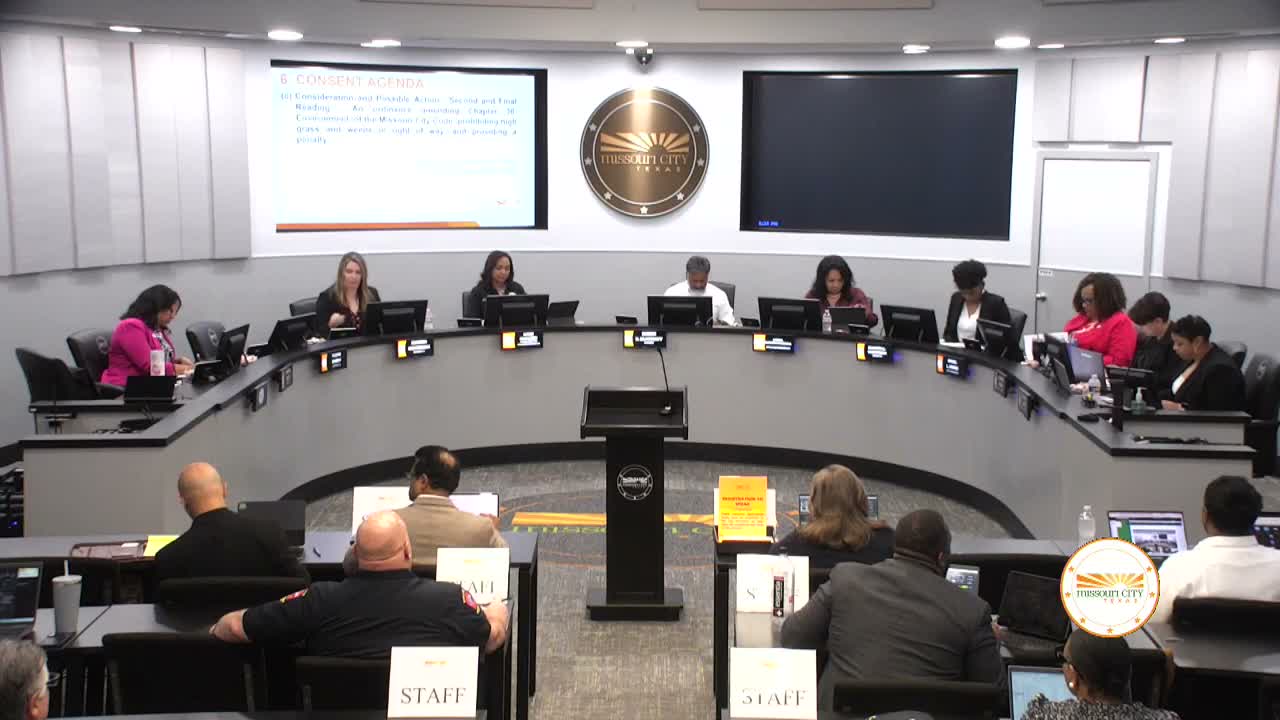
Missouri City council authorizes roundabout design contract after heated debate over consultant-selection policy
Loading...
Summary
After prolonged questioning about consultant selection and earliest start dates, Missouri City council voted 6–1 on March 2 to authorize the city manager to negotiate and execute a design contract with LJA/LGA for a roundabout at Henry Watts and Knight Road; council also directed staff to return with the consultant-selection policy and ranked-firm information.
Missouri City council voted 6–1 on March 2 to authorize the city manager to negotiate and execute a contract with LJA/LGA for design of a roundabout at Henry Watts and Knight Road, after an extended exchange about timelines, right-of-way needs and the city’s consultant-selection policy.
Councilmembers spent more than an hour pressing staff for details on the project schedule and the procurement process. Councilmember Brown Marshall opened the line of questioning by noting she could not find a timeline in the proposal and asked staff whether a design schedule could be incorporated into the contract. Mustafa, a project staffer, said the consultant’s proposal includes an 8½-month design estimate and that staff had allowed up to 11 months in the presentation to account for coordination with two nearby projects and anticipated right-of-way work. “We do anticipate in my PowerPoint, I put 11 months due to the fact that there are multiple projects coming along in that intersection,” Mustafa said.
Assistant staff Shashi told the council the city is sequencing three projects — a distribution water line, the county-managed Watts Plantation West/East work, and the city roundabout — so work is coordinated and to reduce community impacts. “The whole timeline for this project from design to construction is about 2 years,” Shashi said, adding that staff planned to begin right-of-way acquisition during design and was targeting 2027 for construction.
The exchange shifted to procurement procedure when several members asked why staff negotiated only with LJA/LGA for the roundabout design and who the second- and third-ranked firms were from the city’s RFQ pool. Shashi and Mustafa said the city uses a qualifications-based selection for professional engineering services under state law and that staff assigns projects to firms from a ranked pool created via RFQ; the council’s Planning, Development and Infrastructure (PDI) committee reviews recommendations before staff negotiates with a selected consultant. “Selection of a design consultant, the professional engineering services is based on qualifications. That is the state law,” Shashi said.
Several councilmembers objected to what they described as a lack of transparency when a three-member PDI committee reviews matters that come before the seven-member council. Council members pressed staff for the RFQ-ranked list and asked that alternatives (second, third options) be included in future reports so council members can show their reasoning when asked by constituents.
Mayor Pro Tem moved that staff pull the item for further policy consideration; after additional discussion the council reached a compromise: vote to authorize the city manager to negotiate and execute the design-services contract while directing staff to return with the ranked consultant list and proposed policy revisions for review by the council’s first April meeting. The motion to authorize negotiations carried 6–1. The council recorded that staff will return with the consultant-ranking documentation and any recommended changes to the consultant selection policy.
What happens next: staff said they will negotiate a design contract and return to the council with the documentation requested on the RFQ pool and a proposed policy review. Construction remains targeted for 2027, pending completion of design, right-of-way acquisition and coordination with adjacent projects.
Provenance: topic introduced SEG 146, discussion and votes continue through SEG 2006.
Speakers quoted or referenced in this article are listed in the meeting participants file.