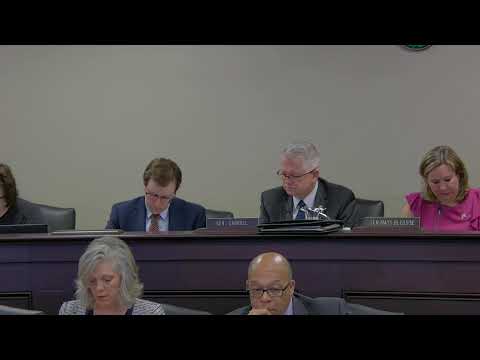
Senate committee advances Rep. Samara Hebron’s childcare package after debate on inspections and administration
Loading...
Summary
The Senate Standing Committee on Families and Children voted 8-2 to advance House Bill 6, a wide-ranging childcare reform package that modernizes provider quality measures, creates microcenters, codifies free childcare for child care workers and reforms the employee child care assistance partnership (ECAP).
The Senate Standing Committee on Families and Children advanced House Bill 6 on a split vote, sending the measure to the full Senate after a marathon presentation and questions about inspections, local zoning and program administration.
Rep. Samara Hebron, the bill’s House sponsor, told the committee HB6 "reflects more than 18 months of conversations and consensus building on key measures to help strengthen access to affordable quality child care," saying the package bundles eight priorities including quality, employer participation, community engagement and data reforms.
The bill would modernize the Kentucky All STARS rating system, authorize a new microcenter license for experienced providers caring for between four and 24 children, reestablish a certified child care community designation to encourage local zoning reforms, and codify the state’s free‑childcare program for child care workers. Hebron said the measure also aims to strengthen the child care assistance program and improve financial transparency.
Witnesses framed parts of HB6 as workforce policy. Sarah Vanover, policy and advocacy director at Kentucky Youth Advocates, described the 2022 pilot that waives childcare fees for providers who work a minimum of 20 hours a week and said that the program "helps recruit and retain our childcare providers," noting federal CCAP block grant dollars and recent General Assembly investments support participation.
Committee members pressed for operational details. Sen. Funke Froehmeyer said recent onboarding cases showed long inspection delays and asked what in HB6 would create "urgency, excellence, expediency" for openings; Hebron and advocates pointed to the certified community designation and the microcenter licensure as tools to reduce local barriers while preserving safety.
Lawmakers also debated administrative structure and costs. HB6 would permit the ECAP program to contract a third‑party administrator and increase the administrative share of the fund (from the roughly 2% historically retained by the cabinet to as much as 10%) to attract a vendor. Rep. Hebron said the change is intended to make the program easier to run and to expand employer participation; she added the third‑party fee authority applies only to ECAP, not the entire bill.
Sen. Williams voiced concern about opacity in future contracts, saying, "My concern is the administrative cost of this, and I don't know what that's gonna be." Sen. Deneen, who identified her vote, said she would vote yes but pressed for clarity on oversight of off‑post DOD‑certified family childcare used by military families. Sen. Funke Froehmeyer delivered a no vote, saying she remained troubled by adding responsibilities to an inefficient agency and by the proposal’s fiscal scale.
On a voice and roll‑call sequence, the committee approved HB6 "with favorable expression" by a vote of 8 to 2. Members who explained their votes asked that the pilot evaluations and oversight plans be strengthened and that the committee receive follow‑up data.
The committee’s action does not enact the bill; HB6 will next be scheduled for Senate floor consideration. Rep. Hebron and witnesses said the legislation also includes a budget request (presenters cited an initial biennial ask in the tens of millions) and that more fiscal details will be vetted in the appropriations process.
The committee adjourned after moving on to a related resolution that would commission a third‑party study of childcare regulations.