Get AI Briefings, Transcripts & Alerts on Local & National Government Meetings — Forever.
Planning commission backs developer request for two downtown towers after debate over contamination and height
Loading...
Summary
The Austin Planning Commission voted unanimously to recommend an applicant’s request to increase entitlements for a full‑block downtown redevelopment on Martin Luther King Jr. Boulevard, approving a move to allow taller towers and higher FAR despite neighborhood concerns about subsurface contamination and compatibility with nearby historic Judges' Hill properties.
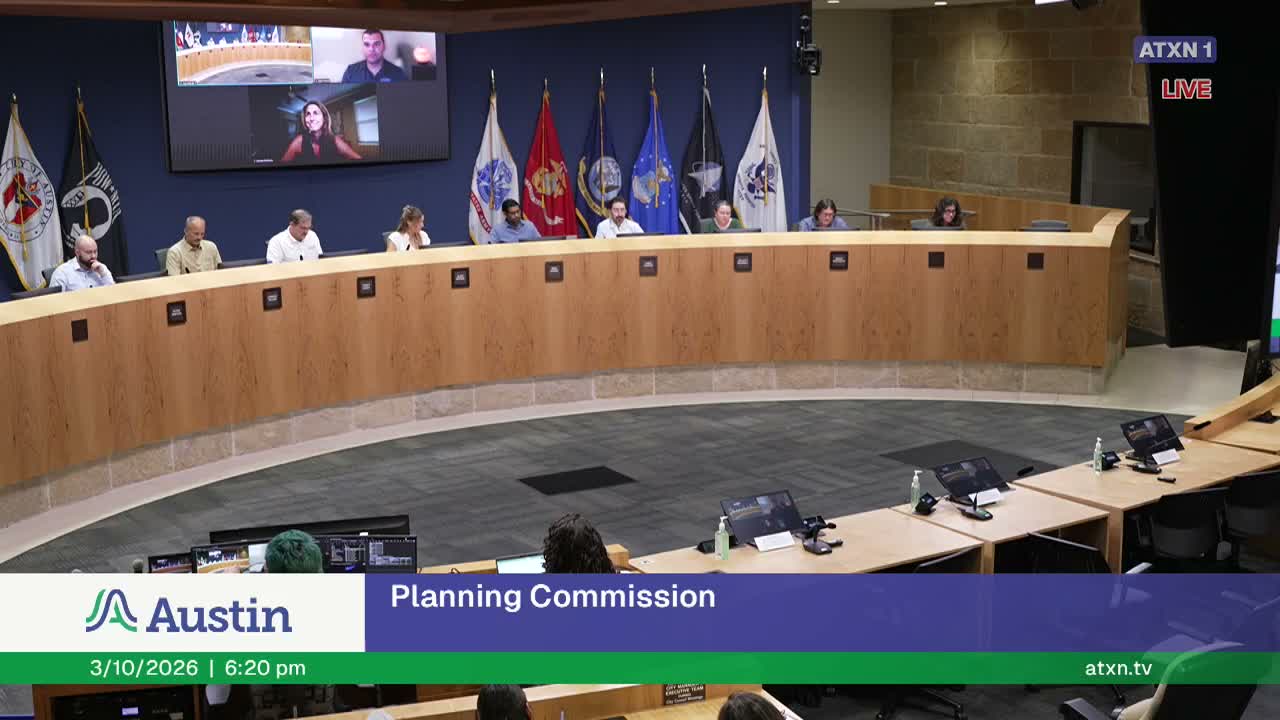
The Austin Planning Commission voted unanimously to recommend the applicant’s requested downtown density‑bonus entitlements for a full‑block redevelopment on Martin Luther King Jr. Boulevard (the Jack Brown Cleaners site), after staff presentations, an applicant rebuttal and more than an hour of public testimony and commissioner questions.
Urban Design staff told commissioners the project proposes roughly 435 residential units plus retail and hotel uses and seeks to increase base entitlements from a 5:1 floor‑area ratio (FAR) to 20:1 and to raise maximum building heights from the existing 120 feet to as much as 445 feet. Staff recommended a more limited approval — "approve up to 200 feet maximum building height and the corresponding floor area ratio" — to maintain consistency with surrounding entitlement patterns and ongoing central city planning work, Jorge Rosalind of Urban Design said.
Neighborhood residents and an environmental consultant urged caution. Brad Snow, a licensed professional engineer and geologist retained by Judges' Hill neighbors, cited Texas Commission on Environmental Quality records and US EPA screening levels and said groundwater concentrations of dry‑cleaning solvents in historical sampling were "as high as 2,100 times greater than that screening level" for PCE and likewise extreme multiples for degradation products including TCE and vinyl chloride. Snow recommended further vapor‑intrusion testing, installation of vapor barriers and an environmental restrictive covenant enforced by the city.
Leah Bojo, the applicant’s representative, said the contamination and remediation steps are being handled through the appropriate regulatory processes and told commissioners they had "received a clear phase 1," while also agreeing to pursue a restrictive covenant and additional testing with the neighborhood. Bojo described project design commitments — reduced curb cuts (from about 10 down to 1), a widened alley, an on‑site pocket park, ground‑floor arts space and removal of a billboard — and pointed to the applicant’s proposed community benefits calculation of more than $3,300,000 in fee‑in‑lieu for affordable housing.
Residents and community members raised competing priorities: supporters emphasized transit access, walkability and the project's proximity to multiple Project Connect stations; opponents stressed traffic and parking impacts for adjacent narrow streets and the potential visual and scale impacts of twin towers over 400 feet tall near Judges' Hill's historic houses. Marisella Maddox (Judges' Hill) said her neighborhood "is not against redevelopment" but wants it "redeveloped safely and responsibly." Josue Howard warned that two 400‑plus‑foot towers would "dwarf" nearby historic landmarks.
Commissioners used an eight‑slot round‑robin to question staff and the applicant about the restrictive covenant timeline (the applicant said a draft had been shared and targeted finalization before a council hearing scheduled for the 26th), the composition and calculation of the $3.3 million fee in lieu, hotel room count (the applicant estimated roughly 200 keys), and how UNO subdistrict bonus tiers and recent entitlements nearby factor into height expectations. Staff explained that UNO and downtown density‑bonus administrative tiers produce variable maximums in adjacent subdistricts — a partial reason staff advised a 200‑foot cap rather than the applicant’s higher request.
After a brief debate, Commissioner Bridal moved and Commissioner Ahmed seconded the applicant motion. Commissioners speaking for the motion cited transit access, the affordable‑housing fee contribution, removal of a long‑standing billboard and the applicant’s site‑level remediation and design commitments. The motion to recommend the applicant request passed unanimously.
What happens next: the Planning Commission’s recommendation goes to City Council for consideration. The applicant said it expects to present a finalized restrictive covenant and related materials to council by the time of the council hearing on the 26th. The commission also approved a minor scheduling amendment and heard various committee updates before adjourning at 7:16 p.m.
Votes at a glance: the Planning Commission voted unanimously to recommend the applicant request for item 16; the consent agenda (minutes and multiple consent/postponement items) also passed without objection earlier in the meeting.
Sources: Staff presentation by Jorge Rosalind (Urban Design), applicant presentation and rebuttal by Leah Bojo, public testimony from Brad Snow, Marisella Maddox, Josue Howard, Philip Wiley and others, and the Planning Commission deliberations and vote recorded at the March meeting.