
Rio Rancho staff describe arts‑integration pilot, request $130,000 to finish implementation
Get AI-powered insights, summaries, and transcripts
Subscribe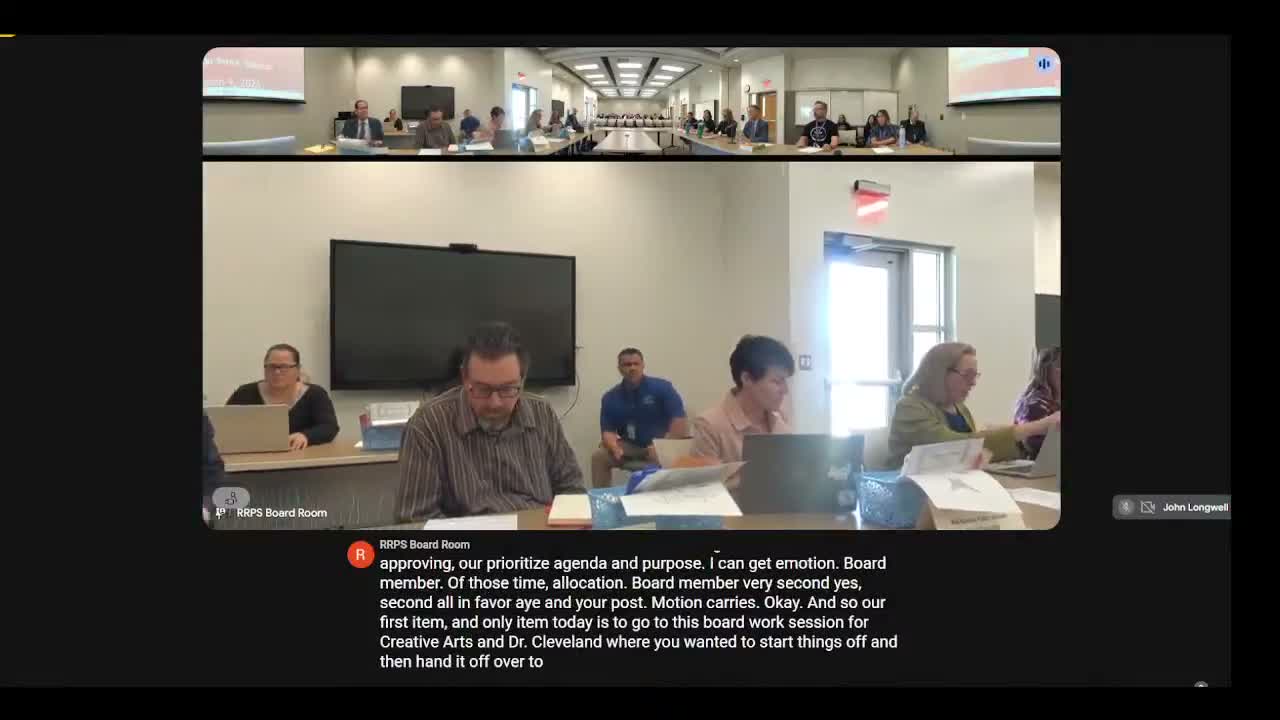
Summary
District leaders presented an arts‑integration pilot at two elementary schools, showed videos and student demonstrations, and asked the board for $130,000 over two years to complete staff training and embed coaching; board members pressed staff on scaling, selection bias and what the money would buy.
District staff on Monday presented a multi‑year arts‑integration pilot for two Rio Rancho Public Schools elementary campuses and requested $130,000 over the next two years to complete implementation and sustained professional development.
The presentation framed arts integration as an instructional approach ‘‘in which students construct and demonstrate understanding through an art form,’’ reading the Kennedy Center definition and stressing that the model is intended to supplement, not replace, existing curriculum. Staff said they piloted ‘‘Acting Right’’ (a behavior and engagement program) and ‘‘Reading Art’’ (using visual art as a text) after visits to model schools in Colorado and conferences supported by partners, including NMART, the Santa Fe Opera and consultants associated with Focus 5.
Why it matters: presenters said the pilot aims to increase student engagement, reduce behavior referrals and give students alternate ways to access content, particularly those who struggle with written language. Staff cited Belmar School of Integrated Arts (Colorado) as an example where leaders reported higher attendance and a sharp drop in office referrals after the school implemented similar practices.
What staff told the board: district presenters described a three‑year rollout (Year 0: education; Year 1: pilot; Year 2: begin full implementation; Year 3: add public performances) and said the requested $130,000 would be used primarily for sustained professional learning and in‑class coaching, with only modest material costs such as copies of foundational books. ‘‘The vast majority [of the $130,000] is that the only material expenses are really to buy books for new staff members,’’ a district presenter said.
Classroom demonstration: staff showed short videos from the pilot sites and invited students and teachers to demonstrate routines. Teacher Mary Cervonta said the morning ‘‘concentration circle’’ helps students calm, ‘‘balance their emotions and get into that space,’’ and a fourth‑grade teacher said tableaus help students retain content by acting it out rather than only writing about it.
Board questions and concerns: board members asked several practical and equity questions. One asked whether the request would expand operating budgets at the pilot schools or simply cover training; staff said the $130,000 is an increase that covers the remaining two years of implementation and is intended to be offset by other funding sources where possible. Another member pressed whether Belmar’s positive outcomes are driven by family selection rather than the model; staff replied Belmar operates as a neighborhood school and that roughly two‑thirds of Belmar’s students come from outside its immediate boundaries, arguing the practices benefited a varied student population.
Implementation details: principals and instructional coaches explained the day‑to‑day schedule: acting‑right routines are built into mornings (about 10 minutes) and tableau or similar strategies are interwoven into 30–120 minute ELA blocks for short intervals rather than replacing core instruction.
Next steps: staff asked board members to submit any follow‑up questions to district curriculum staff for additional detail; no formal board vote on the funding request was recorded in the work session transcript.
Proper names and entities mentioned in the session include Rio Rancho Public Schools; Belmar School of Integrated Arts; Focus 5 (and authors Sean Lane and Melanie Rick); NMART; Santa Fe Opera; and the Fine Arts Education Act (FAEA), which staff said supports elementary fine‑arts staffing and some partnership costs.