Oro Valley council study session directs staff to further analyze Ina/Oracle annexation, add Foothills to plan
Loading...
Summary
At a March 2 study session, Oro Valley staff briefed council on annexation law, fiscal impacts and strategy options for retail nodes near Ina and Oracle Roads. Council asked staff to pursue outreach and detailed cost analysis for Ina/Oracle and to add Foothills areas to the annexation strategy.
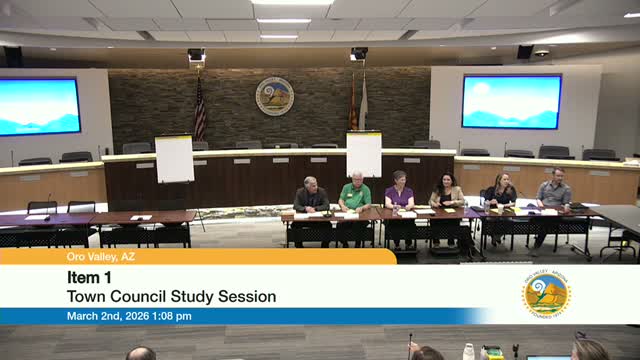
Oro Valley's Town Council on March 2 heard a staff briefing on annexation rules, fiscal trade-offs and specific territory options and directed staff to further analyze annexation of the Ina/Oracle commercial corners and to add Foothills areas to the town's annexation strategy.
The session was framed by assistant to the town manager Carl Shadock, who outlined statutory constraints such as adjacency and shape rules (territory must adjoin the town by at least 300 feet; a minimum 200-foot width; length no more than twice width) and local policy guidance including the 2020 annexation strategy. "Annexation is one of the most permanent actions a municipality can take," Shadock said, explaining staff evaluates proposals on fiscal neutrality or positive annual net impact and on consistency with the general plan.
Why it matters: annexation alters municipal boundaries, brings new service obligations (police, roads, stormwater, utilities) and can shift long-term fiscal responsibilities. Council members raised water supply, stormwater-utility inclusion and long-term road replacement as priorities for any feasibility work. A council member asked that water rights and water-service-provider arrangements be made explicit in future analyses; water-utility director Peter Abraham told council that areas already served by another provider would generally continue with that provider and would not tap Oro Valley's water resources.
Staff presented three retail corners near Ina and Oracle (described in staff materials as the Southwest, Southeast and Northeast retail nodes) as the most visible commercial opportunities. High-level fiscal estimates included recurring utility-tax and retail-sales-tax revenue, and one staff estimate of roughly $4,500,000 in annual utility/retail revenue for consolidated retail parcels (staff described this as a high-level figure, dependent on ownership, redevelopment and whether residential parcels are included). Deputy Chief Hicks and police staff also modeled public-safety impacts: outfitting an additional beat and staffing for a larger footprint would generate one-time equipment costs staff estimated at about $1.7 million and require additional officers.
Council questioned encouragements that property owners had offered revenue-share or other incentives; legal counsel warned the Arizona gift clause constrains inducements that lack direct, quantifiable public benefit. "The gift clause looks for a public purpose and adequate consideration," counsel said, and recent case law has narrowed what courts accept as adequate consideration for incentives.
Council members discussed strategy options: annex retail-only parcels, or pair retail with residential areas to meet petition thresholds (staff said petitions require signatures from property owners representing more than 50% of assessed valuation in affected territory). Staff noted one scenario where about 50 homes would materially change valuation math in favor of the town, but stressed that petitions are risky if ground work is not completed: a failed annexation triggers a statutory cooling-off period before restarting the process.
Direction and next steps: council signaled consensus to proceed with more detailed analysis and outreach for the Ina/Oracle area (including door-to-door polling and more precise road and stormwater cost estimates) and to add Foothills-area territories to the annexation strategy for longer-term work. Staff was asked to return with refined fiscal and infrastructure figures, a water/stormwater analysis and an outreach plan before any petition or formal initiation.
The study session was informational; council did not take a formal vote to begin annexation. Staff emphasized the next deliverables would include: clarified ownership/assessed-valuation figures, a refined fiscal-impact table, road-condition assessments and a water-service/rights summary. The council's guidance was framed as direction to study and return with data rather than authorization to commence an annexation filing.