
Committee deadlocks 7–7 on Mecklen bill to curb 2038 energy-code standard; HF3545 laid on table
Get AI-powered insights, summaries, and transcripts
Subscribe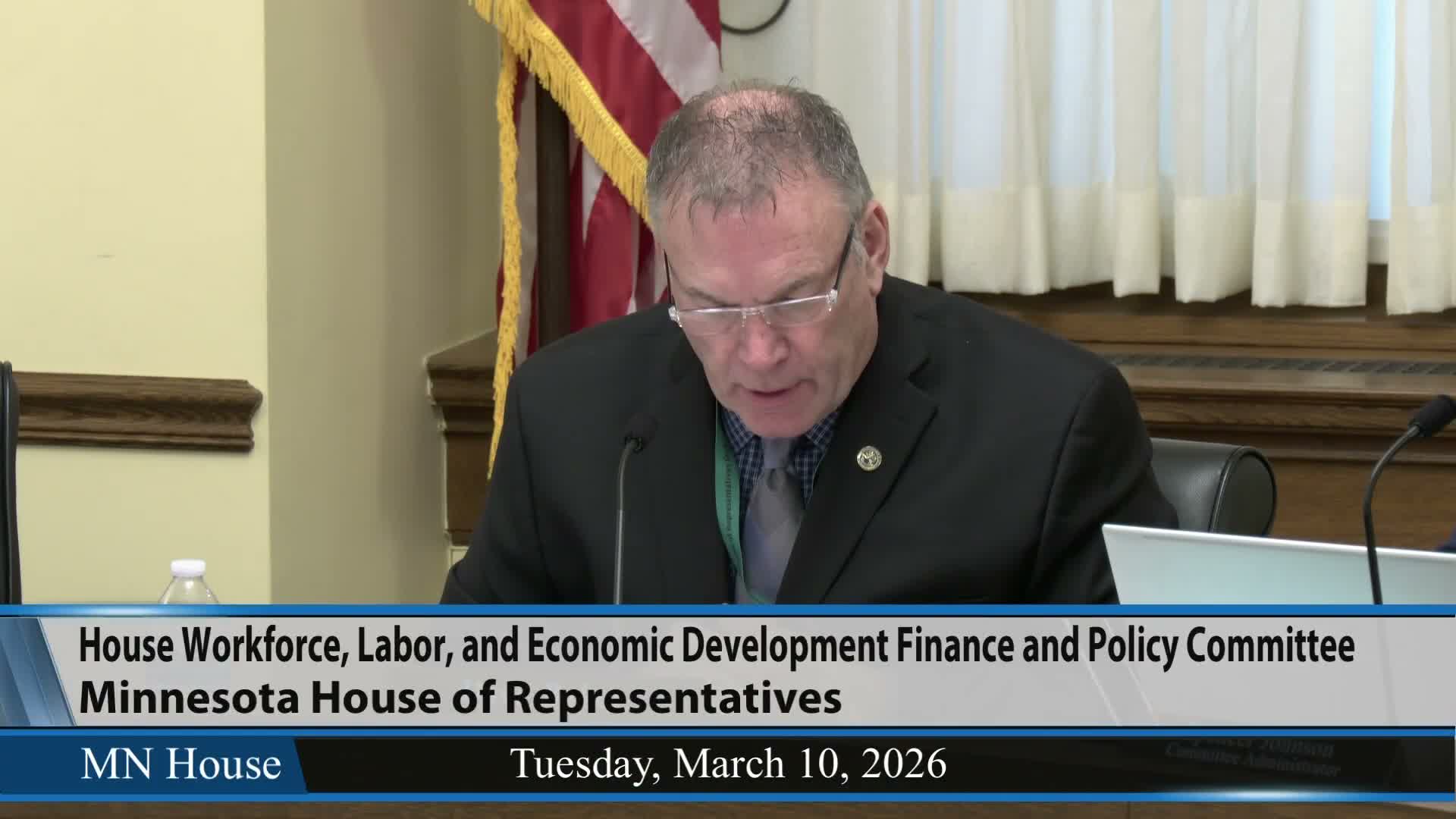
Summary
A House committee on March 10, 2026 split 7–7 on Representative Mecklen’s House File 3545, which would limit the state’s residential energy-code ambitions; testimony split between builders and affordability advocates versus energy and climate experts. The motion failed and the bill was laid on the table.
The House Workforce, Labor, Economic Development and Finance and Policy Committee voted to lay House File 3545 on the table after a 7–7 roll call on March 10, 2026, ending debate for now on a proposal that would limit the authority to adopt the more stringent “2038” residential energy standard.
Representative Mecklen, the bill’s author, said the measure is driven by concerns about housing affordability and asked the panel to move the bill to the general register. “Everything we do affects the cost of housing,” he said, arguing that mandating higher standards can make first‑time homeownership out of reach for some buyers.
Opponents — including energy experts and nonprofit groups — told the committee that stronger codes reduce lifetime costs and improve resilience. Angela Peterson, codes program manager at the Center for Energy and the Environment, said Minnesota’s residential code has not been updated since 2015 while home prices rose roughly 77 percent over that period, and cited modeling showing paybacks of about 5–9 years and estimated savings of $17,500–$37,000 over 30 years for a typical new home. “Energy codes ensure that all new homes become more affordable by locking in lower monthly utility bills for the first homeowner and every future occupant,” Peterson said.
Fresh Energy’s Eric Fowler cautioned that weakening the code would raise bills and compromise safety and resilience. He cited Pacific Northwest National Laboratory figures showing modeled monthly mortgage increases of roughly $10–$16 versus energy bill reductions of about $18–$31 per month in the PNNL study and argued the result is lower total cost of ownership over time.
Builders and inspection firms offered a different view. Eric Boyd, North Region president at Arxis, said jurisdictions that adopted more aggressive codes experienced longer permitting delays and higher per‑home costs in other states, and urged adherence to the model code with steady, department‑led updates. “We’ve seen cost increases between $10,000 and $30,000 per home” in some cases, Boyd said.
The Department of Labor and Industry, represented by legislative director Josiah Moore, told the committee it was concerned the bill would reduce energy‑efficiency standards and could produce unintended effects on the code adoption process. Moore noted that the department’s technical advisory process takes costs into account and is intended to respond to stakeholder concerns.
Representative Mecklen moved the committee to send the bill to the general register and requested a roll call. The committee legislative assistant read names and votes; the tally was seven in favor and seven opposed, so the motion did not carry. The chair announced the 7–7 tie and said the bill would be laid on the table.
Next steps: the bill is not advanced from committee at this hearing. Committee members who voiced further interest said technical details and cost modeling (Slipstream, PNNL) should be provided to the committee record for future consideration.