Get Full Government Meeting Transcripts, Videos, & Alerts Forever!
Get email alerts on the Budget topic
No spam. Unsubscribe anytime.
Superintendent previews roughly $24.6M budget and warns of fund-balance drawdown as health insurance spikes
Summary
The Lake Placid Central School District superintendent previewed a proposed $24.6 million budget that relies on reserves and a projected 3.2% property-tax levy, and warned a 22% rise in health-insurance costs ($1.14M) will force multi-year draws on fund balance.
The superintendent of the Lake Placid Central School District outlined a proposed budget described in the workshop as roughly $24,600,000 and said the district expects to rely on its fund balance to cover rising costs, particularly a 22% health-insurance increase that the superintendent quantified as about $1,140,000.
The superintendent said the proposal reflects the district’s strategic-plan priorities (academics, innovation and well-being) and noted the board will run several workshops and a public hearing before adopting a final budget. The superintendent also said the district projects a property-tax levy of about 3.2% (figures discussed in the session ranged slightly), with final equalization data expected in July.
Staff member: why it matters
A staff member who walked the board through attachments said roughly 80% of the budget is programmatic spending (instruction and transportation), about 12% is capital (debt service, facilities) and about 8% is administrative. Salaries and benefits were described as the largest drivers, making up roughly 83% of total spending. Staff said the district currently plans to use $1.2 million from fund balance this year and is proposing to use a little over $2.0 million next year, which could reduce the unassigned fund balance from about $3.7 million toward an estimated 6–7% level by 2027 if current plans hold.
Instructional and program changes
The superintendent outlined program-level plans that are factored into the draft budget: a K–5 math adoption process (Mrs. Franklin was named in the transcript as overseeing the selection and will recommend a series to the superintendent and then to the board), a plan to double driver-education sections next year, and a staggered Chromebook replacement cycle that will prioritize touch-screen devices for student testing needs. The superintendent said the district has reduced net full-time positions by 14 over four years (11 through attrition/absorptions and 3 through layoffs) as part of cost-management efforts.
Health insurance and the consortium
The board discussed a large insurance premium jump: the superintendent said a 22% increase in health-insurance costs would amount to about $1,140,000 and that covering that single increase would require roughly $580,000 from fund balance after accounting for other revenue changes. Board members and staff discussed the district’s participation in a regional insurance consortium and noted that a small number of high-cost claimants drove much of the recent loss; staff cautioned that leaving the consortium could increase volatility for the district and that other regional consortiums had faced similar shocks.
Revenue, reserves and specific costs
Staff reported that roughly 76% of revenue comes from property tax, 8% from appropriated fund balance and about 14% from the state, with smaller amounts from other sources (interest, rental agreements, tuitions for out-of-district students and PILOTs). The transcript lists several reserve balances and planned uses: an unassigned fund balance described as a little over $3,700,000, a capital reserve with roughly $1,000,000 (from which approximately $537,000 was proposed for three buses), an employee-benefits reserve of about $800,000 and a repair reserve of roughly $1,118,000. Staff said the district’s use of reserves has increased in recent years and that New York State requires districts to maintain a statutory minimum reserve (discussed in the session as 4%), while a cited Rockefeller study recommends 10%.
Board questions and public/board comment
Committee members asked for building-level breakdowns (staff said those can be produced from the attachments and ESSER reporting), pressed on insurance alternatives and asked whether plan-design changes could reduce premium growth. One committee member criticized an external provider (Elderwood) for a past leak the member said reduced reserves and expressed frustration about the impact on classroom resources; staff acknowledged reserves had been used for such liabilities.
Next steps
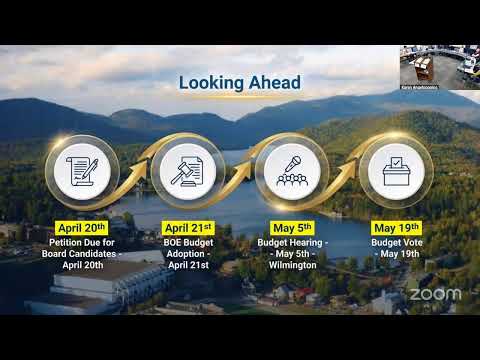
The superintendent said the district will hold its budget hearing in Wilmington this year and reminded the board that candidate petitions for school-board seats are due April 20; the superintendent also said the board must adopt a budget prior to the public vote period and that the district will hold further workshops before a first-draft adoption. No formal motions or votes were recorded during the workshop.
Quotes (selected)
"This will be an important budget season for us," the superintendent said, summarizing the fiscal constraints created by the tax cap and rising costs.
"About 80% of our budget is program," the staff member said, describing the line-by-line appropriations and revenue attachments provided to the board.
"That's very shameful on the end of Elderwood," a committee member said, criticizing an outside provider for a leak that the member said had reduced reserves.
What’s not decided
The workshop produced no formal votes and left several unknowns pending: final equalization data (expected in July) and the state budget outcomes that will determine final state aid figures. Staff said additional detail by building and further refined projections will be available at upcoming workshops.
Closing note
The superintendent closed the workshop after board questions and reiterated that the board will continue deliberations at follow-up sessions and a formal budget hearing before adoption.