
Data advisory commission reviews revised research agenda and nine draft recommendations for legislative report
Get AI-powered insights, summaries, and transcripts
Subscribe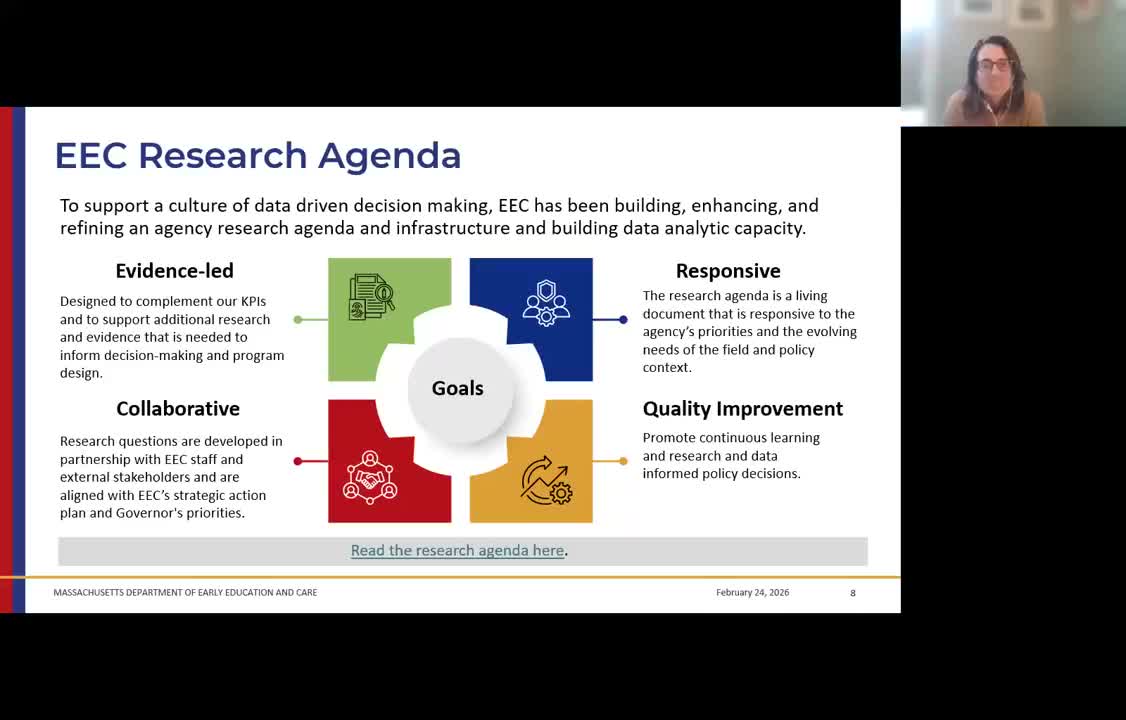
Summary
The commission reviewed an updated research agenda focused on workforce questions and cross-cutting analysis, discussed data gaps (retention, compensation, family childcare), and heard a proposed report structure and nine recommendations that staff will flesh out before a draft is circulated ahead of April.
Ashley White, the commission’s director of research, presented EEC’s revised research agenda and described workforce-focused research questions the agency proposes to prioritize. She said the updated agenda reflects internal program priorities and external feedback and added a new cross-cutting questions section for research that spans agencies and domains.
White said the agency organized workforce questions into near-term (6–12 months) and longer-term priorities and encouraged commission input on which questions to prioritize. Commissioners raised several recurring themes: studying whether higher degree attainment correlates with educators leaving the EEC sector for K–12, how compensation and hours worked relate to retention, and how outcomes differ for family childcare and license-exempt providers.
Staff outlined a proposed structure for the commission’s annual legislative report: a summary of past commission activities, context on EEC’s data and research capacity, an IT modernization status update, and a set of recommendations organized into four strategy areas (identify key questions and data needs; improve public access; improve data quality; streamline collection). Staff said there are nine draft recommendations in total and that each recommendation will be accompanied by short explanatory paragraphs in the report.
Commissioners emphasized the need to balance improved data validation and quality with minimizing administrative burden on providers and families, and suggested including examples that show how data has informed funding or policy decisions to help legislators see the value of investments.
No formal policy was adopted at the meeting. Staff said they will circulate a draft of the report before the April meeting, when the commission is expected to discuss and consider formal approval. The commission approved the previous meeting’s minutes; Heidi Gold and Amherst recorded abstentions.