Get Full Government Meeting Transcripts, Videos, & Alerts Forever!
Get email alerts on the Utilities topic
No spam. Unsubscribe anytime.
Commission denies variance to permit overhead electrical poles on Lake Ridge Lane
Summary
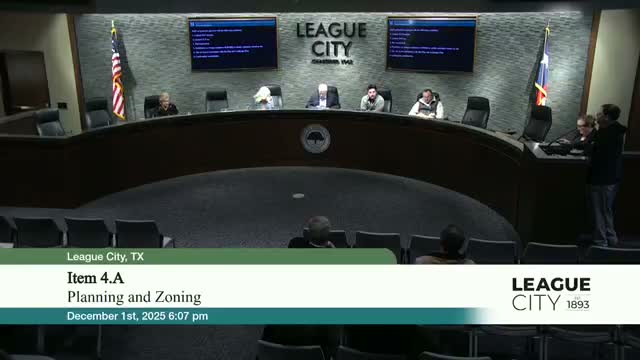
After a lengthy public hearing with testimony from the developer and a recorded homeowner‑association letter of opposition, the Planning & Zoning Commission voted to deny variance VA 25‑0009 that would have allowed up to nine concrete poles with overhead electrical lines within and adjacent to a future Lake Ridge Lane right‑of‑way.
The Planning & Zoning Commission voted against granting subdivision variance VA 25‑0009, which would have allowed overhead electrical lines and a maximum of nine concrete poles within and adjacent to a proposed Lake Ridge Lane right‑of‑way in League City.
Staff planning manager Mark Lanishman explained the request and the background ordinance (adopted in 2015) that generally requires undergrounding of utilities; he said the right‑of‑way in question is a 100‑foot future ROW that would link to the larger Lakeside Bayou development, most of which lies in Texas City. The applicant sought the variance on the grounds that the 700‑foot, 100‑foot‑wide strip in League City is a narrow connector and that overhead poles would align with adjacent development and with planned TxDOT work.
Developer representative Jeff Gilpatrick and project staff argued that requiring underground utilities would force a redesign of the already‑approved road profile — shrinking the median and altering lane alignments — and could delay construction and the delivery of detention that benefits League City. Project representatives said they had support from an adjacent property owner and noted prior examples where overhead lines appeared on perimeter entries at other developments; they also said TxDOT had approved related plans for overhead lines along FM 646.
The commission reviewed a letter of opposition from the Whispering Lakes Ranch homeowners association, which staff entered into the record, and commissioners raised concerns about visual impacts, precedent and whether the ROW could accommodate the necessary ductbank for underground power. Staff replied that the 100‑foot ROW could carry a standard primary ductbank without moving the right‑of‑way, but commissioners remained divided.
A motion to approve the variance failed when the nays carried, and the commission did not grant the requested overhead‑pole variance. The developer’s representatives had warned of up to a roughly 15‑month delay if the variance were denied and the project were forced to change to underground utilities; staff and engineering said permit review would apply and that the ordinance has been in place since 2015.
Because a variance was not granted, the applicant must either redesign the road to comply with undergrounding requirements or pursue alternative approaches consistent with the ordinance and city code; any future changes will require resubmittal or a new application.