Get Full Government Meeting Transcripts, Videos, & Alerts Forever!
Get email alerts on the Donation Bin Ordinance topic
No spam. Unsubscribe anytime.
Rowlett staff proposes permit, setbacks and fees for unattended donation bins
Summary
City staff recommended an ordinance to regulate unattended donation bins across Rowlett, proposing a definition, a 200-foot residential setback, one bin per platted lot, twice-weekly servicing, a 30-day outreach, and fees including a $300 annual permit, a $200 impound fee and $30 storage fee.
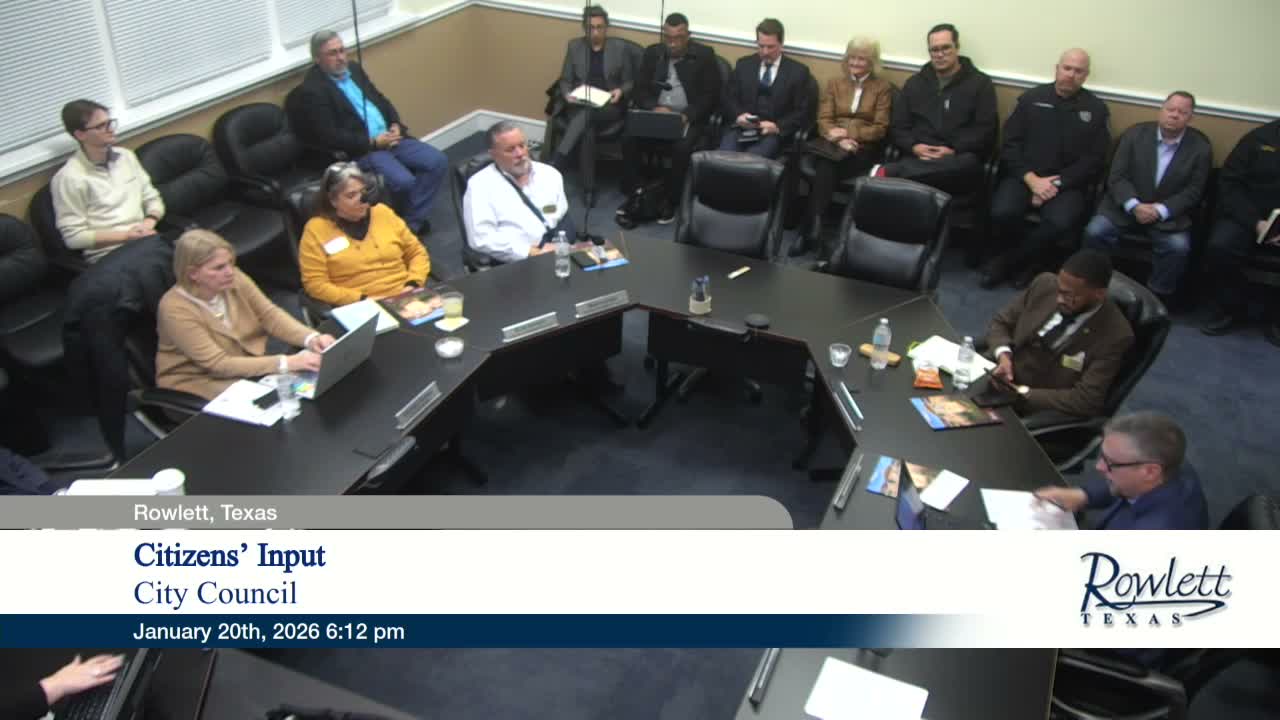
City staff presented a draft ordinance at the Rowlett City Council work session on Jan. 20 proposing new rules for unattended donation bins aimed at reducing blight and illegal dumping.
The presentation, delivered by a staff member, said the draft would add a definition of “donation bin” to the code and a separate definition for unattended bins. "It means any bin, container, building trailer, or other receptacle equal to or larger than 45 feet," the staff member read during the presentation, emphasizing the size threshold. The draft would apply to new and existing bins, meaning there would be no legal nonconforming status for current installations.
Staff said the draft ordinance would require an annual permit and decal, a notarized property-owner authorization on the permit application, site plans showing the box dimensions and location, and operational details such as hours and frequency of collection. "These facilities would have to be emptied at least twice weekly to prevent overflow and clutter," the presenter said.
The draft limits unattended donation bins to nonresidential property and parking lots, forbids encroachment on setbacks, easements or required parking, and proposes a 200-foot radius setback from any residential zoning district or residential use. It also proposes limiting bins to one per platted lot of record and making unpermitted bins or those with more than two violations in 12 months subject to impoundment; after 10 days of unclaimed impounded property, the city could dispose of it.
Staff proposed fees to offset administrative and storage costs: a recommended $300 annual permit fee, a $200 impound fee and a $30 per-day storage fee. The presenter cited comparative fees in neighboring jurisdictions to justify the amounts.
Council members asked clarifying questions during the work session. One asked whether there would be a cap on the number of bins at a site; staff confirmed the draft limits one bin per platted lot. Another asked whether the property owner must sign the application; staff confirmed that property-owner authorization would be required to enable communication and to avoid leaving property owners with unaddressed bins on their lots.
On enforcement, a staff speaker said the city could issue notices of violation and, if unresolved, ultimately impound unpermitted bins. "We can issue a notice of violation," staff said, "and ultimately impound if it's not removed." Several council members cautioned that some complaints reflect private-property civil disputes and urged staff to be judicious in using city enforcement tools so the city does not become the default resolver of private conflicts.
Staff said the council would conduct a 30-day outreach to operators and property owners if the ordinance proceeds, and after outreach the city would begin enforcement. The work session concluded with general support for addressing the problem and requests for minor clarifications.
The item remains a work-session discussion; no formal action or vote was taken at this meeting. Council indicated intent to refine the draft and to move forward with outreach if the ordinance receives further consensus.