
Fargo Dome Authority presents convention‑center plan tied to Fargo Dome; financing plan relies on Baker Tilly bond model and FDA permanent fund
Get AI-powered insights, summaries, and transcripts
Subscribe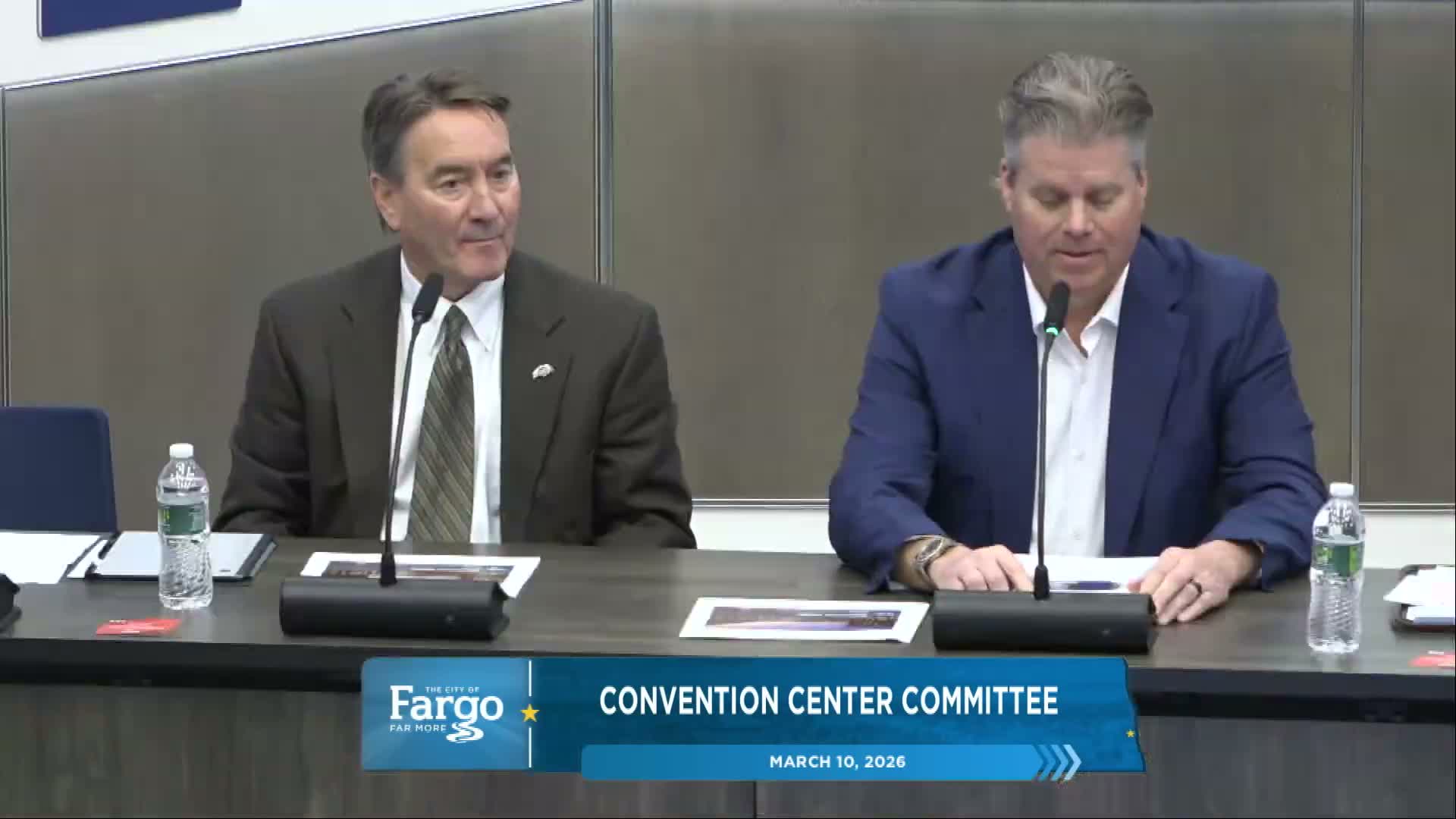
Summary
The Fargo Dome Authority and project partners presented a convention‑center + hotel + entertainment district concept sited at the Fargo Dome. Presenters detailed building program (about 52,000 sq ft exhibit/ballroom), cost ranges, and a public financing plan that uses Baker Tilly bond models and potential draws from the Fargo Dome permanent fund.
The Fargo Convention Center Committee heard a presentation from the Fargo Dome Authority and its design and development partners on a proposal to build a standalone convention center adjacent to the Fargo Dome and connect it for joint operations.
David Supas, president of the Fargo Dome Authority, opened the presentation saying the Fargo Dome location is the "strongest long term solution" and framed the combined convention center, hotel and retail/entertainment district as about a $120 million economic development effort for Fargo. Architects from Perkins+Will and RLE showed plans for a convention building sized to meet or exceed the RFQ: a 52,000‑square‑foot exhibit/ballroom (the RFQ asked for 50,000), a U‑shaped prefunction concourse (about 24,000 sq ft vs. a 10,000 sq ft minimum in the RFQ), a 6,000 sq ft kitchen, 12,000 sq ft of storage and roughly 8,800 sq ft of meeting rooms.
Project partners emphasized flexibility: the convention center can operate as a standalone facility or be combined with the Fargo Dome’s 80,000‑square‑foot arena floor for large expos and sports tournaments. The team cited parking synergies with NDSU and the Dome and described mezzanine connections and future expansion capability.
On cost and sources, project presenters described a convention‑center cost range (their materials cited roughly $61.9M–$70.4M for the convention center work) and presented a financing plan built from Baker Tilly models. The team said Baker Tilly’s scenarios produced bond proceeds ranging from about $43M to $51.5M; they used a midpoint of $47.3M in their working plan, combined with an equity contribution from the Fargo Dome Authority permanent fund (presenters cited roughly $13.3M) and other sources (about $11.8M) to reach total sources near $72.3M. The presentation noted Baker Tilly’s 25‑year bond projection assumed about a 6.25% interest rate and warned that deviations in rates would materially affect bond proceeds.
Presenters also showed pro formas spanning a high and low case. Under the high case (blending HVS demand assumptions and local operational assumptions), the combined Fargo Dome + convention center was projected to yield a combined operating gain (the team cited a high‑range operating figure of roughly $1.3M); under the low case, they showed a smaller positive operating benefit (roughly $600k–$700k). The team described an initial city subsidy pattern in early years in their model and said they would retain a capital set‑aside for convention‑center capital needs separate from operations.
Committee members asked whether a land lease was included in operating cost; the presenters said the MOU under discussion would set the convention‑center land lease at $0. Members also questioned lodging‑tax assumptions tied to Baker Tilly’s modeling; the presenters said their Baker Tilly column assumed lodging tax growth of 2% per year for the first 10 years and 1% thereafter and that other modeling variants used different growth assumptions.
The group acknowledged a funding "gap" element: presenters said the Fargo Dome Authority permanent fund sits at roughly $47M and that the Authority had discussed a potential $25M drawdown, with roughly $13M allocated to Fargo Dome improvements and roughly $11–12M for the convention center, but added the team had "undetermined" items to resolve with NDSU and other partners before those funds could be deployed.
The presentation ended with committee questions about hotel letters of intent and management; the Fargo Dome Authority team said they had not yet secured hotel commitments and that operator selection and detailed contracts would be resolved during later stages if the proposal is selected. The committee set follow‑up work and scheduled another session to continue vetting proposals.
Next procedural step: the committee will reconvene for additional city perspective and to consider proposals further; no formal vote was taken during this meeting.