
Lawmakers press DHS on senior‑services funding, TANF reserves and SNAP employment plans
Get AI-powered insights, summaries, and transcripts
Sign Up Free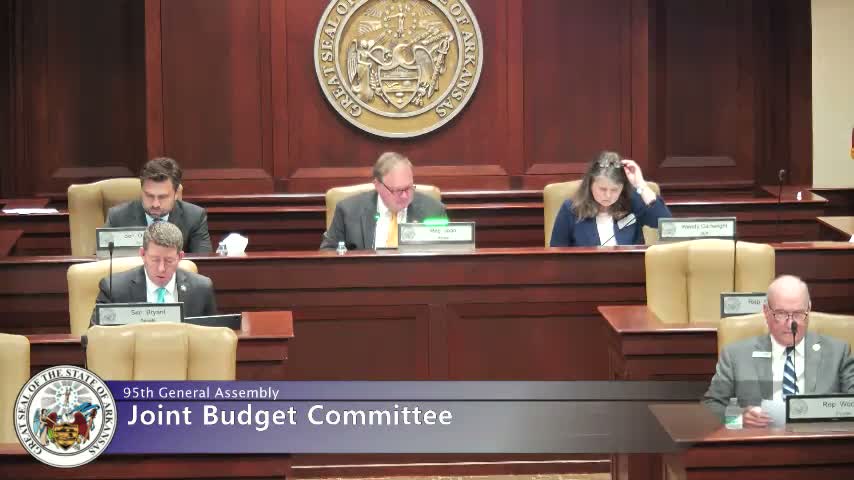
Summary
At a Joint Budget Committee briefing, lawmakers pressed Department of Human Services officials about flat budgets for senior centers, a shift of tobacco‑settlement funds between divisions, depleted TANF reserves and a planned expansion of SNAP employment and training. DHS said some increases reflect timing and policy changes; members sought more data and follow‑up.
The Joint Budget Committee examined appropriations for the Department of Human Services on the committee’s first session of the fiscal review, with repeated requests for clearer accounting of senior‑services funding and federal block grants.
Bureau of Legislative Research analyst Lila Walls told the committee the division of aging, adult and behavioral health services carries a legislative recommendation of about $318.9 million for fiscal 2026–27, with an operations appropriation of roughly $148.5 million and a grants paying appropriation of about $56.6 million that supports senior citizen centers across the state. Walls also noted two appropriations — the Medicaid Tobacco Settlement Program and an Independent Choices grant — were moved to the aging and behavioral health division via a governor’s letter in 2025.
Lawmakers pressed DHS officials on whether senior‑center funding is effectively declining. “Are we going backwards on those?” asked Senator Rice, citing local concerns. DHS replied that the apparent reductions are timing effects tied to federal fiscal years and that funds halted by a government shutdown were subsequently received and passed through to area agencies on aging. “We are not in a deficit from what we expected to receive,” a DHS official said.
Several members pressed DHS for more transparency on how transfers and fund balances are recorded. Representative Clowney asked why a tobacco settlement appropriation appears with zeros in some agency request columns; staff explained those expenses were recorded in the prior division where the program operated and that the presentation reflects a lateral transfer of the appropriation. The committee agreed staff should provide more detailed page references showing the prior expenditures.
TANF reserves and subgrantee decisions drew sustained scrutiny. DHS officials said the agency inherited substantial TANF subgrant obligations and has been reducing new subgrants to draw reserves down to sustainable annual spending of about $56.5 million. “We are trying to spend only what we receive,” an agency official said, adding that recent time‑only extensions were used so existing grantees could finish previously awarded work. Members urged the agency to produce reserve‑balance figures and to explain priorities for subgrant funding.
On SNAP, agency leaders described a plan to implement mandatory SNAP employment and training and said that change — plus provider matching — explains the modest increase in the SNAP employment and training appropriation. “We are preparing to implement mandatory employment and training, and so we have … flexibility in the appropriation,” a DHS official said. Senators asked for a breakdown of how much of the line is federal formula funding versus local provider match and whether services will be outsourced to providers; DHS agreed to provide the detail.
The committee repeatedly asked DHS to return follow‑up information on: (1) senior‑center funding flows and the net impact of one‑time infusions outside RSA; (2) the dollar amount and timing of tobacco settlement expenditures that moved between divisions; (3) TANF reserves and a list of prior subgrantees and current status; and (4) a line‑item breakdown for SNAP employment and training and farmer’s market program funding. DHS staff agreed to provide the requested documentation.
The committee adopted the executive recommendation on the DHS divisions under consideration and moved on to other agencies. Several members said they would monitor the follow‑up materials before final votes on larger budget decisions.