Get Full Government Meeting Transcripts, Videos, & Alerts Forever!
Get email alerts on the Tree Removal topic
No spam. Unsubscribe anytime.
Planning commission approves large Glory Hill tree‑removal request over dissent
Summary
The Leander Planning and Zoning Commission approved a tree‑removal permit for the Glory Hill subdivision, allowing removal of a high percentage of significant and heritage trees after the applicant proposed on‑site tree plantings and a $630,375 mitigation payment; the motion passed 4–1 with Commissioner Morales opposed.
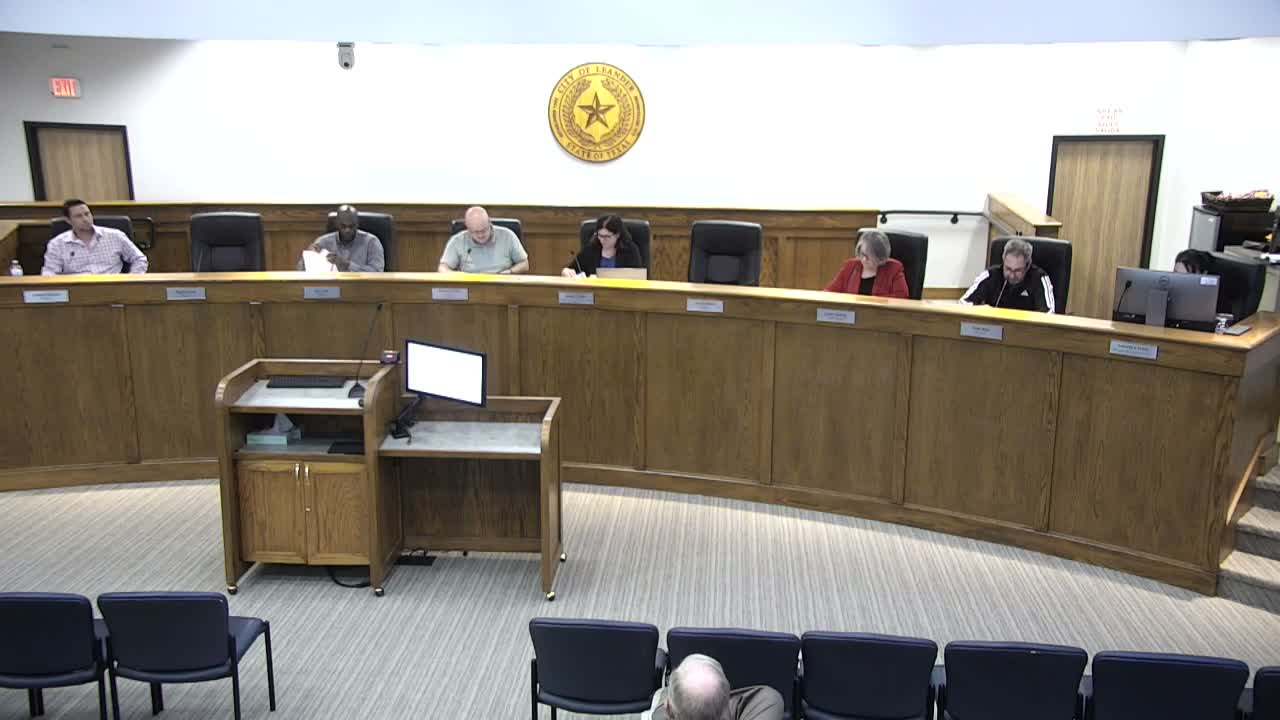
The City of Leander Planning and Zoning Commission voted 4–1 on Jan. 8 to approve a tree‑removal permit for the Glory Hill public‑improvement plans, allowing removal of numerous significant and heritage trees that staff and the applicant said are necessary to grade a steep site.
Staff planner Mary Lee Van Lubin told the commission that the request is the first step in the tree‑removal process and that the site’s extreme topography requires extensive grading for roads and home sites. Under the subdivision ordinance, she said, removal of significant trees greater than 18 inches in caliper requires commission approval; staff recommended approval based on the topographical constraints and the applicant’s proposed mitigation.
Pat, representing TriPoint Homes, presented site plans showing a 40‑foot change in topography across the tract and explained that grading the hill will make it “impossible to save trees because you’re lopping off a certain area.” He said the developer plans to plant 165 new trees on site and to pay $630,375 in tree mitigation fees, and that the mitigation funds could be used to purchase and install roughly 514 three‑inch trees off‑site, which the applicant calculated would yield about 679 new trees total. “With the trees that we’re planning on‑site at maturity, the tree canopy at this site will exceed the tree canopy that currently exists,” the applicant stated.
Commissioners pressed for preservation information and topographic detail. Vice Chair Lantrip said the topography slides helped and that she would “reluctantly vote yes” because of the constraints; Commissioner Morales opposed the request, saying the subdivision layout looked optimized for housing and that “maybe some of the streets or a couple of lots were compromised, maybe one or two just to save a couple of the heritage trees.” The chair noted a packet discrepancy between two pages showing different mitigation totals; staff confirmed the correct figure for this application is $630,375.
After debate, Vice Chair Lantrip moved to approve the tree‑removal permit; the commission approved the request 4–1. Commissioner Morales recorded the sole dissent. Per staff, mitigation fees and any heritage‑tree removal fees must be paid with the site development (PIC) permit and the commission’s recommendation will go to City Council, which has final authority to issue the permit.
The commission’s packet lists additional mitigation‑fee calculations and a heritage removal fee (the packet cites a heritage fee calculation based on 107 caliper inches at a $300 per‑inch rate). The next formal step for the applicant is the site development permit and any required mitigation payment.