
House Judiciary Committee hears survivors, experts on civil protective orders and enforcement gaps
Get AI-powered insights, summaries, and transcripts
Subscribe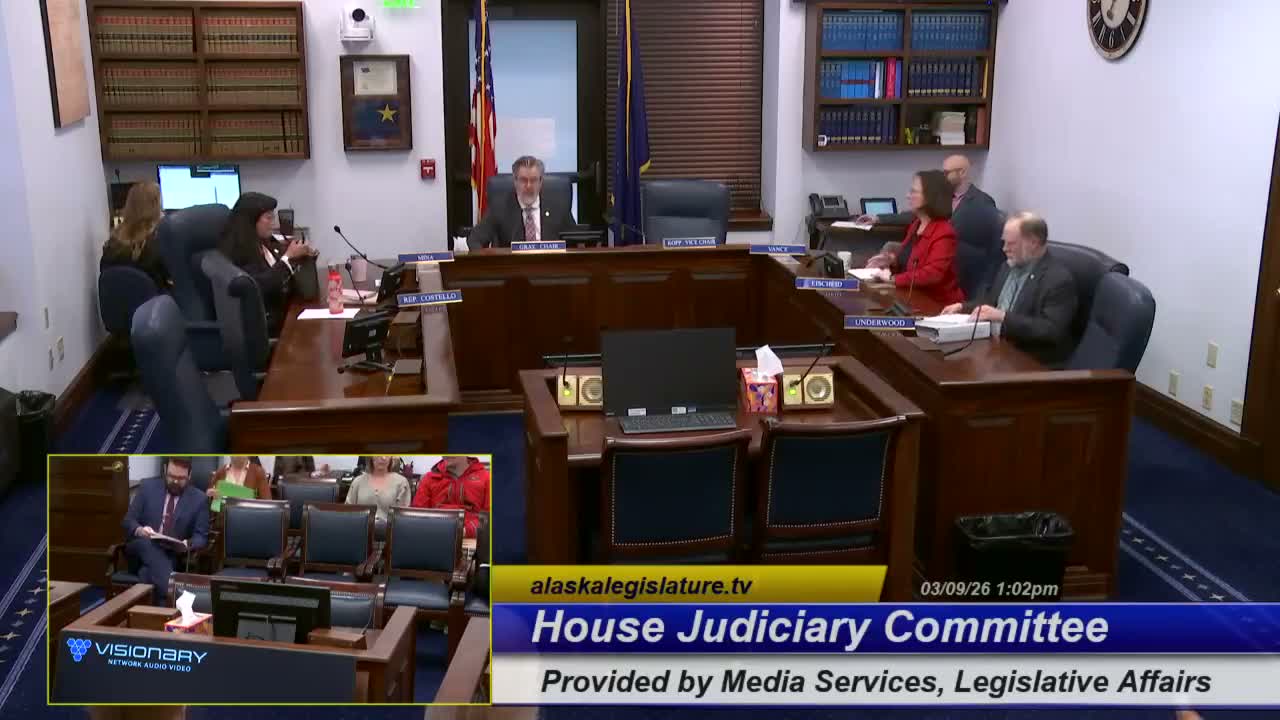
Summary
Survivors, a university researcher and the Alaska Network on Domestic Violence and Sexual Assault told the House Judiciary Committee on March 9 that Alaska’s current civil protective order process often re‑traumatizes petitioners, produces low long‑term grant rates and faces enforcement and access barriers; advocates urged longer durations, clearer enforcement language and procedural fixes.
ANCHORAGE — The Alaska House Judiciary Committee on Monday heard testimony from a survivor, a University of Alaska researcher and statewide advocates who said civil protective orders (CPOs) are a vital survivor tool but are hampered by procedural burdens, low long‑term grant rates and enforcement gaps.
“Each filing triggers conflict and escalations that come out in all kinds of different ways. It gives him a platform to continue exerting power and control through the legal system as well,” said Laura Booch, a constituent from House District 5, describing why she must annually reopen a long‑term domestic violence protective order to keep its protections in place.
The committee’s presentation panel included Dr. Ingrid Johnson, an associate professor at the University of Alaska Fairbanks, and Christine Pate, legal program director for the Alaska Network on Domestic Violence and Sexual Assault. Johnson cited statewide survey data: the Alaska Victimization Survey (2020) estimates that roughly 70 percent of women have experienced partner abuse in their lifetimes and Alaska’s homicide rate for women is about twice the national average. She also noted the courts reported nearly 7,900 civil protective order filings in 2024.
Johnson summarized academic findings as mixed on whether CPOs reduce repeat incidents of physical and psychological abuse, but she said the evidence is more consistent that orders improve survivors’ mental and physical well‑being by reducing fear and increasing perceived safety.
Pate walked lawmakers through how Alaska’s three CPO types work — emergency (72‑hour), ex parte or short‑term (typically up to 20 days) and long‑term (one year) — and described standards of proof and procedural timing. “If the court does not hold a hearing on an ex parte petition and denies it on paper, that can be really harmful because some people just don’t present well on paper,” Pate said, urging in‑person hearings before denials in borderline cases.
Pate also reviewed court data for the last half of 2025, saying nearly 3,000 short‑term domestic violence protective orders were requested in a six‑month span while only 1,302 were granted (about 46 percent); long‑term orders were granted in roughly 17 percent of requests. For stalking and sexual‑assault protective orders she reported similarly low grant rates.
Advocates flagged practical barriers: many petitioners proceed pro se, only about 10 percent of cases have attorney representation on either side, and the court’s newer TrueFiling process adds digital steps that can be inaccessible to survivors with limited internet access or only phone access. Pate said service and enforcement problems are common: unserved orders are not enforceable, law enforcement can be reluctant to act where order language is ambiguous, and civil contempt remedies require additional court steps.
Committee members pressed presenters on several policy options. Survivors and advocates recommended shifting more of the burden to respondents seeking to dissolve or modify orders, extending order durations beyond one year (some states allow multi‑year or permanent orders), creating an ex parte process for extension windows, clarifying that temporary custody awards include both physical and legal custody, and strengthening statutory language and procedures for firearm surrender and law enforcement assistance.
Pate noted pending bills on one issue: “There is legislation pending — SB 49 and HB 22 — that would close the loophole allowing prevailing respondents in stalking and sexual‑assault cases to recover attorney fees,” she said, adding advocates believe that change would reduce a deterrent for survivors seeking protection.
On capacity, advocates and committee members discussed batterers intervention programs and accountability measures. Britta Stanfield, executive director of the Alaska Network on Domestic Violence and Sexual Assault, said some effective local programs exist but funding and administrative capacity are limited; she cautioned any statutory requirement that respondents complete programs would require additional resources and implementation planning.
Members also asked about geographic variation and data; Dr. Johnson deferred to court annual reports and legislative research for regional breakdowns of filings and recommended the committee invite Department of Law and judicial staff to a future hearing to analyze due‑process implications and comparative models from other states.
The hearing ended with lawmakers saying they would consider reforms that balance survivor safety with due‑process concerns and rural subsistence and firearms uses. Chair Rep. Grama closed the hearing with procedural reminders and adjourned the meeting at 2:40 p.m.
What happens next: committee members asked staff to invite Department of Law and judicial research staff to follow‑up hearings to provide comparative data on duration options, enforcement practices and potential fiscal or capacity impacts for intervention programs.