
Committee hears HB 324 to regulate cryptocurrency kiosks amid rising fraud complaints
Get AI-powered insights, summaries, and transcripts
Subscribe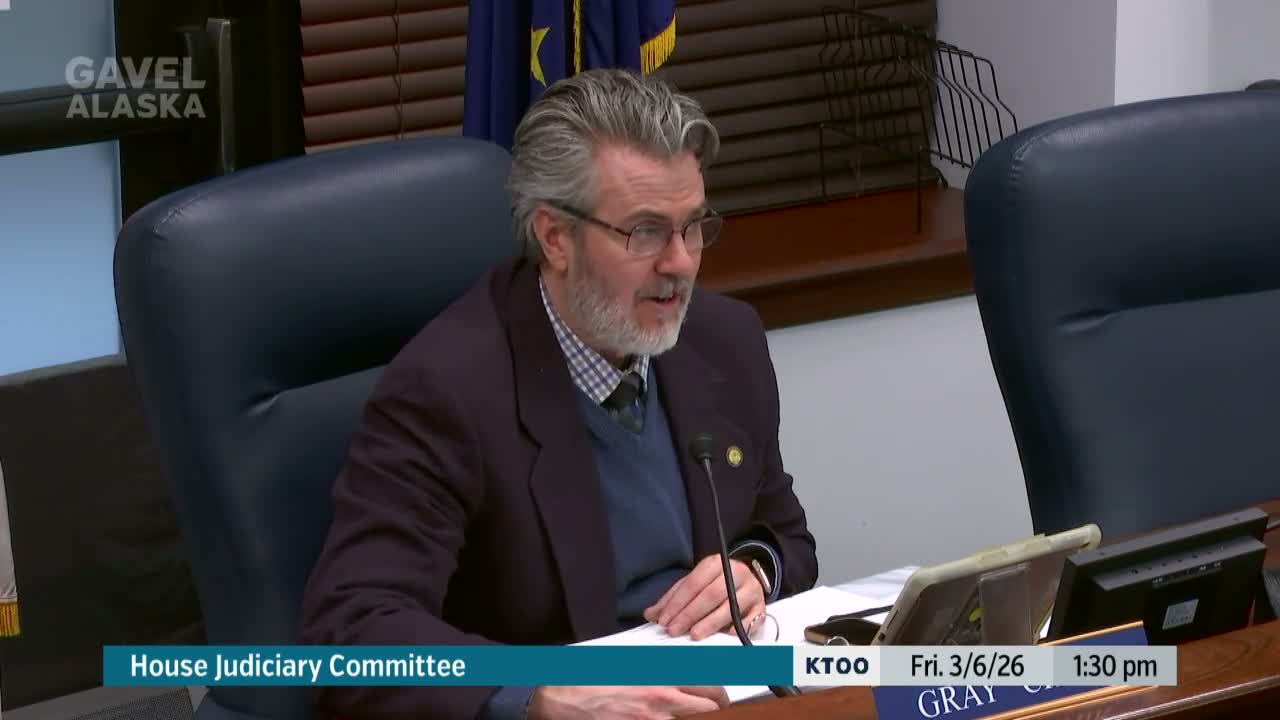
Summary
Bill sponsor staff and invited witnesses told the House Judiciary Committee HB 324 would require kiosk licensing/registration, quarterly reporting, refund rights, receipts with transaction hashes, KYC, fraud warnings, transaction limits and penalties; AARP and state regulators presented data showing rising IC3 complaints and numerous kiosk locations in Alaska. Public testimony and regulators urged provisions to aid investigations and protect older adults.
House Bill 324, introduced for a first hearing March 6, 2026, would create a licensing, reporting and consumer‑protection regime for virtual currency (crypto) kiosks operating in Alaska. Sponsor staff N. T. Harbison and invited witnesses told the House Judiciary Committee the bill is designed to reduce a surge in kiosk‑linked fraud and give law enforcement and victims practical tools to recover or investigate stolen funds.
N. T. Harbison (staff to Rep. Moore) summarized HB 324’s major provisions: operator licensing and registration requirements (AS 6 55 1 20), quarterly reports of kiosk locations and transaction metrics, conspicuous fraud warnings and detailed receipts that include transaction hashes and law‑enforcement contact information, mandatory anti‑fraud and anti‑money‑laundering policies and blockchain‑analytics tools to block transactions to known fraudulent wallets, identity‑verification (KYC) thresholds, limits on daily and 30‑day transaction amounts and fee caps, required customer service hours and a dedicated law‑enforcement access line, and penalties for violations including civil penalties, kiosk seizure and forfeiture of fees.
Clark Flint Barr, government affairs director for financial security at AARP Alaska, said kiosks are increasingly used by criminals because transactions are fast and irreversible. Flint Barr cited national attorney‑general litigation analyses showing very high shares of kiosk transactions tied to fraud in other states and presented IC3/FBI data that Alaska had 48 kiosk‑related complaints in 2024 with nearly $1,000,000 in reported losses. He told the committee kiosks disproportionately affect older adults and recommended the bill’s combination of warnings, receipts (including wallet addresses and transaction hashes), KYC and refund windows to improve recoveries and investigations.
Tracy Reno, director of the Division of Banking and Securities, said Alaska regulates money transmission, currently has 173 licensees (six identified as operating kiosks) and documented about 76 kiosk locations in a February report; she confirmed the division requires kiosk agent locations to be recorded and that signage with fees/conversion rates is required, but that state law does not currently cap fees. Regulators, sponsor staff and AARP representatives said receipts that record wallet addresses and transaction hashes would allow law enforcement to begin tracing attempts immediately rather than waiting for subpoenas.
Committee members asked detailed questions about how kiosks collect ID and how receipts would be generated; Flint Barr and Harbison said machines can scan government IDs or use phone apps for ID capture and that receipts would include the wallet address and transaction hash law enforcement needs. The committee did not vote; Chair Gray set HB 324 aside and scheduled public testimony for March 13, 2026.
The hearing highlighted competing data points (AARP presented a map with 64 kiosks; the Division of Banking reported 76 agent locations in February and six licensees identify as operating kiosks) and identified key follow‑up items: confirming the number of kiosks, defining the operator licensing pathway, and setting technical standards for receipts, KYC and blockchain analytics.