
House Resources Committee forwards DNR and DEC commissioner designees after hearings
Get AI-powered insights, summaries, and transcripts
Sign Up Free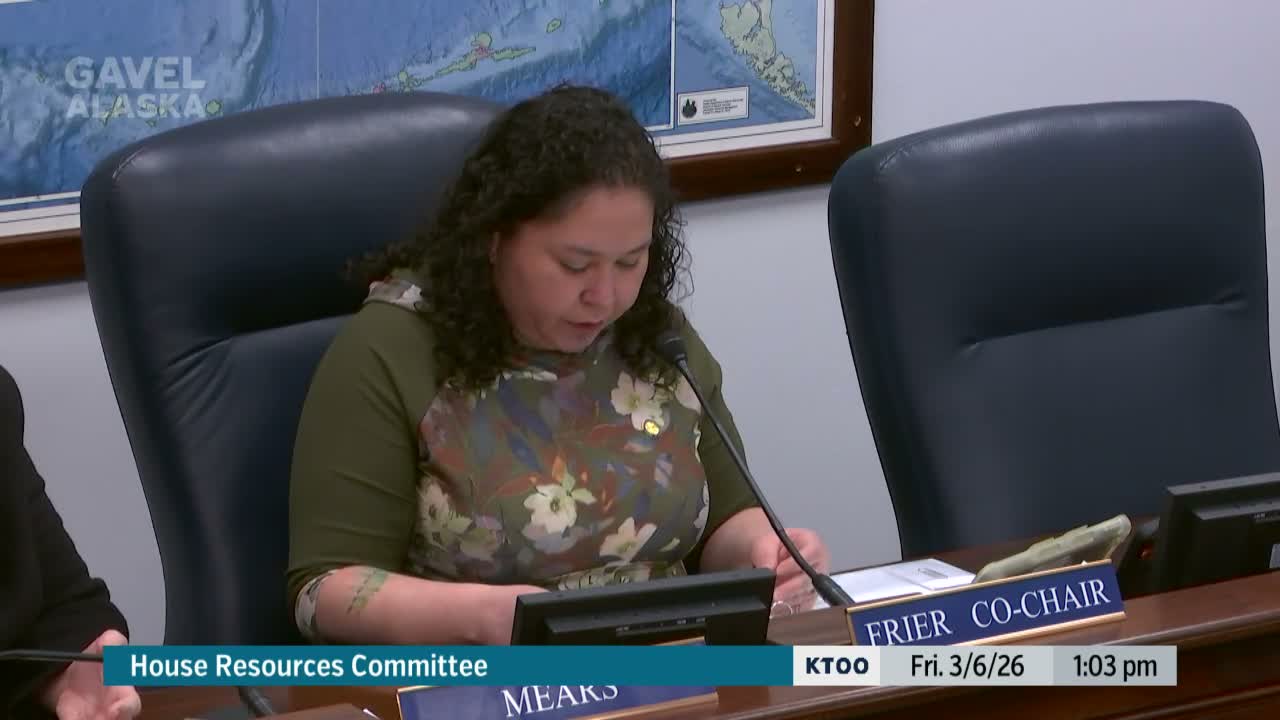
Summary
The House Resources Committee heard Gov. Dunleavy’s commissioner designees — John Crother for the Department of Natural Resources and Randy Bates for the Department of Environmental Conservation — and, with no public testimony, forwarded both nominations to the joint session after questions on permitting, PFAS, air quality and regulatory reforms.
The Alaska House Resources Committee on March 6 heard testimony from two of Gov. Mike Dunleavy’s commissioner designees and, hearing no objection, forwarded both names to the Legislature’s joint session for final consideration.
John Crother, nominated to lead the Department of Natural Resources, opened with prepared remarks listing five guiding principles and five priorities for 2026, including advancing the governor’s growth initiatives, pursuing federal land and entitlement opportunities and reinforcing the department’s responsiveness and workforce development. “It’s an honor and a privilege to serve as commissioner designee pending my confirmation,” Crother said.
During questioning, Crother highlighted opportunities tied to recent federal actions such as partial revocation of Public Land Order 5150 and cited rising oil and mineral markets. He told members the state must be clear and decisive with federal partners while also improving internal clarity about regulations and processes. Crother said DNR has reduced its appeals backlog about 50% in the last six months after creating an appeals director position and that the department values succession and mentorship to address staffing shortages.
Committee members pressed Crother on several topics: coordination with federal agencies, parks and fire-management challenges, the effect of a proposed unfilled deputy-commissioner slot on operations, and how the department would handle ‘duty to produce’ enforcement on oil-and-gas leases. On enforcement, Crother said the department can press operators administratively and, when necessary, pursue litigation, but those paths can be slow and require strategic use of resources.
Randy Bates, the governor’s designee for the Department of Environmental Conservation, described a 25‑year state career across resource agencies and framed three pillars for the agency: resource development, states’ rights and restoring fish to rivers. “Nearly every industry in this state requires a permit from DEC,” Bates said, adding that DEC’s mission is to balance permit issuance with protection of human health and the environment.
Bates told the committee he has been working closely with federal partners and EPA regional leadership on issues including PM2.5 air pollution in the Fairbanks–North Pole area and contaminated‑site cleanups. He called PFAS “a concern” and said DEC will sample public drinking-water systems consistent with EPA guidance, provide funding to system operators to monitor, and work with responsible parties on cleanup and replacement of affected water supplies. Bates referenced a federal timeline toward final compliance in the 2029–2031 period for maximum contaminant levels (MCLs).
On air quality, Bates identified PM2.5 from residential wood heating as the main regional challenge around Fairbanks and North Pole and said coordinated actions and grant funding have produced reductions. He also told members DEC is preparing a phased package of regulatory revisions under Administrative Order 360 to improve transparency and reduce burdens, with about 40 regulatory packages identified and the first set expected to be released soon.
Committee members asked both designees about communication with the public and local governments, institutional knowledge amid turnover, and how the agencies will handle complex local issues such as septic-system replacements, wastewater waivers and airport contamination related to firefighting foam and deicing runoff. Bates said DEC holds open monthly staff meetings, is working on clearer public summaries of regulations and will continue to pursue grant and federal funding opportunities for local projects.
The committee opened public testimony on the two nominations, received none in the room or online, and the chair announced the committee would forward both names to the joint session. The committee record notes that signatures on the committee report do not indicate how members will vote in any subsequent floor or joint-session action.
The House Resources Committee adjourned at 2:52 p.m.; the next committee meeting is scheduled for Monday, March 9, 2026, at 1 p.m.