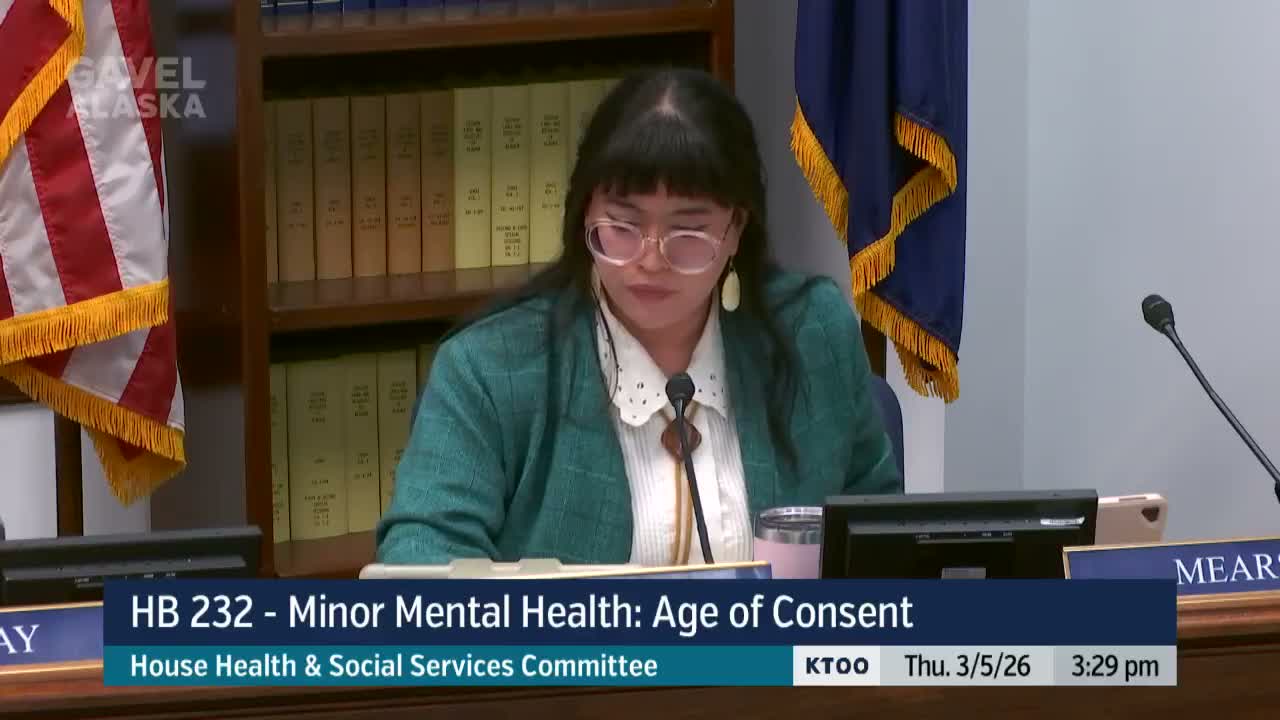
Committee advances bill allowing 16- and 17-year-olds to consent to five behavioral-health sessions
Loading...
Summary
House Bill 232 would allow 16- and 17-year-olds to self-consent for up to five outpatient behavioral-health sessions (no medications) in cases where parental consent is unsafe or unavailable. Supporters cited access for homeless and unaccompanied youth; opponents warned it shifts authority from parents and gives providers discretionary power.
The House Health and Social Services Committee on March 5 advanced House Bill 232, sponsored by Representative Gray, which would permit 16- and 17-year-olds to provide self-consent for up to five outpatient behavioral-health sessions without parental permission. Representative Gray moved the bill from committee with individual recommendations and an attached zero fiscal note; the chair recorded no objection and the bill passed from committee.
Supporters told the committee the change would reduce barriers to timely care for youth at risk of crisis. "Today, I'm testifying in support of House Bill 232, which would allow 16 and 17 year olds the ability to provide self consent to receive up to 5 behavioral health treatment sessions," said Trevor Storrs, president and CEO of Alaska Children's Trust. He pointed to state data showing increases in persistent sadness among high-school students and framed the bill as a narrow, preventive pathway to early intervention. Michael Carson of My House said the bill's first sections are important for unaccompanied and homeless youth who cannot reach parents.
Opponents cautioned that the bill shifts decision-making away from parents and could grant clinicians broad discretion. "HB 232 creates a significant shift in the balance from parental authority to state-authorized behavioral health intervention for minors," Kathleen Wiedemeyer of the Citizens Commission on Human Rights told the committee, arguing that providers might continue treatment beyond five sessions and that parents would have limited ability to contest services. Representative Ruffridge raised a separate concern about page 4, lines 30–31, which relieves parents or guardians of financial obligation under the section; he said that provision could create unsustainable services if not clarified.
Committee members pressed for limits and safeguards: Rep. Gray and others emphasized the bill is intentionally limited in scope (five sessions, does not allow prescription medications) and said many counselors would seek to involve parents before a sixth session. Representative Prox asked whether mandatory reporting or OCS involvement would be triggered; Representative Gray answered the committee that OCS would not automatically become involved in the scenarios described and that the bill is focused on narrow access. Heather Ireland, executive director of Anchorage School-Based Health Centers, said clinicians can help youth work toward involving parents and that the measure provides a bridge to earlier intervention.
The committee heard concerns about who qualifies as a provider (social worker, school counselor, other licensed clinicians) and about financial responsibility for care, but supporters argued that early access reduces later crisis costs. After discussion, the committee moved HB 232 from committee with the reported recommendations. The chair recessed to finalize the committee report.
Next steps: HB 232 will proceed with the committee's report; members asked for additional technical clarifications and may consider amendments before further action.