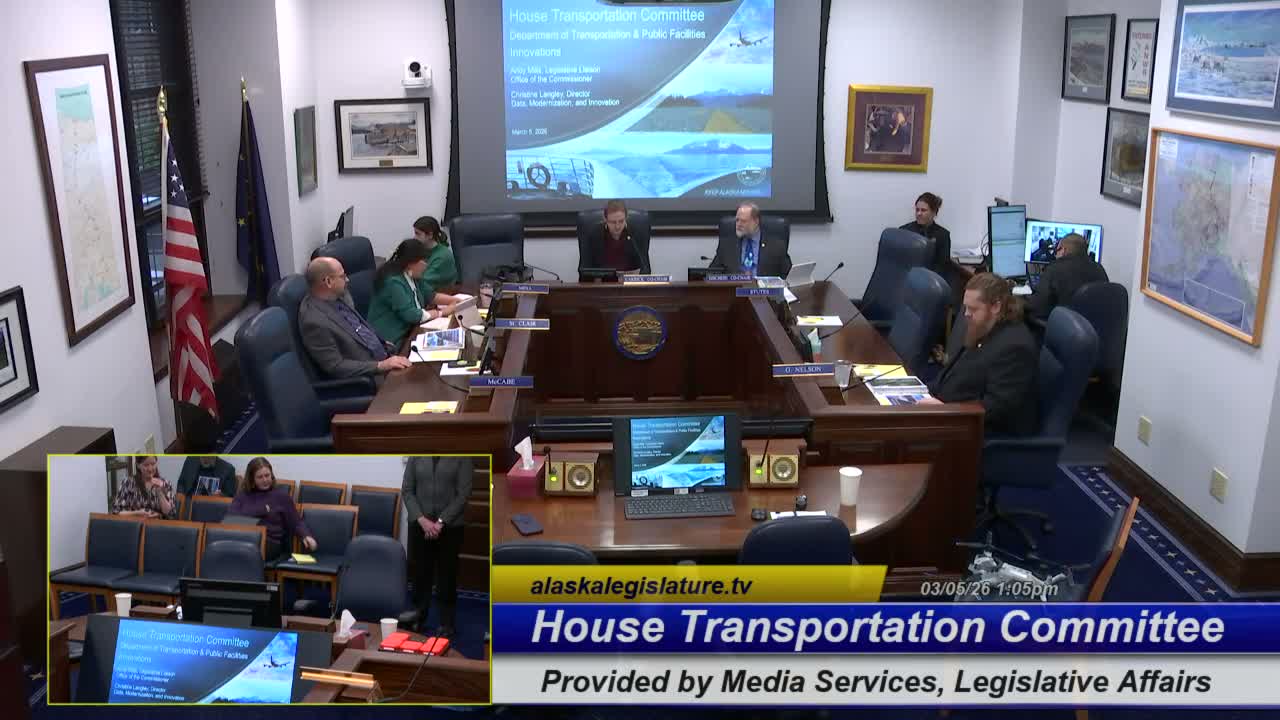
Alaska DOT tells House committee it is expanding drones, robotics and AI for inspections, avalanche response and traveler alerts
Loading...
Summary
The Department of Transportation and Public Facilities told the House Transportation Committee on March 5 that it is deploying drones, robots and AI tools across Alaska for bridge inspections, avalanche mitigation, asset maps and traveler alerts, and is phasing out some DJI drones tied to federal funding rules.
Christine Langley, director of data modernization and innovation at the Alaska Department of Transportation and Public Facilities, told the House Transportation Committee on March 5 that “the transportation's future is technology,” laying out a package of tools the agency says will improve safety and response in Alaska's remote environment.
The presentation to the House Transportation Committee, led by Langley and Andy Mills, DOT legislative liaison and special assistant, described current programs — a 130-drone fleet that will be reduced as some DJI models are phased out, robotics for underwater and wildlife work, AI-driven asset-mapping and a series of avalanche-detection and mitigation pilots — and outlined next steps including a connected-corridor pilot and a joint traffic operations center with the Department of Public Safety.
Langley described several operational uses for drones and robots. She said underwater robots (called Archimedes in the presentation) help inspect docks and that a “wildlife mitigation robot dog” is stationed at Fairbanks International Airport to haze animals on runways. On drone procurement, Andy Mills told the committee “the DJI is a Chinese, based company,” and both he and Langley said federal Build America/Buy America rules tied to federal funding are driving a transition toward U.S.-made models such as Skydio and other systems.
The presenters highlighted aviation and public-safety applications. Langley said a recent test produced an "air blast" by detonating a canister roughly 2 meters above the snow, which she said moves more material than ground detonation; she described geofencing, pilot training and an air-tag retrieval aid for unspent canisters as safety controls. Mills added that DOT had obtained provisional authority from the Federal Aviation Administration to test explosive deployment on drones.
Committee members asked about safety and recovery. Representative Nelson pressed on why DJI models are being phased out and whether DOT can transfer decommissioned drones to local governments; DOT said disposal practices are being reviewed and that some state equipment is typically offered to local governments before public auction. Cochair Eisheid asked whether drones are equipped with infrared sensors to locate avalanche victims; Mills and Langley said drones have been used with infrared in past responses and can support search-and-rescue.
Langley also described a suite of nonexplosive tools: drone-acquired 3-D models to speed construction estimates and bridge inspection, AI systems for predictive road-surface conditions, pole-mounted vehicle-count units that classify traffic, a public STIP (Statewide Transportation Improvement Program) interface and award dashboards that list prime and subcontractors and paid-to-date amounts. She said DOT is piloting 70 fleet-monitoring units (Samsara) to detect engine faults and schedule maintenance and that it has distributed 42 extrication equipment sets to 14 EMS agencies and more than 800 LED pilot beacons to improve roadside safety.
Langley discussed a Kodiak pilot of an AI-powered pedestrian light that automatically tracks and highlights crosswalk users. She said the unit costs about $37,000 with roughly $1,000 per year in update/maintenance costs and requires an electrician and a marked crosswalk for installation; she also said the light’s AI is trained per location to adjust to local conditions. Committee members asked about lower-cost flashing-LED alternatives and interest in testing in Anchorage, given local pedestrian-safety concerns.
On alerts and operations, Langley detailed radar and infrasound avalanche detection pilots along the Seward Highway and Thane Road, a trailer-mounted "mobile boom" device tested in Thompson Pass that creates air blasts to dislodge small avalanches, and a planned "Alaska Alerts" geofencing system to message cell phones during events. She said DOT is designing a joint traffic operations center to share live camera and condition data with the Department of Public Safety.
The presentation prompted several follow-up items the committee identified for staff: clarification on disposal rules for phased-out drones, more detail on retrieval practices for unspent canisters, and consideration of where to pilot pedestrian lights and dynamic signage. The committee adjourned at 2:24 p.m. and scheduled its next hearing for March 10.
The briefing contained operational details and pilot results but no formal committee votes; lawmakers asked for additional written material and follow-up demonstrations.