
Alaska Department of Law seeks $1 million for statehood litigation as trial and digital‑evidence costs rise
Get AI-powered insights, summaries, and transcripts
Subscribe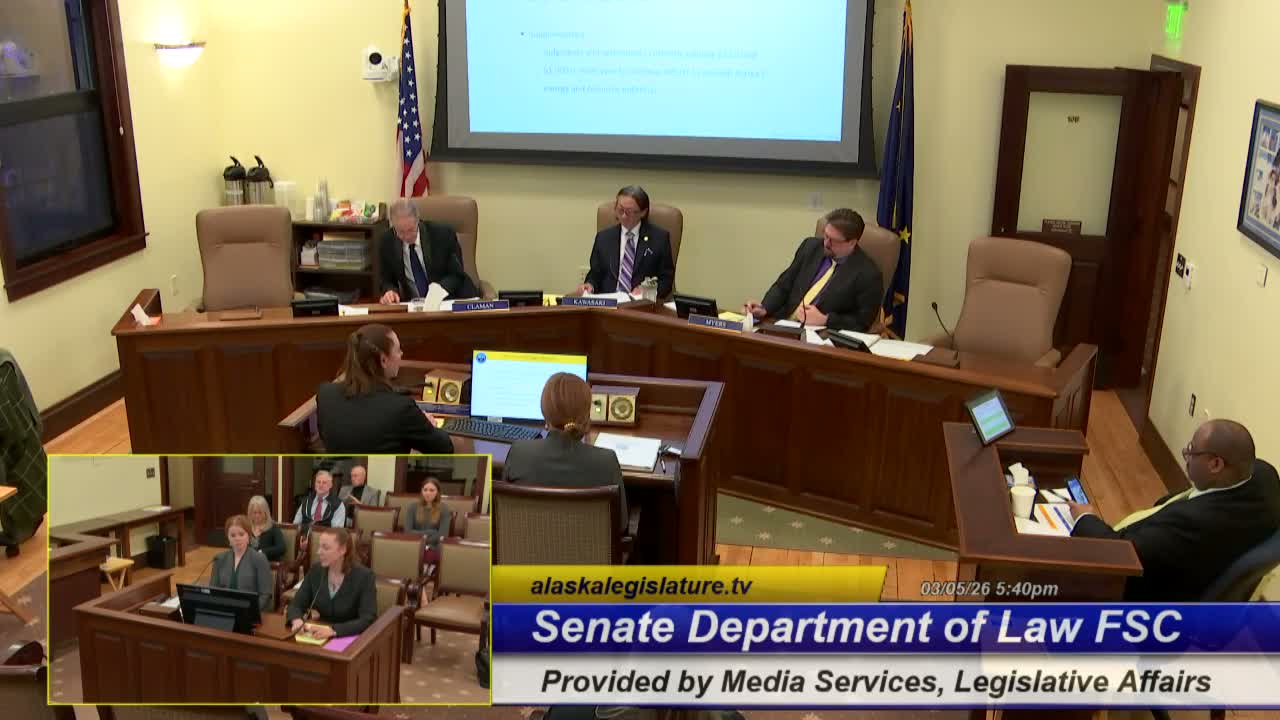
Summary
Department of Law officials told a Senate Finance subcommittee they need a $1 million multi‑year appropriation to sustain statehood‑defense litigation and shore up capacity as trial volumes, expert fees and digital‑evidence review costs grow; department leaders also warned of a large ACLU class action that could require extensive data review.
The Alaska Department of Law asked a Senate Finance subcommittee on March 5 for a $1 million multi‑year supplemental to sustain statehood‑defense work while warning of sharply rising litigation and discovery costs across criminal and civil dockets.
Deputy Attorney General Corey Mills, who leads the civil division, told the subcommittee the request is driven by capacity constraints as the federal government issues new rules that will prompt litigation in which Alaska needs to participate. “The additional money would ensure that as these actions come out and there's lawsuits brought that Alaska can intervene and have its own voice at the table,” Mills said.
The nut of the request, Mills said, is not a change in policy but an operational expansion: prior RFPs produced outside‑counsel contracts with Davis Graham & Stubbs and Fenimore Craig, and the state sometimes brings in Consovoy McCarthy for Supreme Court‑level matters. Mills said the department will continue to handle many appeals in‑house but needs additional staff and outside capacity to pursue and defend multiple simultaneous federal challenges.
Why now: officials described rising trial activity and growing expense items that strain the department's current budget. Deputy AG Angie Kemp (Criminal Division) said the office conducted 292 trials in FY25, including 173 felonies—about 30 more felony trials than the prior year—and expects trial counts to exceed 300 this year. Kemp flagged witness travel, housing and attorney travel costs as major budget pressures and gave a concrete example of a roughly $22,000 housing authorization for a rural three‑week homicide trial.
Mills and Kemp also cited rising expert witness fees, subscription and e‑research costs such as Westlaw, and a rapidly escalating volume of digital evidence—“about 5 terabytes” for the pending class‑action matter described to the committee. Those pressures, they said, make it difficult for existing staff to complete discovery and trial preparation without supplemental funding or expanded use of outside counsel.
The department asked the committee to treat a roughly $32,000 tab of current judgments and settlements as the baseline for annual supplemental work and to approve the $1 million multi‑year appropriation to preserve the state's ability to litigate resource and federal‑rule matters that directly affect Alaska's lands and industry.
Senators pressed several operational points. Senator Clayman asked whether the two prosecutor positions the legislature funded last year remain in the FY27 budget; Kemp said they are included in the department's operating budget. Senator Myers asked for detail about the duration of the rural trial that produced the $22,000 housing bill; Kemp estimated two to three weeks, likely three.
Committee members also questioned why the state would not rely more on the federal government’s legal team in cases where the United States is the plaintiff or co‑party. Mills said the issue is capacity: the department must pick which matters to join and needs expanded resources to get cases through to final judicial rulings without being repeatedly delayed by changes in federal administration or rulemaking.
Mills pointed to prior results the state achieved using similar funding: a federal disclaimer of a disputed 40‑mile river system, favorable rulings in RS 2477 trail matters near Chicken, and successful defenses related to polar‑bear incidental‑take rules. He described those wins as evidence that appropriated funds can protect Alaska’s interests when federal regulatory changes prompt new litigation.
The hearing also flagged a significant pending matter that could create large discovery burdens. Mills said the ACLU‑filed putative class action (referred to in the hearing as “Veil v. Department of Corrections”) seeks systemic reform of inmate medical, mental‑health and dental care policies and could encompass medical records stretching about four years. Mills said the department has identified roughly 5 terabytes of electronic records and is exploring both in‑house review teams and negotiated use of AI‑assisted review, subject to agreement with plaintiffs on procedures and reliability.
Kemp cautioned that AI use in discovery requires negotiation with opposing counsel and presents reliability concerns; both she and Mills said the department is testing “AI‑light” tools and other technologies but emphasized the need to validate outputs and reduce the number of custodians to reasonable levels for review.
The subcommittee heard no final action on the $1 million request during the session; officials confirmed judgments and settlements are being tracked and that the department will submit a written response to an outstanding legal‑status letter by the March 6 deadline referenced at the hearing.
The subcommittee adjourned at 6:09 a.m.