
Task force told state funding covers a fraction of recommended school capital needs
Get AI-powered insights, summaries, and transcripts
Subscribe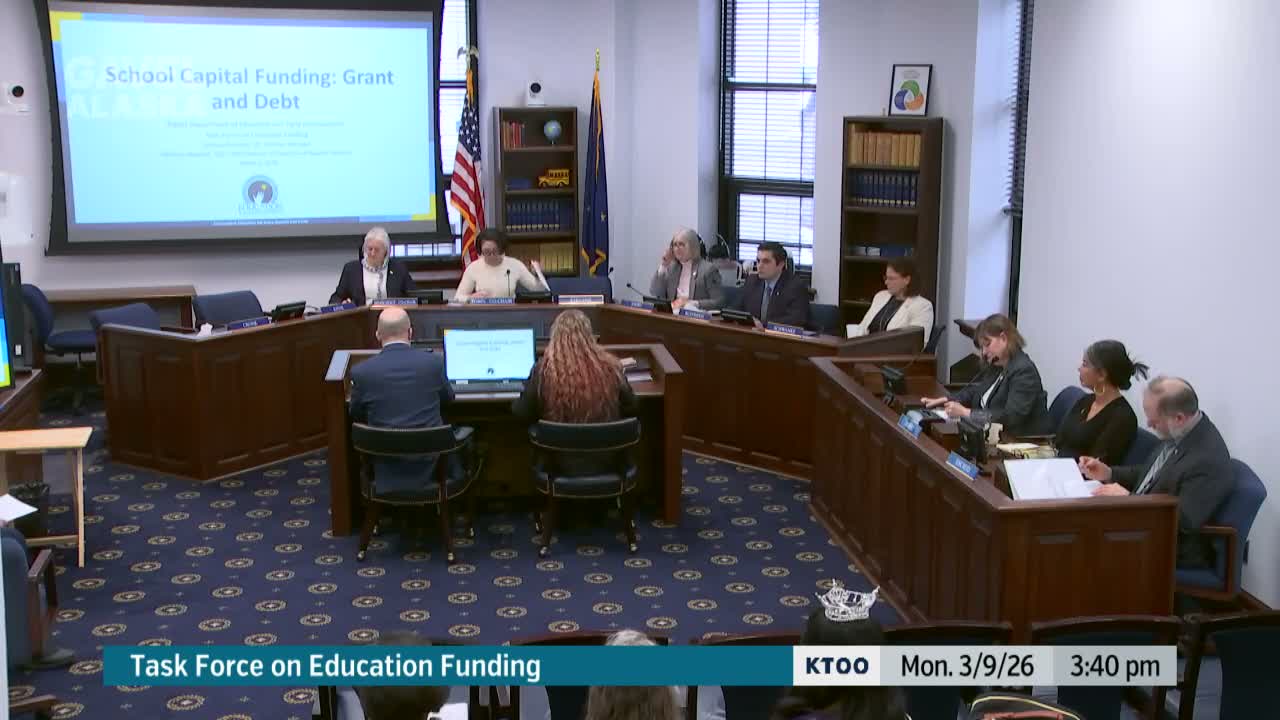
Summary
DEED and the Legislative Finance Division told a joint task force that Alaska’s statutory funding streams and limited appropriations leave a multiyear shortfall: FY26 funding was roughly 7.7% of DEED’s recommended 3% capital-renewal benchmark for school facilities, and the REA fund and debt-reimbursement program provide inconsistent support.
The Joint Legislative Task Force on Education Funding heard on March 9 that state funding for school construction and major maintenance falls far short of industry-recommended levels, leaving many districts to delay work or front costly condition surveys.
Heather Heineken, director of finance and support services at the Department of Education and Early Development, outlined the statutory funding mechanisms used for school projects and said the department submitted its 14th annual report on Feb. 27. She told the task force that districts can pursue grants from the School Construction Grant Fund and the Major Maintenance Grant Fund, apply for debt reimbursement, or access the Regional Education Attendance Area (REAA) and Small Municipal School District Fund — but all funding is subject to annual legislative appropriation.
Alexi Painter of the Legislative Finance Division emphasized the practical effects of constrained appropriations: “If you take 3% for capital renewal … that would be $376,000,000. What we actually funded in FY26 was $28,900,000,” Painter said, noting the 3% benchmark has been met only three times in 16 years. Painter described a decade-long moratorium on debt reimbursement that ended in 2025 and explained current reimbursement rates of 40–50% contrast with earlier, higher levels. He warned that as outstanding school debt declines, revenue into the REA fund — which is tied to debt levels — has dropped, reducing a fund source that once exceeded $30 million and is now under $20 million.
Committee members pressed DEED and the finance staff on specific mechanics: Michael Budicofer, DEED facilities manager, said DEED typically visits districts on a roughly five-year cycle and performs limited site visits (covering two to three facilities per district) rather than comprehensive condition assessments. Heineken and Budicofer explained that condition surveys — which can cost between $200,000 and $300,000 — strengthen applications and are reimbursable when projects are later approved, but districts that front those costs risk spending without assurance of an award.
The task force heard that the BRGR (Bond Reimbursement and Grant Review) committee sets scoring categories and that projects are evaluated on both formula-driven points and evaluative points from a three-rater panel. Painter flagged a statutory $70 million unobligated cap on the REA fund that makes financing very large projects difficult and said DEED tries to phase large projects across years when funding is insufficient.
Members raised concerns about the complexity and cost of applying. Heineken said some applications were determined ineligible, modified, or adjusted for budget after review; she described a case where an application submitted in 2007 only reached funding in 2025 after scoring changes and additional documentation.
The task force did not take formal votes. Members asked DEED and Legislative Finance for follow-up material, including current BRGR membership, confirmation of condition-survey validity periods, fund balances by statute, and options for emergency funding or approaches to phase projects and better target life-safety needs.
The task force scheduled follow-up sessions and a next joint meeting (House and Senate education committees) on March 11 in the Davis Committee Room.