
Coalition urges base facilities allocation, shared services to address Alaska school maintenance crisis
Get AI-powered insights, summaries, and transcripts
Subscribe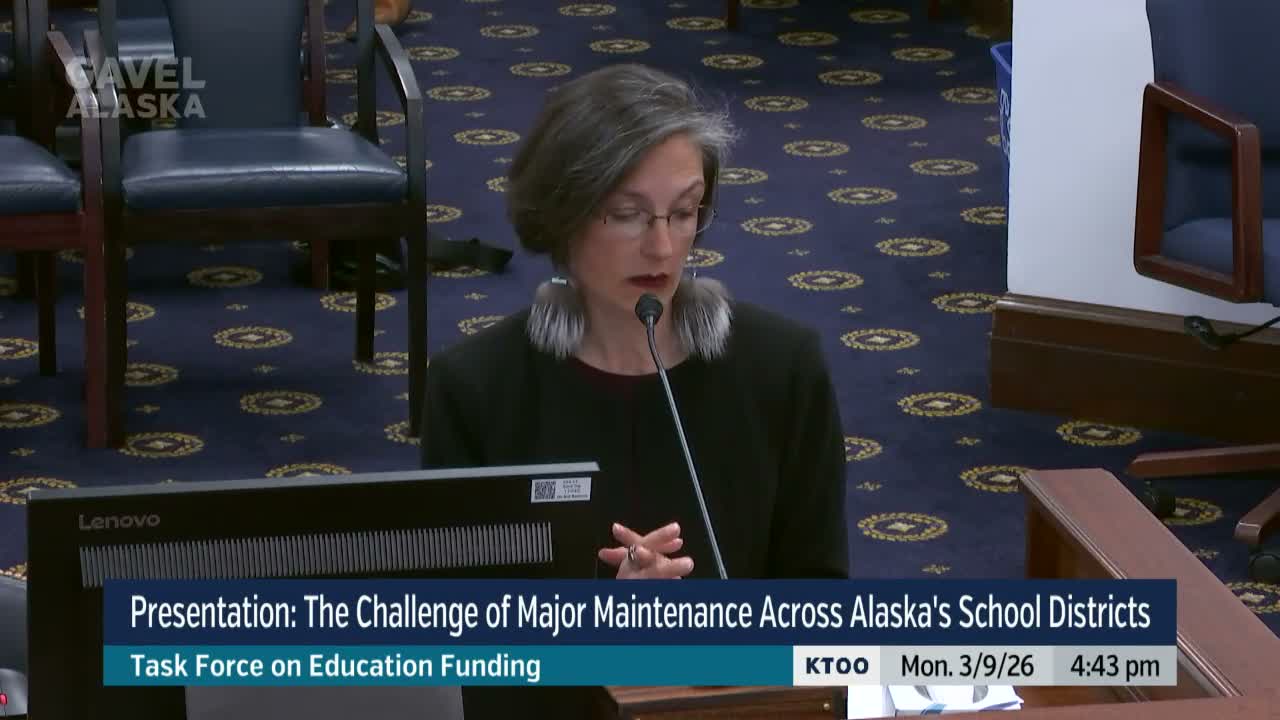
Summary
Coalition for Education Equity executive director Caroline Storm told lawmakers March 9 that many Alaska schools face aging, unsafe infrastructure and recommended a base facilities allocation, centralized condition assessments, shared regional maintenance services, and workforce investment to address mounting costs.
Juneau — Caroline Storm, executive director of the Coalition for Education Equity, told the Joint Legislative Task Force on Education Funding on March 9 that Alaska’s school buildings are aging and that deferred maintenance has put students at risk in some districts.
Storm, trained as an architect, said Alaska has 493 schools with an average age of 45 years and that many buildings built before 1980 face code noncompliance and worn systems. “Currently, we really are failing many of our children by allowing them to attend school in substandard environments,” Storm said, citing examples of collapsed walls, prolonged gym closures and schools without functioning fire suppression systems.
Storm highlighted several drivers of high costs in Alaska: remote logistics and barge service, higher labor rates (she noted welders earning $30–$60 per hour), long lead times for mechanical equipment, and materials price volatility. She said condition surveys used to rank projects can cost $200,000–$300,000 and that many small districts cannot absorb that expense.
To address those problems, Storm recommended that the legislature consider a dedicated base facilities allocation separate from general education funding, a contract model to centralize condition assessments (one firm on a cost‑plus contract), incentives for shared regional maintenance services, and investments that would restore contractor capacity and skilled labor across the state. She argued that funding the existing list would also support job creation in construction and skilled trades.
“Major systems have a useful life of about 25 years,” Storm said, urging prioritization of life‑safety and code compliance items in funding decisions and recommending policies to help smaller districts obtain assessments and move projects forward.
Task force members asked Storm about building lifespans and equipment standardization; she recommended standardizing certain components within districts or regions to lower long‑term maintenance costs, while recognizing arguments about competitive bidding.
Storm said the coalition’s recommendations are intended to reduce inequities between resource‑rich and resource‑poor districts and to shift the state from reactive repairs to preventative maintenance.
What happens next: Storm made herself available for offline follow‑up; lawmakers asked staff to gather additional detail on program design and possible funding mechanisms.