Get AI Briefings, Transcripts & Alerts on Local & National Government Meetings — Forever.
House committee advances bill limiting masks for peace officers, adopts Alaska‑specific exemptions
Summary
The House State Affairs Committee on March 5 advanced HB250 restricting masked peace‑officer anonymity but adopted targeted exemptions (medical respirators, helmets, tactical gear) after debate over constitutionality and tribal/federal applicability; the measure passed the committee 4–2.
The House State Affairs Committee advanced House Bill 250 on March 5 after adopting a set of Alaska‑tailored exemptions that narrow the bill’s original language while preserving its core prohibition on masking by peace officers in certain interactions.
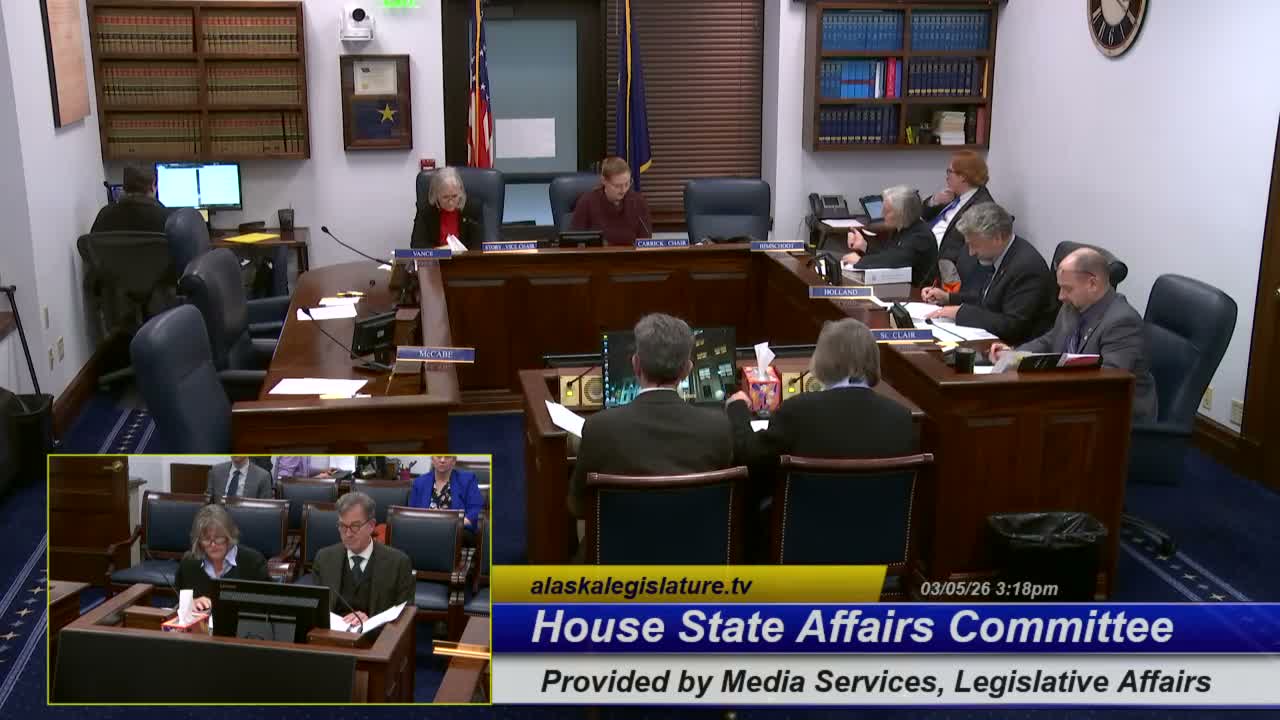
Chair Kerrick opened the fourth hearing on HB250 and moved Amendment I.5, which she said was drafted with the sponsor’s office and in consultation with the Department of Public Safety. The amendment clarifies permitted face coverings to include medical/surgical masks, air‑purifying respirators, self‑contained breathing apparatuses for smoke, gas or hazardous conditions, and adds explicit exemptions for helmet use while operating a motorcycle, snowmachine, ATV or other helmet‑required vehicles. The amendment also carves out tactical‑operation exemptions and an exception for active SWAT duties. Sponsor Representative Sarah Hannon urged members to adopt the change “in an attempt to reflect the functioning reality of Alaskan peace officers.”
Debate centered on civil‑liberties and constitutional limits. Representative Saint Clair and others raised concerns about parity and the rights of citizens to anonymity in protests; Representative Saint Clair briefly offered (then withdrew) an amendment to bar anyone interacting with peace officers from covering their face. Representative Vance and others pressed whether the bill could run afoul of the supremacy clause or separation‑of‑powers principles, noting a recent federal court preliminary injunction in California that limited enforcement of a state mask ban against federal officers. Several lawmakers asked for and received a legal memo on those constitutional issues.
The committee also considered Amendment I.8, which would have removed a criminal penalty and directed the Alaska Police Standards Council to set policy rather than creating an offense. That amendment failed on a roll call vote (2 yeas, 4 nays) after floor discussion about whether state law can or should reach federal and tribal officers and whether policy authority belongs with the Standards Council.
With those amendments resolved, Vice Chair Story moved HB250 as amended. The committee voted to advance the bill out of House State Affairs by a 4–2 margin. Chair Kerrick noted the Department of Law was not present but would provide written responses to member questions; the sponsor also agreed the bill will go to Judiciary for further legal review, including tribal‑sovereignty implications.
The committee record shows the Alaska Police Standards Council was available to answer technical questions during the hearing but said it does not currently have a standard on mask use. The committee attached fiscal notes and authorized legal services to make technical conforming changes as part of its recommendation.
Next steps: HB250 will move to its next referral (Judiciary) for additional legal analysis and any further amendment work before future floor action.