
Committee moves transmission authority bill after debate on landowner consultation, board makeup and PILT
Get AI-powered insights, summaries, and transcripts
Subscribe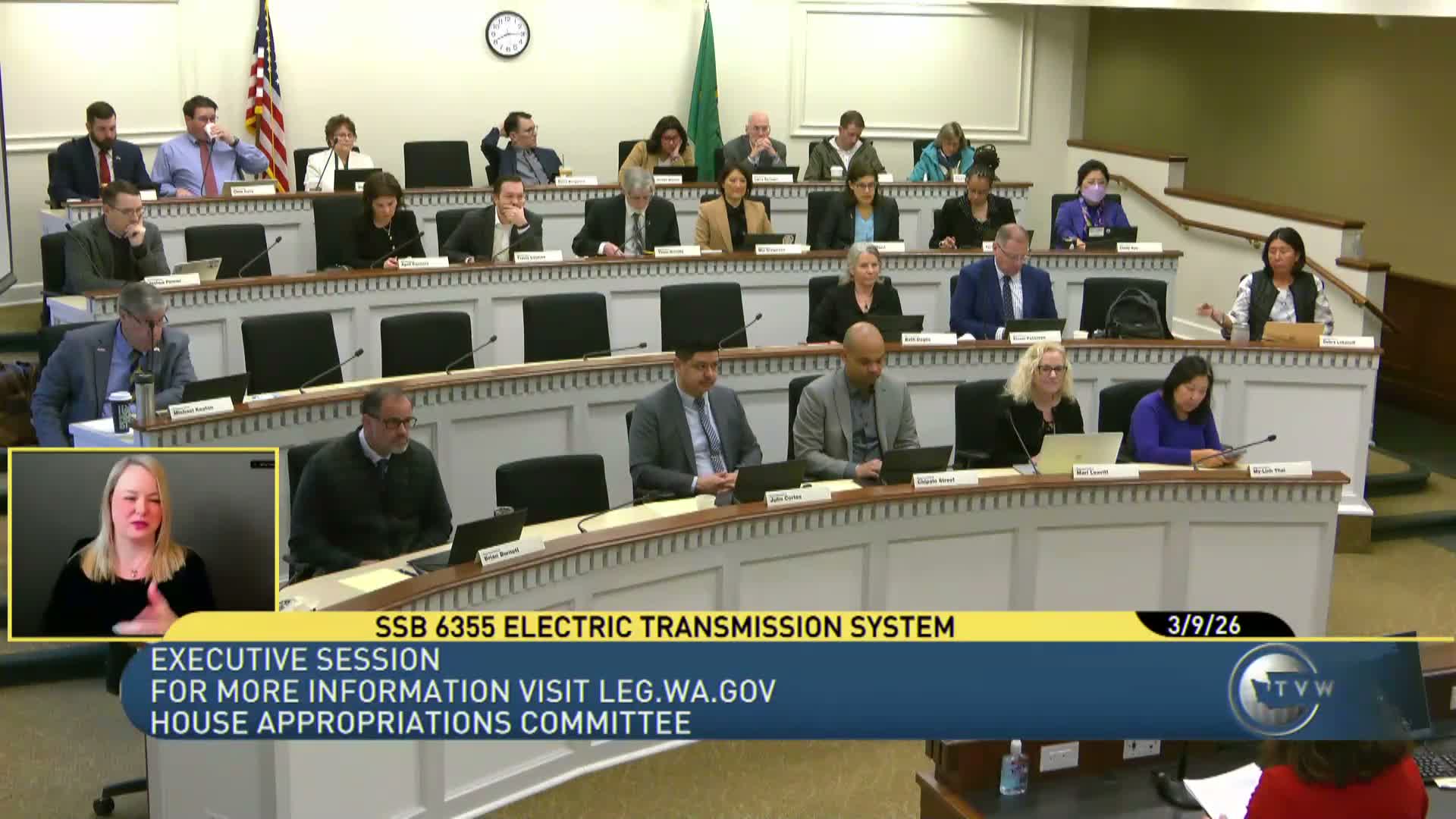
Summary
The committee reported substitute Senate Bill 6355, creating a Washington Electric Transmission Authority, after votes on amendments addressing landowner consultation, east‑of‑Cascades board residency and payments‑in‑lieu‑of‑taxes; members split over scope, eminent domain and ratepayer risk.
The House Appropriations Committee voted to report substitute Senate Bill 6355, which would establish the Washington Electric Transmission Authority, after a lengthy briefing and several amendment votes that touched on landowner consultation, board expertise and payments in lieu of taxes.
Megan McFadden, staff to the Environment & Energy Committee, told the committee the bill creates an authority and board, a tribal clean energy partnership work group and a clean energy partnership work group and allows Commerce to convene an advisory committee to review recommendations. McFadden described five amendments in the EBB that would: allow the authority to consult neighboring landowners and define those stakeholders; require board expertise in rural county land‑use planning; require at least half of the board to reside east of the Cascade crest; require written findings and public processes before corridor designation; and require annual payments in lieu of property taxes to counties for authority‑owned facilities.
Representative Dolio and others supported amendments (McFadden 187 adopted) that add rural land‑use expertise and neighbor consultation, and Representative Dye moved amendments to require representation from eastern Washington and to seek payments in lieu of taxes to offset property‑tax losses in counties. Opponents raised concerns that the authority would create an unaccountable new bureaucracy, pose ratepayer risks if it used large-scale public financing, and could expand eminent domain powers. Representative Couture cautioned that building a new state agency would not necessarily overcome permitting or siting barriers and worried about impacts on private property rights and ratepayers.
After final debate the committee recorded a roll call of 18 ayes, 11 nays and 2 excused; substitute Senate Bill 6355 as amended was reported out of committee with a due‑pass recommendation. Members noted the bill's similarity to other Western states' approaches and emphasized the need for further refinement on PILT and board composition.