
Appropriations committee advances abortion savings program after amendment fights
Get AI-powered insights, summaries, and transcripts
Subscribe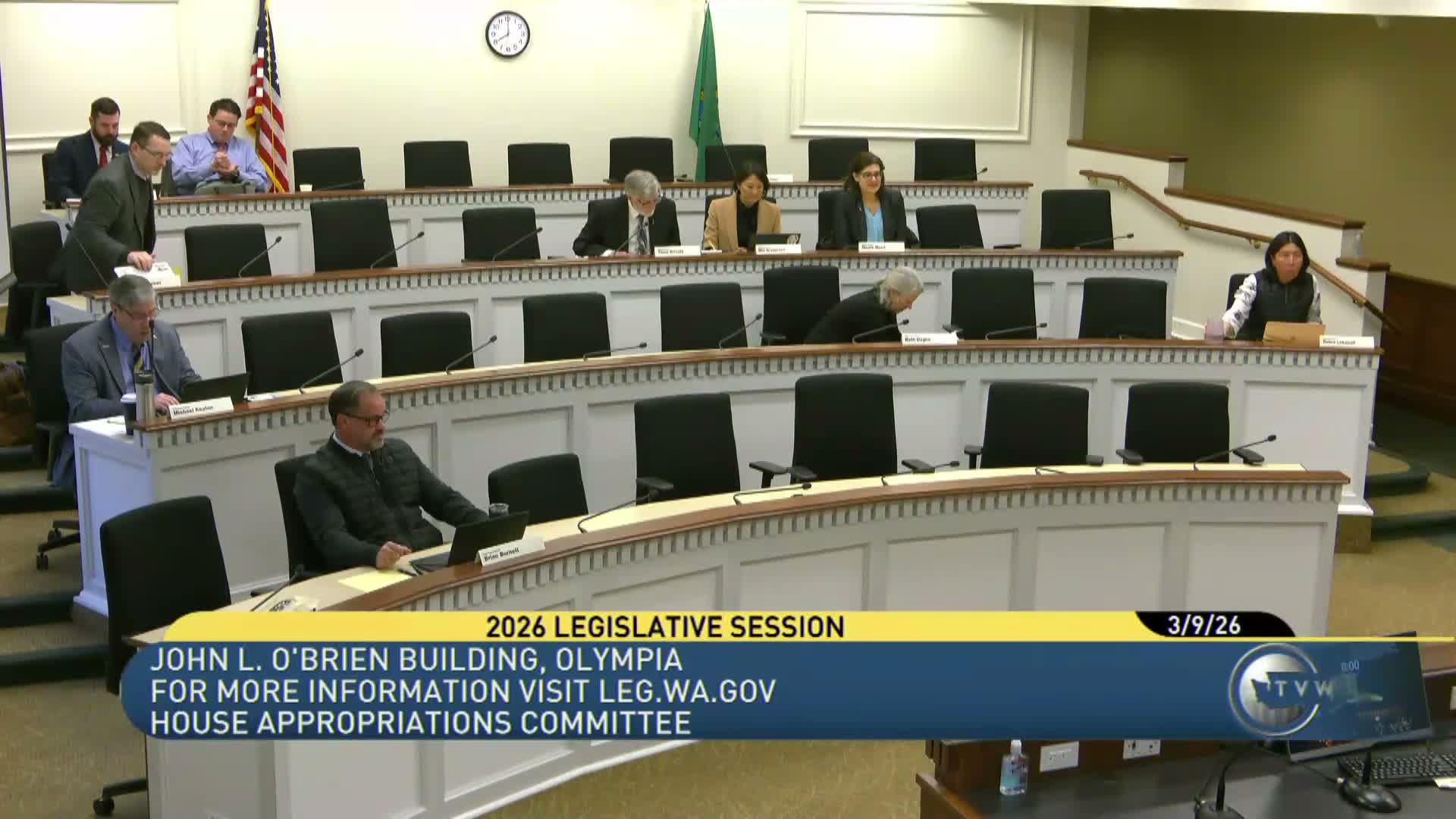
Summary
The House Appropriations Committee voted 18–10 to report second substitute Senate Bill 6182, creating an abortion savings program funded by an assessment on health carriers; members debated residency limits, a 50% set‑aside for fertility services, and a proposed sunset date.
The House Appropriations Committee voted to report second substitute Senate Bill 6182 to the floor with a due‑pass recommendation after extended debate over amendments and fiscal details.
Committee counsel Emily Stevens briefed members that SB 6182 would create an "abortion savings program" and a dedicated abortion savings account at the Department of Health, funded by an increased assessment on health carriers. Stevens said the program would generate an estimated $10,000,000 in revenue in fiscal year 2027 and about $2,000,000 annually thereafter to provide grants that "maintain access to direct patient abortion and clinical care services." (Emily Stevens, committee counsel.)
Representative Marshall led several amendment efforts seeking to restrict or reshape the program. Marshall moved an amendment (MORM 031) that would prohibit recipients of program grants from providing reproductive health care to residents of other states, arguing that "if we're gonna compel Washington families and employers to fund this new program, the very least ... is guaranteed that those dollars will be spent on Washington residents." Marshall also proposed an amendment (STEV 074) to expand eligible organizations to include in‑vitro fertilization and fertility providers and to require that at least 50% of grant funds go to those providers; and a sunset amendment (STEV 073) setting the carrier assessment and new account to expire June 30, 2031, to compel future legislative review.
Opponents, including Representative Macri, warned that residency or eligibility restrictions could interfere with clinical practice and patient safety, noting that providers sometimes treat nonresident patients for safety or confidentiality reasons. Macri said the bill responds to recent federal CMS guidance and emphasized the committee should ensure Washingtonians retain access to essential reproductive services.
The committee rejected the residency amendment (MORM 031), the 50%‑set‑aside amendment (STEV 074) and the sunset amendment (STEV 073) after debate and voice votes. During final passage the roll call, Mister Fouts announced the tally as 18 ayes, 10 nays and 3 excused; the bill was reported from committee with a due‑pass recommendation.
Supporters framed SB 6182 as preserving access after federal guidance changed how plans segregate a monthly abortion assessment; opponents framed it as a permanent mandatory assessment placed on every health plan with no opt‑out for objectors. The committee's action sends the bill to the next stage with the committee's recommended amendments and the record of the failed changes.