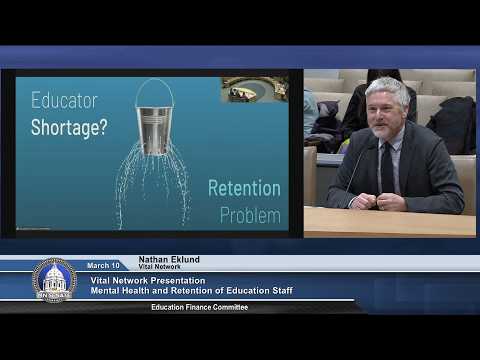
Presenters tell Senate committee staff mental health and working conditions are central to teacher retention
Loading...
Summary
Northeast Service Cooperative and Bridal Network told the Education Finance Committee that staff mental health, workload, leadership support and teacher voice drive retention; presenters cited a 1,700-respondent NESC survey and estimated turnover costs near $192 million in 2024–25 for Minnesota.
Presenters to the Minnesota Senate Education Finance Committee on March 10 linked educator working conditions to student outcomes and to persistent staffing shortages in K–12 schools, urging systemic approaches to support staff mental health and retain teachers.
Aubrey Hoover, behavioral and mental health services regional manager at the Northeast Service Cooperative, described a 2022 staff well-being initiative that surveyed more than 1,700 school staff across 16 districts and delivered district-level reports to inform local planning. "We had over 1,700 respondents," Hoover said, and added that districts used the data to tailor supports such as staff appreciation events, bus driver inclusion in trainings, calm-room spaces for dysregulated students and other implementation tools.
Presenters said the survey identified top stressors: inadequate recognition and supervision, staff shortages and workload, and student behavior and policy matters. Hoover told the committee the NESC follows up with districts through ongoing technical assistance and implementation science to avoid adding to local burdens.
Bridal Network founder Nathan Eklund and Dr. Erin Raub, the organization’s chief strategy and impact officer, presented statewide data tying working conditions to attrition. Raub said roughly 20,000 positions are open or filled by underlicensed staff and that one in three teachers leave within five years; she added that Minnesota’s teacher turnover and related costs were approximately $192 million in 2024–25. "We should pay teachers more," Raub said, while also emphasizing that working conditions and teacher voice are primary retention drivers.
Committee members pressed presenters on which day-to-day conditions matter most. Presenters identified three domains: time management (including reducing wasteful meetings), voice and decision-making (ensuring educator input is systematically incorporated) and levels of care and support (school and community systems that back educators). They recommended district-level systems that elevate educator voice and concrete practices to strengthen staff belonging and workload management.
Presenters also described a North Dakota pilot funded by that state’s legislature (initial investment 2022; extension in 2024) covering about half of that state’s educators and showing early positive outcomes. Senators requested comparative data on teacher-attraction metrics and starting pay between Minnesota and neighboring states; presenters agreed to supply state-by-state figures.
The committee did not adopt policy at the hearing; presenters offered to provide follow-up data and materials to committee members as requested.