
Committee to send bill allowing local approval of stormwater and rainwater reuse to Health and Human Services
Get AI-powered insights, summaries, and transcripts
Subscribe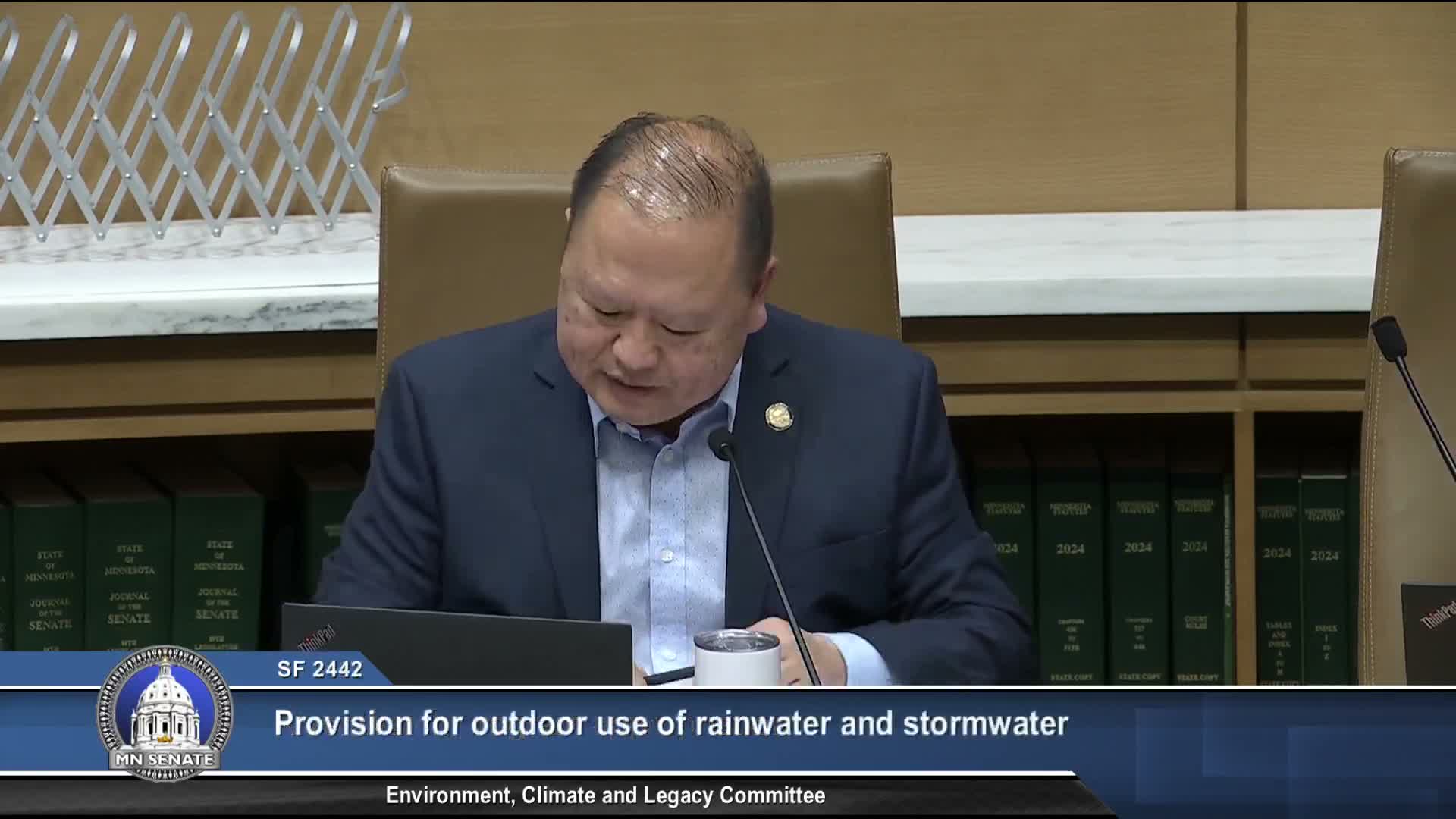
Summary
Senate File 2442, which would let political subdivisions permit outdoor use of collected rainwater and stormwater for irrigation when human or animal contact is unlikely, was amended and referred to the Health and Human Services Committee after mixed testimony on conservation benefits and public-health risks.
Sen. Weber presented Senate File 2442 to the Senate Committee on Environment, Climate and Legacy as a measure to encourage conservation by allowing political subdivisions to permit outdoor use of collected rainwater and stormwater for irrigation and similar outdoor purposes when the probability of human or animal consumption or immersion is low or nonexistent.
The sponsor framed the bill as a practical water-conservation tool that keeps treated potable supplies for uses that require them and allows local officials discretion to approve reuse as appropriate. “This is a proposal that will alleviate the use of potable water resources and will continue to lead us in the path of conservation, innovation, and sustainability,” a testifier from the landscaping industry told the committee.
Supporters included landscapers, irrigation designers and developers who cited examples across the state where stormwater reuse has been implemented, and argued the legislation clarifies existing practice and reduces demand on municipal water systems. Jeff Laterl of Heritage Landscape Supply and consultant Tim Maluli offered technical testimony on systems and low-impact development practices. Developer Rob Walcawls said many reuse systems already operate following local approvals.
Opponents warned of potential public-health risks and municipal liability if local officials are asked to approve reuse without completed state guidance. Randy Dipresh of the Minnesota Cities Stormwater Coalition said constructed stormwater ponds can contain bacteria, viruses and chemicals and urged that the Department of Health and MPCA complete guidance before the Legislature adopts permissive statewide language.
Craig Johnson of the League of Minnesota Cities told the committee city officials could be held liable if reuse is approved without clear science and urged agencies to finish stakeholder processes. The sponsor and other supporters said the bill is permissive — localities "may" approve reuse and would retain authority to require permits or deny reuse where risks exist.
After discussion, the committee referred SF2442, as amended, to the Health and Human Services Committee for further review; the sponsor and supporters said they will work through health and implementation concerns as the bill proceeds.