
Sen. Clark's mattress-recycling proposal draws industry support and retailer opposition over $10 fee
Get AI-powered insights, summaries, and transcripts
Subscribe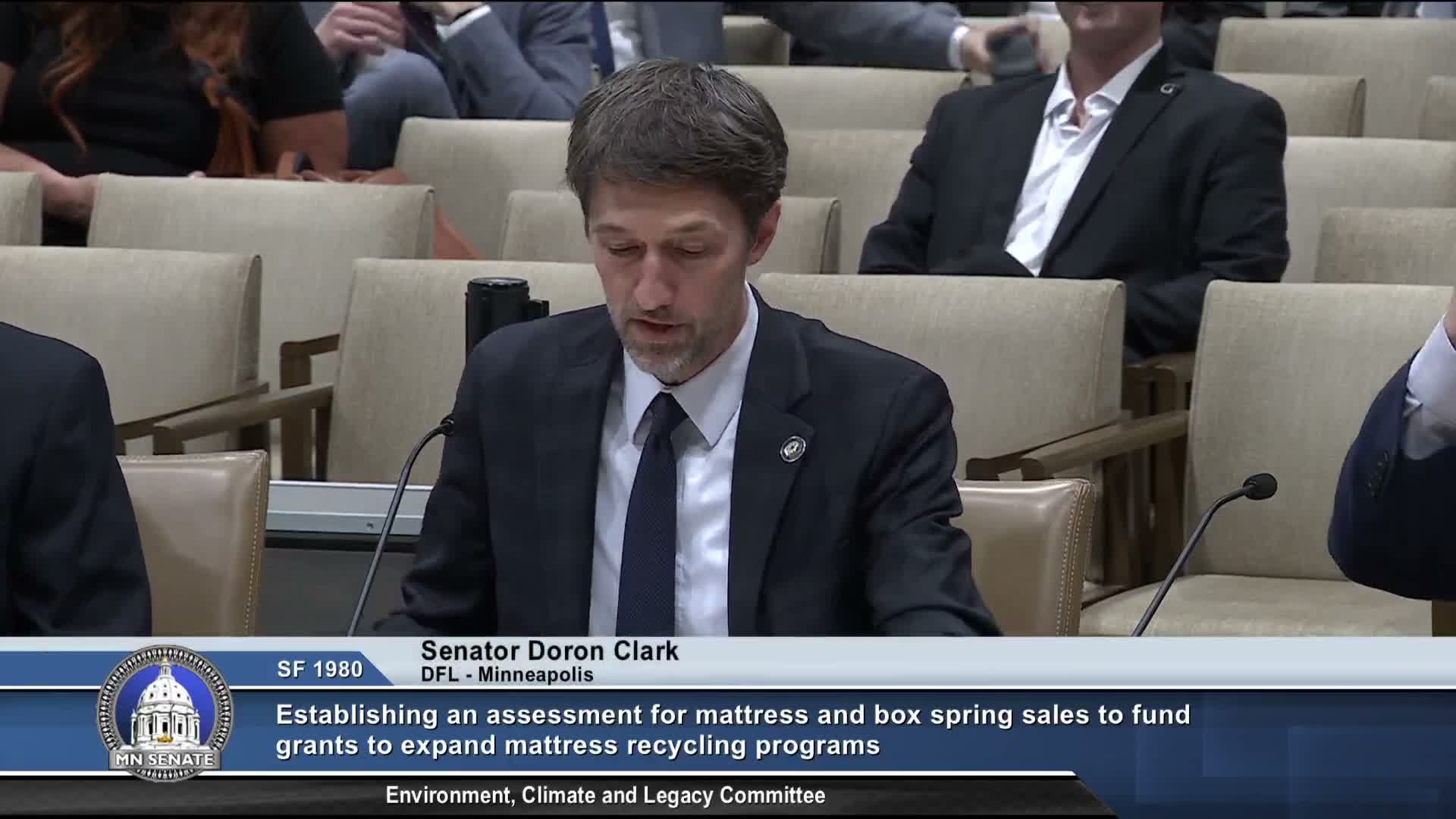
Summary
Supporters told a Senate committee mattress recycling can divert bulky waste and create jobs; retailers and business groups said the $10 point-of-sale fee unfairly burdens consumers and urged waiting for pilot results. An amendment to re-label the fee as a tax failed and the bill was laid over.
Sen. Clark on Tuesday told the Senate Committee on Environment, Climate and Legacy that Senate File 1980 creates “a straightforward product-based solution” to reduce bulky-mattress disposal and fund recycling access with a modest $10 point-of-sale recycling fee.
The proposal would return the majority of revenue to local governments to support collection and processing. “A modest $10 fee at the point of sale ensures the product helps fund its own end-of-life management, rather than shifting the cost to local taxpayers,” Clark said.
Proponents included representatives from mattress recyclers and stewardship groups who described both environmental benefits and local job creation. “We are currently the largest recycler of mattresses and box springs in Minnesota,” Kevin Engdahl of Emerge Community Development and Second Chance Recycling told the committee, adding, “Last year, we recycled nearly 90,000 mattresses.” Sean Dolan, general manager at Second Chance Recycling, said proper dismantling can recover roughly 94% of a mattress by material and that recycling is labor intensive and creates meaningful jobs.
Business groups pushed back. Will Hagen, vice president of Minnesota Retailers, said the bill places the fee on consumers at checkout, imposes compliance duties on retailers and is not a true extended producer responsibility because producers do not design or fund the program. “That fee will be paid directly by consumers at the register and collected by retailers, even though retailers have no role in designing or running the program,” Hagen said. The Minnesota Chamber also urged caution, noting a $2.8 million pilot funded by the Legislature is still underway and arguing the committee should await the program’s report before adopting a permanent statewide charge.
The committee also debated terminology. Sen. Joukowsky moved an amendment to replace every occurrence of the word “fee” with “tax,” arguing the proposal functions as a sales tax collected through the Department of Revenue. After a roll-call the amendment failed (4 yes, 5 no). A separate motion to immediately refer the bill to the taxes committee was also defeated on a roll-call.
Committee members asked for more data on volumes and costs. Testimony cited an industry estimate of about 600,000 mattresses and box springs sold annually in Minnesota and industry-recovery numbers suggesting perhaps 150,000 mattresses are recycled statewide; Clark estimated recycling costs of about $25–$35 per unit and said the $10 fee would not cover the full cost but would create predictable funding for local programs.
The committee laid SF1980 over for further work. Clark said he would follow up with members on outstanding data requests as the bill is refined.