Senate committee vets $206.9M rural health transformation plan, members press ambulance, sustainability details
Loading...
Summary
The Senate Finance, Ways and Means Committee reviewed the administration's rural health transformation plan on March 10, 2026, focusing on competitive grants for existing rural hospitals and clinics, proposed ambulance purchases and sustainability questions tied to payer rules and workforce shortages.
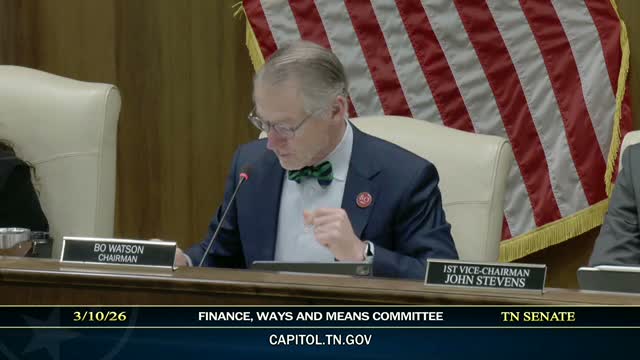
Chairman Watson on Tuesday opened a detailed review of the administration's Rural Health Transformation plan, a multi-year, competitive set of grants intended to expand high-priority service lines and strengthen health care in 89 counties designated rural.
The committee spent about an hour hearing administration officials explain 17 initiatives in the plan, including service-line expansion grants, a program to provide an ambulance to each rural county, mobile behavioral-health clinics, nonemergency medical transportation, health-technology investments and a workforce pipeline. Officials said most grants are for existing facilities; CMS guidance bars using these funds for new bricks-and-mortar construction.
Michael Hendricks, Governor Lee's policy director, said the program is designed to "add and expand high-priority service lines" and stressed it is meant "not to be a Band-Aid on a severed artery of rural health" but a backbone investment to make rural facilities more sustainable. J.W. Randolph, a deputy commissioner at the Tennessee Department of Health, said applications will be scored out of 100 points (35 community need, 35 project fit, 10 sustainability, 10 evaluation, 10 budget).
Why it matters: the federal funding would be one-time money over five years, and the administration repeatedly warned members the state must satisfy CMS conditions to avoid clawbacks and to preserve future funding. Officials cited a ballpark CMS estimate of about $8.43 million in potential clawbacks from funds already awarded and an uncertain baseline risk of roughly $10.3 million going forward if policy benchmarks are not met.
Key details and debate
- Program design and eligibility: Randolph and Hendricks said the grants are competitive and intended for existing hospitals and clinics (not new construction). They described flexible award types: about 10 specialty-care site awards and 10 behavioral-health integration awards as baseline targets, not strict caps. The administration said it has not set a hard cap on the number of awards.
- Award size: officials said prior programs averaged roughly $1.8 million to $2.0 million per award, but amounts can vary widely by project.
- Ambulance purchases and logistics: the plan designates roughly $30 million for new ambulances (about $350,000'$360,000 per vehicle under their specifications). John Webb said the state would grant the money to counties, which would purchase vehicles and enter use agreements with whichever provider (hospital or private vendor) serves that county to ensure federal procurement compliance.
- Nonemergency medical transport and sustainability questions: the committee asked how new vehicles and nonemergency transport (a separate $9 million line) will be sustained when payers do not always reimburse at full cost. TennCare representatives said TennCare does reimburse authorized nonemergency medical transportation for covered services, but other payers do not always cover those costs; administration officials said the grants should catalyze fleet, driver and coordination capacity where it is lacking.
- Mobile clinics and primary-care expansion: Matt Yancey described a mobile-clinic program grown with SAMHSA support that has expanded from two to four units and reportedly prevents an estimated 600 ER visits per clinic per year; the plan would fund two more mobile clinics and expand partnerships with local sites.
- Maternal health and workforce concerns: several senators pressed how the plan will increase birthing hospitals and workforce capacity in areas with provider shortages. Officials said recruitment, structural investments (for example, fetal and infant mortality review teams) and partnerships with the state's perinatal regional centers are part of the strategy, and a separate shared-savings request of $125 million could address capital and sustainability gaps.
- Health technology and data: the administration proposed $76 million for health-technology grants (telehealth, AI-enabled clinical tools, wearables, cybersecurity and EHR interoperability), milestone-based disbursement and procurement support to reduce negotiating burdens on small providers.
Committee reaction and next steps
Members expressed strong interest but warned about sustainability, payer reform and the difficulty of recruiting providers to rural areas. Senator Hensley noted that counties without facilities cannot access these particular grants and urged clarity on other funding avenues for those communities. Chairman Watson said the funds are effectively one-time federal dollars over five years and scheduled the expansion request for the committee's next meeting so members could review details further.
The administration emphasized audit readiness and procurement controls: officials said they are finalizing a third-party procurement consultant, building an online invoice and application system and preparing audit packages for internal and comptroller review to reduce fraud and ensure compliance.
What comes next: the committee will consider the expansion request at its next meeting and will seek more detail on award targets, county-level impacts and sustainment strategies.
Attributions: quotes and specific program descriptions are attributed to Michael Hendricks (Governor Lee's policy director), J.W. Randolph (TDH deputy commissioner for public health infrastructure), John Webb (TDH chief of staff/deputy commissioner for operations), Matt Yancey (Deputy Commissioner, Tenn. Department of Mental Health and Substance Abuse Services), and TennCare representatives who answered sustainability questions.