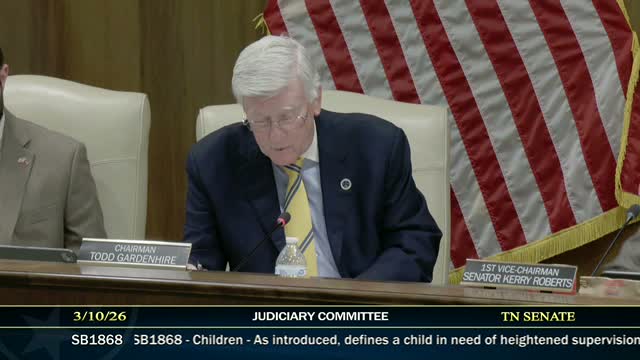
Senate panel advances juvenile‑commitment task force bill while debating a new six‑month extension for assaults on staff
Loading...
Summary
The Senate Judiciary Committee advanced an administration bill to create a juvenile commitment review task force and added a narrow six‑month extension for delinquent youth who assault residential‑placement staff; advocates warned the extension risks unintended harm and due‑process gaps while the Department of Children’s Services said the change targets a narrow population.
The Tennessee Senate Judiciary Committee on Wednesday approved an administration bill establishing a juvenile commitment review task force and a controversial provision that would allow courts to extend a delinquent youth’s commitment by six months after an assault on a staff member.
Sponsor Sen. Waller described the bill as a tool to study and address “crossover youth” — young people who have both dependency/neglect and delinquency involvement — and to identify gaps in placement, treatment and court processes. The amendment requires the Department of Children’s Services (DCS) to report findings and recommendations to the governor and General Assembly by Feb. 1, 2027.
“This task force will review available data and develop recommendations to improve treatment options, placement availability and interagency coordination,” Waller said. He added the extension provision would apply only when an assault on staff occurs in a residential placement and that the measure aims to give courts an additional tool when warranted.
Jasmine Miller, senior attorney at the Youth Law Center, testified in opposition to the six‑month extension and urged the committee to consider risks to treatment capacity and due process. “The portion of the bill about the six month sentence extensions would allow youth sentences to be extended,” Miller said, arguing the provision could leave youth in expensive treatment beds longer or push them back into temporary placements or detention. She noted that beds can cost about $600 a day and said forcing more time in treatment without clearer procedural protections could worsen the problems the task force is meant to fix.
Miller also raised due‑process questions: the bill’s text, she said, suggests the extension could occur without a delinquency adjudication and does not clearly require prosecutor involvement, counsel for the youth or a defined standard of proof. “Whether the child has counsel? Is this decision appealable? This all gets complicated very quickly,” she said.
Jim Layman, speaking for DCS, said the amendment targets a very narrow population — delinquent youth already adjudicated and in DCS custody under the health‑and‑safety exception — and argued it provides a judicial avenue when law enforcement does not bring charges for assaults on staff. “This is a very narrow population that this will end up affecting,” Layman said, and he said juvenile judges worked with the department on the approach and would ensure due process before any enhancement.
Committee members pressed both witnesses about where the extension would apply and whether private operators could be incentivized to keep youth longer. Rep. questions highlighted recent reports and past facility audits, with some senators expressing concern that the paragraph creating the extension lacked sufficient safeguards. Senator Roberts and others said they wanted internal controls to prevent misuse; one committee member described the provision as a “red flag” without more built‑in protections.
After extended questioning and debate, the committee voted to approve the measure as amended. By roll call the bill was reported favorably and sent to the Senate Finance Committee with a vote of 6 ayes and 3 noes.
Next steps: DCS is required by the amendment to report to the governor and legislature by Feb. 1, 2027; the task force must deliver its recommendations by July 1, 2027, per a later bill discussion. The Finance Committee will receive the bill for further consideration.