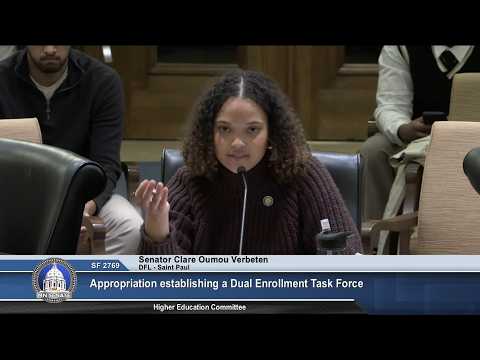
Senate committee approves dual‑enrollment funding task force after broad testimony on access and funding
Loading...
Summary
Lawmakers approved SF 2769 to create a time‑limited task force to study dual‑enrollment funding (PSEO/dual credit). Supporters urged attention to access, transportation, and equity; witnesses recommended broader stakeholder and faculty representation. The bill, as amended to add stakeholders, was referred to State and Local Government.
Senator Umu Rebedin introduced SF 2769 to create a task force charged with a data‑driven review of how Minnesota funds dual‑enrollment programs (including PSEO), focusing on funding gaps, regional cost variation, administrative burdens and equitable access. "We were one of the first states in the nation to pass a dual‑enrollment law in 1986, and it’s one of our most effective tools to reduce college costs," the senator said.
The committee adopted amendment A7 to add stakeholders, including additional faculty representation, tribal colleges and distinctions between two‑year and four‑year institutions. Supporters at the hearing included Beatrice Hanlon (president, People for PSEO), Pranav Sriram (executive director, People for PSEO), Joe Nathan (founder/former director, Center for School Change), Khalik Rogers (executive director, Catalyst for Systems Change) and Mark Grant (representing Minnesota State College Faculty). Witnesses emphasized PSEO’s long record of saving money for students and taxpayers and urged that the task force include students and families with lived experience.
Some senators asked for additional district‑level perspectives and cautioned about unintended effects. Senator Duckworth noted prior litigation over changes to PSEO and urged caution so the study does not create pathways that could reduce student access. Several members raised concerns that changes to funding formulas could disadvantage small or rural districts or threaten campuses that rely heavily on PSEO enrollments. Committee members stressed that the task force should keep the interests of students central and avoid diverting PSEO dollars away from tuition support.
The committee approved SF 2769, as amended, and referred it to the Committee on State and Local Government by voice vote.
What happens next: SF 2769 will be considered by the Committee on State and Local Government, which may refine task‑force membership, scope, and deliverables.