Lifetime Citizen Portal Access — AI Briefings, Alerts & Unlimited Follows
Senate committee hears cultural and legal case for recognizing wild rice’s “inherent right”; amendment fails
Loading...
Summary
Supporters and tribal representatives urged the Senate committee to add language recognizing wild rice’s inherent right to exist and thrive; state agencies warned the wording is vague and could invite litigation. An amendment to strike the language failed on a 7–5 roll call and SF 3749 was laid over for possible inclusion.
Senator Mary Kunish presented Senate File 3749 to the Minnesota Senate Committee on State and Local Government, asking the panel to add one sentence to the statute that describes Minnesota’s state grain to "recognize the inherent right of uncultivated wild rice to exist and thrive in Minnesota."
Supporters — including Anishinaabe harvesters and tribal representatives — framed the change as a narrow, species-level policy to honor treaty obligations and protect manoomin. "We only want to hold on to Oshkanegan," testified Annie (Annette) Humphrey of Leech Lake, who said the rice she brought to the committee was harvested on Leech Lake and described wild rice as central to Anishinaabe identity and subsistence.
Jessica Intermill, a treaty-rights attorney and strategic policy consultant at Minnesota Interfaith Power & Light, told the committee the proposal "is not a trespass action" but a jurisprudential and cultural shift meant to recognize the plant as a living entity and to help fulfill U.S. treaty obligations, including the 1837 treaty that specifically guaranteed the right to gather wild rice.
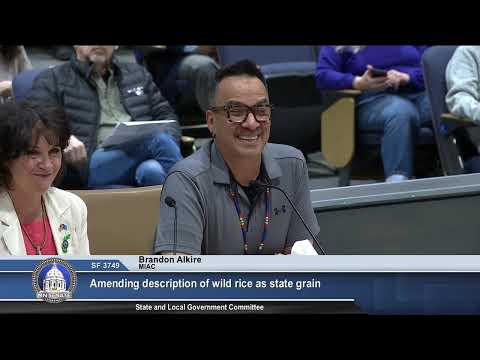
Tribal and allied witnesses emphasized ecological benefits and documented declines. "Studies show that wild rice contributes to improved water quality," said Brandon Elkayer, interim director of the Minnesota Indian Affairs Council, arguing the plant supports biodiversity and filters pollutants. Patty O'Keefe of Vote Solar cited a statistic the committee heard repeatedly: "In the last hundred years, we've lost one-third of wild rice watersheds," and estimated continued annual losses of 5–7 percent.
State agencies expressed support for protecting manoomin but warned the proposed wording is imprecise. Tom Johnson, director of government relations at the Minnesota Pollution Control Agency, said the MPCA is "committed to continuing to protect wild rice" but that the addition of an "inherent right" clause could "massively complicate agency decision making" because terms such as "thrive" are difficult to operationalize. Bob Meyer, assistant commissioner at the Department of Natural Resources, said the DNR manages tens of thousands of acres of wild rice and that the language could be cited in litigation; he noted the agency has previously faced litigation involving wild rice.
Committee debate focused on hypotheticals and legal consequences: would the language require agencies to take actions such as hazing birds from rice beds, or could it create standing for new lawsuits? Senator Drazkowski moved to amend the bill by striking the inherent-right language, arguing the change would protect the state and taxpayers from a new wave of litigation. The amendment was put to roll call and failed by 7 noes to 5 ayes. The committee laid SF 3749 over for possible inclusion.
Outcome and next steps: The amendment to strike the inherent-right sentence was defeated in committee (vote: 5 ayes, 7 noes). The bill itself was laid over for possible inclusion; no final enactment occurred in this hearing.