Get Full Government Meeting Transcripts, Videos, & Alerts Forever!
Get email alerts on the Zoning Reform topic
No spam. Unsubscribe anytime.
Gallatin County Commission narrows zoning reform direction, prioritizes growth-area approach
Summary
After months of outreach, county planners outlined three reform options; commissioners directed staff to prioritize growth-area (option 4) reform for the Belgrade–Bozeman–4 Corners/Gateway corridor while developing templates for later work in rural areas.
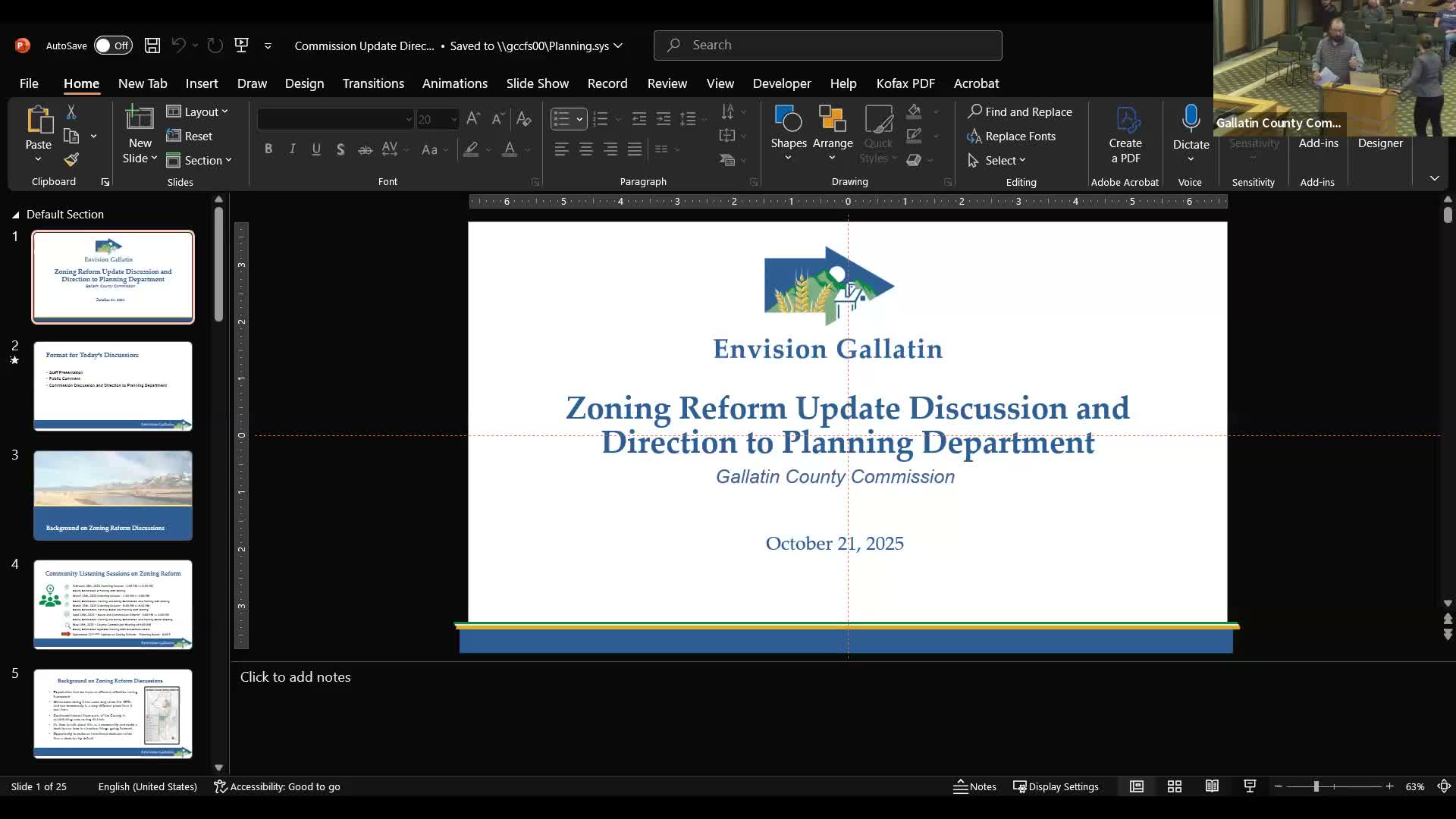
On Oct. 21, 2025, the Gallatin County Commission heard a detailed update from planning staff on options for countywide zoning reform and directed staff to prioritize a growth-area focused approach for the county's highest‑pressure corridors.
"We started community discussions concerning zoning reform back in February," said Sean O'Callaghan, the county's chief planning officer, who summarized listening‑session input, issues with the county's long‑standing patchwork of districts, and four options the commission had asked staff to study more closely. O'Callaghan told commissioners the county has 22 separate zoning districts with inconsistent terms and procedures that make administration and public understanding difficult.
Megan, a planning staff member who led the option analysis, told the commission staff had examined three pursued options in detail: a zoning‑district "menu" that would allow landowners to opt in to pre‑defined regulation sets (option 3); a growth‑area focused reform that would zone or reform zoning in mapped high‑growth corridors (option 4); and a straightforward effort to zone all currently unzoned areas (option 5). She described tradeoffs: the menu approach can be participatory but risks low engagement and complexity, option 4 is more straightforward for public comment and addresses cumulative impacts in pressured areas, and option 5 would provide guardrails but risks leaving implementation gaps elsewhere.
Public comment reflected a range of views. "I support option number 4. I believe it is the best, and we have to have something happen pretty quickly the way this is growing in this valley," said Walter Nixon, who addressed the commission in person. Virginia Kelly, a resident of an unzoned part of the county, said she "would encourage more of an option 5 approach," but added that a light‑touch option 4 would still be progress for rural residents who want some protections. Chow Miao told commissioners he wants any county reform to guarantee the sanctity of citizen‑initiated zoning districts.
Commissioners focused discussion on where effort would be most effective. One commissioner said the county should align zoning reform with existing plans and target growth near services and infrastructure to keep service costs and taxes under control. Another emphasized legal and logistical feasibility, saying the county should avoid approaches that would be derailed by procedural hurdles. Several commissioners pointed to a triangle of particular concern — Belgrade, Bozeman, and the 4 Corners/Gateway corridor — and said prioritizing that geographic wedge would yield the greatest short‑term benefits.
The commission recorded general consensus to direct planning staff to proceed primarily with option 4 — a growth‑area reform — and to begin defining the growth‑area boundary, develop outreach materials, and return with tangible next steps. Sean O'Callaghan said staff will draft a boundary map and outline engagement and implementation tasks for the next hearings.
Next steps: planning staff will prepare the growth‑area boundary proposal and public outreach materials and return to the commission and planning board for additional hearings and direction.