Get Full Government Meeting Transcripts, Videos, & Alerts Forever!
Get email alerts on the Housing Policy topic
No spam. Unsubscribe anytime.
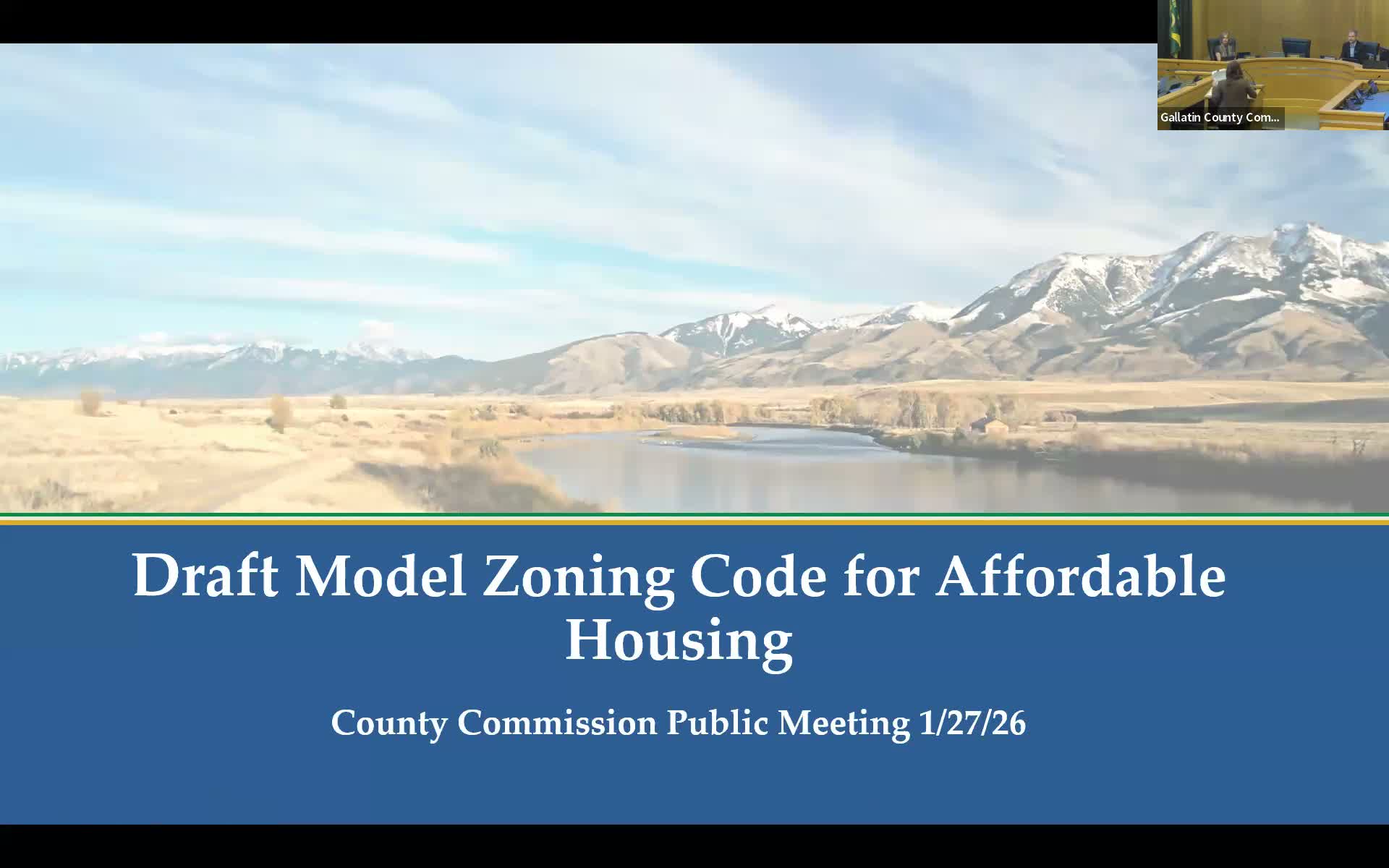
Draft model zoning code for affordable housing draws sustained public comment over short‑term rental provisions
Summary
Staff presented a draft model zoning code aimed at reducing zoning barriers to affordable housing; public commenters and counsel raised legal and policy concerns—especially over proposed short‑term rental rules—and commissioners said the draft is a non‑regulatory menu to be revised based on feedback.
Gallatin County planning staff on Jan. 27 presented a draft "model zoning code" intended as a menu of options to help local communities and the county consider zoning changes that could support affordable and attainable housing. The presentation prompted extensive public comment—primarily focused on proposed short‑term rental (STR) provisions—and legal concerns about owner‑occupancy and owner‑presence requirements.
Ashley Burke, county planning (speaker 6), opened the presentation by summarizing the project background and timeline: the draft was released Dec. 15 for public comment, the feedback form was open through Jan. 31, 2026, and staff expects to finalize and publish the code later in 2026; Burke said the draft is "not an adopted document, so it's not a regulation" and described it as an optional resource for future zoning updates.
Key elements in the staff presentation
- Purpose and scope: The model code is intended to remove zoning barriers (for example, minimum unit sizes and restrictions on manufactured homes), allow ADUs without a special permit process, and tie standards to a future land‑use map that accounts for infrastructure and sensitive lands. Burke emphasized the draft is an example code tailored to four feature land‑use categories (urban growth area, rural growth area, public infrastructure holding area and managed growth area).
- Affordable‑housing incentives: An optional, voluntary incentive program would grant density and dimensional relaxations to developers who restrict at least 10% of units in perpetuity (rent restricted at 60% of area median income or less; ownership units restricted at 120% AMI or less). Incentives could include density bonuses (example: community business in UGA up to 15 units/acre by right, 25 units/acre with affordable housing), an additional story of height and reduced parking minimums.
- STR provisions: The draft includes an owner‑occupied distinction and a permitting/registration pathway intended to protect neighborhood quality and public health and safety. Burke said short‑term rentals are not disallowed across the example subdistricts, but the draft treats owner‑occupied units more permissively and restricts non‑owner occupied units in some contexts. Staff noted concerns from fire districts about inspection capacity and recommended tailoring STR provisions for resort areas.
Public reaction and legal concerns
Public comment—both in the room and on Zoom—focused heavily on STR restrictions. In‑room and Zoom commenters argued that limiting STRs would harm legacy property owners who rely on rental income, would not create affordable housing in the way proponents suggest, and risks displacing owners to wealthier buyers. Several speakers requested that any new restrictions be applied prospectively and that existing, lawfully established uses be grandfathered.
An attorney appearing by Zoom (speaker 20) said her firm filed a lawsuit on behalf of property owners challenging similar STR restrictions in the 4 Corners RRA district and urged the county to remove owner‑occupancy and owner‑presence requirements from the model code’s STR section (2.6), citing potential dormant‑commerce‑clause and state statutory issues. Speaker 20 recommended handling STR policy in a separate forum and cautioned that the draft language could be difficult to unwind later.
Commission response and next steps
Commissioners and staff repeatedly described the document as a "menu" or resource—not current county regulation—and said future adoption or use would require separate local processes and additional community engagement. Ashley Burke confirmed the county received a $30,000 Montana Department of Commerce grant to support the drafting effort and said staff will compile public feedback, review legal issues raised in comment and return with revisions for potential acceptance later in 2026.
Representative quotes
- Ashley Burke (county planning): "It will not be an adopted document, so it's not a regulation."
- Public commenter (speaker 8): "This STR is really important to my veteran disabled landlord... If he's forced to sell, this 68‑year‑old disabled woman... has got nowhere to go."
- Stephanie Bacchus (attorney): "Earlier this month our firm filed a lawsuit on behalf of property owners in the 4 Corners RRA district challenging certain short term rental regulations... I respectfully encourage the commission to reconsider and revise or remove section 2.6 of the model code."
What to watch for
Staff will analyze the feedback submitted through Jan. 31, 2026, revise the draft as needed (including attention to the legal issues raised), and aim to present the model code for commission acceptance later in 2026. Any eventual regulatory changes would follow separate public hearing and adoption processes required by state law.