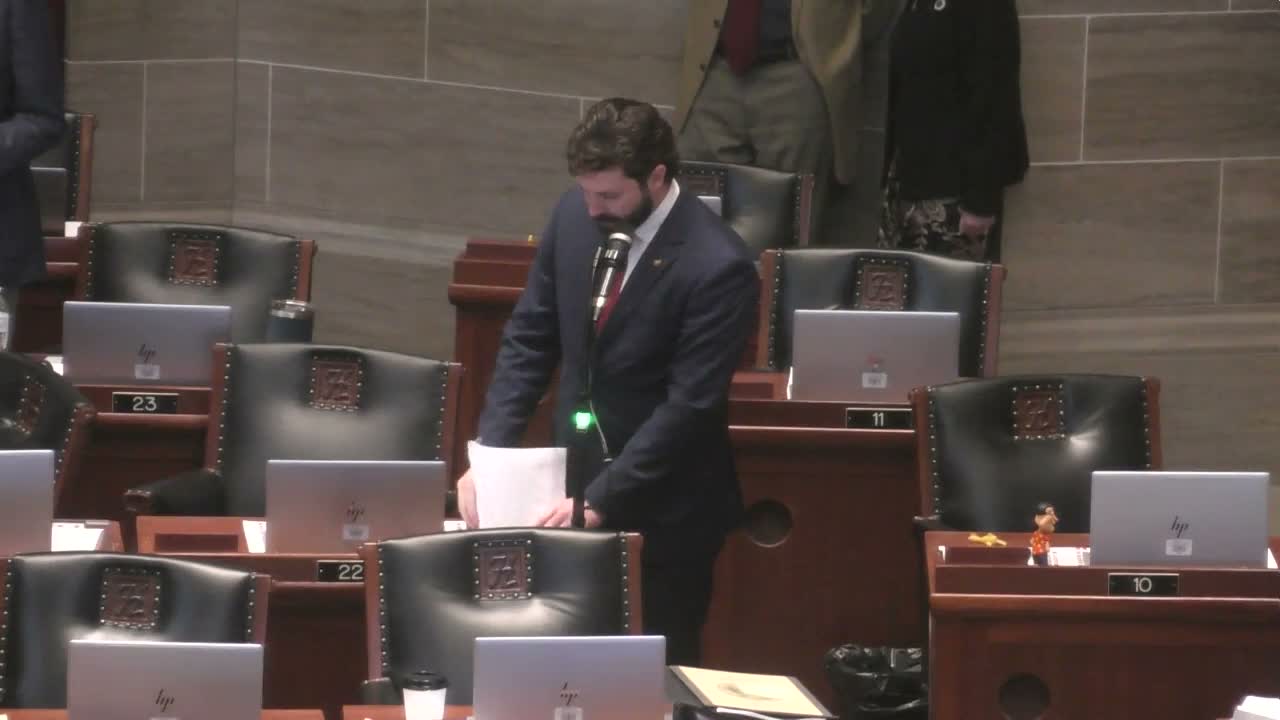
Missouri House perfects constitutional amendment to phase out income tax after heated floor debate
Loading...
Summary
The Missouri House voted to perfect a House Committee Substitute for HJR 173 and 174, a constitutional amendment to phase out the individual income tax via revenue-growth triggers and authorize limited sales-use tax base changes; supporters said it returns money to Missourians, opponents warned it would shift the burden to consumers and risk cuts to schools.
The Missouri House on March 9 debated and perfected a constitutional amendment that would phase out the state individual income tax over time and authorize the Legislature to modernize the sales-and-use tax base to offset revenue changes.
Representative (Greene County), the bill sponsor (S17), told colleagues the amendment ties incremental reductions in the individual income-tax rate to growth in net general revenue collections, with small, repeated reductions of 0.01 percentage point triggered when net general revenue grows by $20 million (adjusted for inflation). The sponsor said the mechanism is designed to be revenue neutral over time, and that if the individual income-tax rate would fall below 1.4 percent in any year, the rate would instead be set to 0 percent as a practical "break-even" point cited by the Department of Revenue. He described the measure as giving Missourians a choice at the ballot box and argued it would spur growth and opportunity.
Opponents across the chamber disputed the projected fiscal and distributional effects. Multiple members cited the fiscal note range discussed on the floor (figures cited between roughly $7.7 billion and $8.5 billion) and warned that eliminating the income tax would require either large sales-tax increases or expansion of the sales-tax base to services (for example, attorneys' fees, lawn care, accounting, rent and many everyday services). Representative (Saint Louis City) (S21) called the plan a "bait and switch" that could raise sales taxes on groceries, medical visits and home repairs and argued the ballot language does not disclose the constitutional changes it authorizes. Other critics said the plan could be regressive and harm seniors and low-income households.
Supporters countered that the amendment includes guardrails: any sales-and-use tax base expansions enacted "for the purpose of" eliminating the income tax must include legislative findings and are constrained by provisions intended to keep the overall approach revenue neutral; the text requires local adjustments so that local governments do not receive an unintended windfall from any base expansion, and it says public-school funding cannot be reduced by local adjustments. Sponsors also said the measure phases reductions over time and requires auditor estimates and trigger thresholds designed to prevent sudden revenue shortfalls.
Floor exchanges focused on technical mechanics: how the $20 million trigger is adjusted annually for inflation (CPI), how the 0.01 percent steps compound, the 1.4 percent break point, and which constitutional provisions are amended or left in place (members discussed Article X and specific subsections during a line-by-line floor Q&A). Several members asked for numeric models; the sponsor and colleagues cited internal analyses and Department of Revenue figures in response.
On procedure, the House first voted to order immediate consideration (motion to move the question), a procedural roll call that passed 92–42. The House Committee Substitute was adopted by voice and then perfected and printed after a recorded roll-call vote that was 85–48 in favor. Earlier in the session the chamber had approved the daily journal by roll call (117–1).
The sponsor said the HCS will go forward to the next steps in the constitutional-amendment process; opponents urged caution and criticized the ballot summary for not listing specific future tax base changes. The House recessed after announcements and committee scheduling.
The House action does not itself change tax law: it perfected the committee substitute for House Joint Resolutions 173 and 174 for further processing and placement on the ballot if the constitutional-amendment process continues.