
MOIA commissioner Faiza Ali outlines staffing, hotlines and legal‑service investments and backs signage and contract limits
Get AI-powered insights, summaries, and transcripts
Subscribe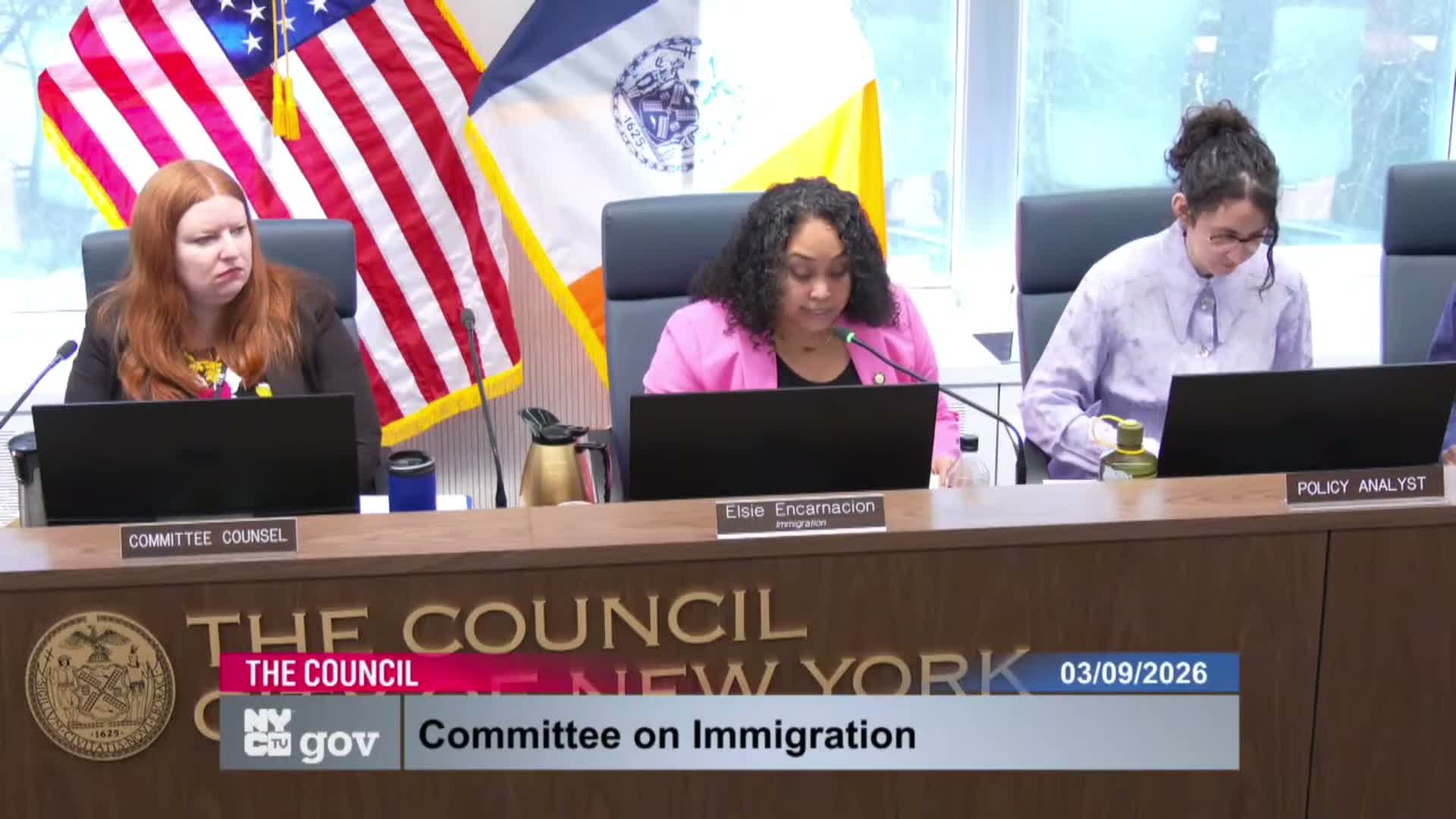
Summary
New MOIA commissioner Faiza Ali told the City Council Committee on Immigration that her office is rebuilding capacity, expanding legal support centers and hotlines, and will work with the council on Intro 55 (Know Your Rights signage) and Intro 261 (limits on contracts with immigration‑enforcement entities). Audits under Executive Order 13 are due in early May.
Faiza Ali, the newly appointed commissioner of the Mayor's Office of Immigrant Affairs, told the New York City Council Committee on Immigration that her office is focused on turning sanctuary‑city values into enforceable practice and bolstering services for immigrant New Yorkers.
In testimony and a lengthy question‑and‑answer session, Ali described a MOIA that is rebuilding capacity after prior years of constrained authority. She said MOIA has a network of 35 community‑rooted immigration legal support centers created with roughly $18,000,000 in investments over three years and that those centers have conducted about 7,500 comprehensive legal screenings since the program’s July 2025 launch. Ali also said MOIA’s immigration hotline received more than 26,000 calls in calendar 2025 and later provided a July 2025–February 2026 figure of 13,912 calls with 13,357 answered.
"We will also work alongside senior administration leadership on the interagency response committee to provide guidance on preparing and responding to crises," Ali said, describing the role MOIA will play under Executive Order 13, which requires public‑safety audits and interagency coordination.
The committee used the hearing to press Ali on operational detail: how many MOIA staff are on payroll, whether MOIA has in‑house counsel for detainer questions, and how the office will coordinate with agencies such as the New York Police Department, the Department of Correction and the Department of Education. Ali said MOIA’s current direct headcount on its own lines is small (between four and five), with a broader team of roughly 60 staff including personnel detailed from other agencies. She said MOIA currently has legal counsel on staff and external partnerships to support rapid response work.
Council members also pressed on the office’s role in accountability. Ali described EO13’s interagency response committee and said that mandated public‑safety audits — due in early May — will inform where agencies need to improve training, policies and compliance with Local Law 228 and other local requirements. "Part of the audit is to reveal where gaps are on training, and so we're hoping to learn more information from that," she said.
On the legislation before the committee, Ali said MOIA supports Intro 55, the New York City Know Your Rights Act, and will work with sponsors to refine bill language. Intro 55 would require MOIA, in consultation with the Law Department, to develop multilingual signage explaining sanctuary protections and identifying non‑public spaces on city property. Ali also expressed support for consultation on Intro 261, a bill to prohibit the city from entering contracts with entities that carry out immigration enforcement activities.
The hearing included detailed operational exchanges about Project Open Arms (a DOE‑MOIA school safety coordination effort), outreach to storefront businesses, whether training materials are in plain language, and how MOIA plans to disseminate time‑sensitive policy changes to communities. Ali said MOIA distributes Know Your Rights materials online and through community partners and LinkNYC screens and that materials are written in plain language and multiple languages.
The committee received written and in‑person follow‑up requests (for breakdowns of hotline usage, numbers of Project Open Arms districts, and counts of trainings). Ali committed to providing additional data and to continuing the conversation in future oversight hearings.
The committee did not vote on either Intro 55 or Intro 261 at the hearing; staff and advocates said MOIA’s cooperation on implementation details would be important to the bills’ success.
What happens next: the public‑safety audits required by Executive Order 13 are due in early May; committee members and advocates said they expect follow‑up hearings and additional requests for data from MOIA.