
Los Alamitos board advances first reading to cap outside coursework at 40 credits, requires juniors to enroll full school day starting with class of 2029
Get AI-powered insights, summaries, and transcripts
Subscribe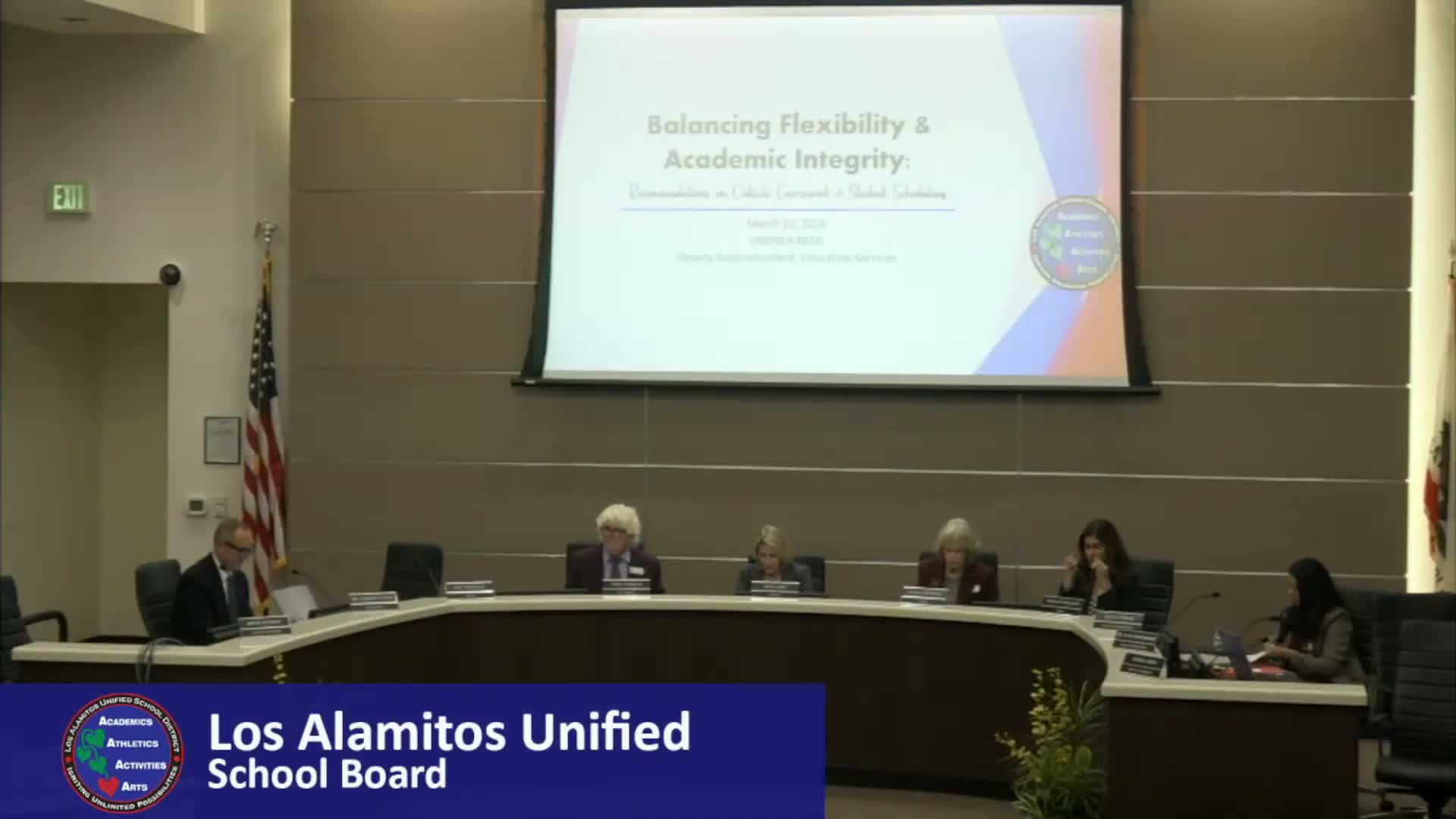
Summary
District staff presented committee findings showing steady off-site coursework in social science fields, and recommended a two-phase policy set: a 40-credit cap for outside coursework, clarified transcript rules and requiring juniors to be enrolled in six courses (five on campus) starting with the class of 2029; the board approved the first reading and set the second reading for April 21.
Mrs. Reed, the district staff lead on the outside coursework committee, told the Los Alamitos Unified School District Board that the committee’s work has been focused on equity, transcript clarity and preserving the integrity of the high school diploma.
"The new language we're proposing is no more than 40 credits of outside coursework may be allowed to count towards credits of graduation requirements, and that all outside coursework must have prior approval," Mrs. Reed said, presenting the committee’s recommended language for a first reading of a revision to Board Policy 6146.1.
The committee traced its inquiry back to 2018, when counselors and teachers reported unusual off-campus enrollment patterns. Reed said the district’s Griffin Connections program — the district-run summer/alternative offering — reduced outside social-science enrollments by 52% in its first post-implementation summer, but that social-science courses remain the largest category taken off campus.
Reed summarized student-course patterns for recent graduating cohorts: "Approximately 14 percent of students completed one core social science course off-site, about 6.5% completed two, and 1 to 3% completed all three of the core history social science courses," and noted that many students who take one off-site course replace it with an AP or arts course on campus.
The committee recommended a two-phase approach: adopt the foundational board policy changes now, then follow with a comprehensive administrative regulation. The proposed policy elements include prior approval for outside coursework, transcript rules that only preapproved courses counting toward graduation or A–G requirements will be added, and a 40-credit district cap (10 units per year suggested by committee comparisons with other Orange County districts).
To address schedule and staffing impacts, Reed said the committee recommends requiring juniors to be enrolled in six courses each semester — five of which must be on campus — beginning with the class of 2029. That requirement would be accompanied by a formal waiver process for exceptional circumstances and by efforts to restore or add campus courses such as a work-study period that can count as a sixth course.
Board members asked for clarifications about seniors and students who take alternative programs. Mrs. Davidson emphasized the district’s funding constraints and the need to advocate for resources: "We are the lowest funded, unified district in Orange County," she said, urging continued staff work on the policy and communication strategy so families understand the changes.
Several members flagged the need for equitable waiver processes and for more student input on why many juniors are enrolled in five-period days. Reed said counselors reported many reasons: a preference to finish early, jobs or internships, or heavy AP loads; the committee recommended a year to phase in changes and to restore campus offerings so students retain flexible, rigorous options.
Board member Mr. Forham moved to approve the proposal as a first reading. The motion was seconded and the board approved the first reading during the meeting; the board agreed to return with a second reading at its regular meeting on April 21 to allow additional community engagement and to finalize related administrative regulations.
What happens next: Staff will draft a full administrative regulation to accompany the policy amendment, flesh out waiver criteria and timelines, continue outreach to families and counselors, and reconvene the committee annually to review data and impacts.
Why it matters: The policy would formalize practices that now vary across cases, limit the amount of off-campus coursework that can count toward graduation, and aim to protect program integrity, master-schedule stability, and equitable access to campus-based learning opportunities.