
Council committee hears HPD plan to overhaul third‑party transfer program in 'Safer Homes Act'
Get AI-powered insights, summaries, and transcripts
Sign Up Free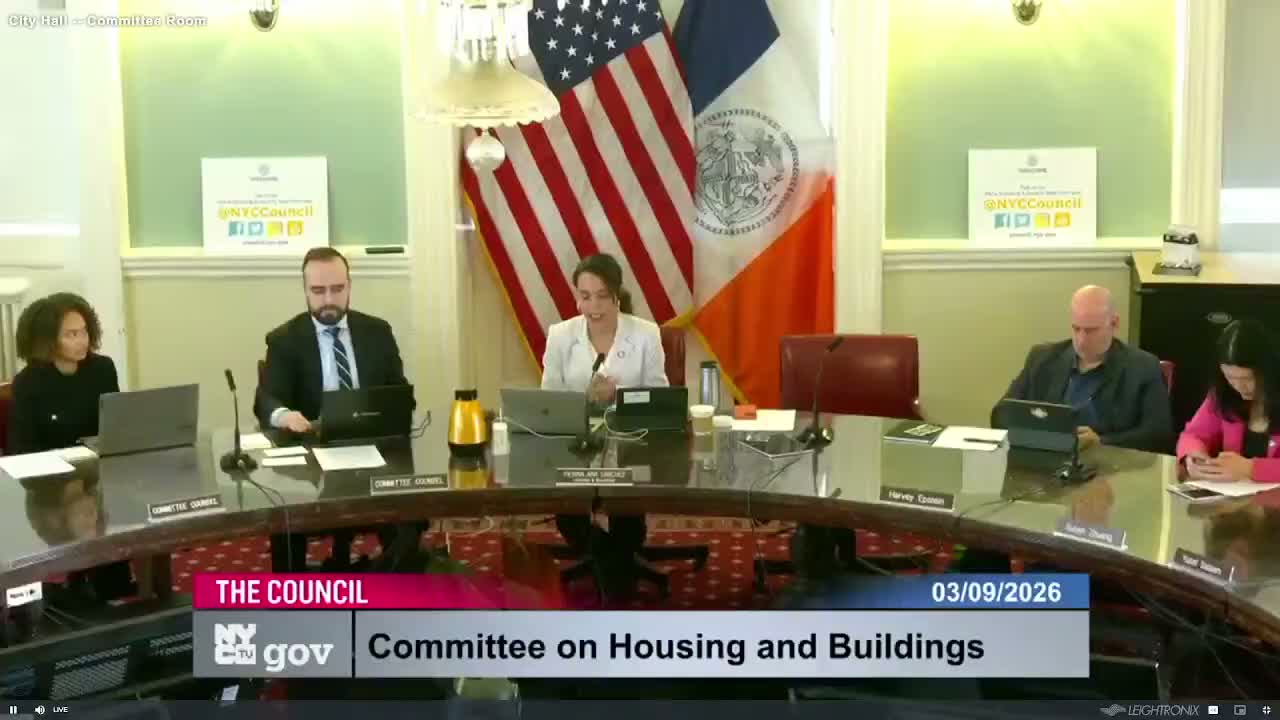
Summary
HPD officials testified to the New York City Council Housing & Buildings Committee on Intro 657, the Safer Homes Act, which would replace the old third‑party transfer (TPT) selection method with a 'critical eligible' index to target severely distressed buildings, add outreach and owner supports, and create a surplus‑equity claims process. Council members pressed HPD for statutory guarantees for tenant ownership and protections for HDFC cooperatives.
The New York City Council Committee on Housing and Buildings heard testimony on Intro 657, the Safer Homes Act, a proposal to retool the city’s third‑party transfer (TPT) program to target the most severely distressed residential buildings while expanding homeowner protections and tenant pathways to ownership.
Rosa Kelly, chief of staff to the commissioner at the Department of Housing Preservation and Development (HPD), told the committee the program is intended for a narrow slice of the housing stock where “years of unpaid municipal debt and persistent hazardous housing conditions” require intervention. “HPD views the program as a key part of our broader enforcement and preservation toolkit to ensure that housing remains safe and livable for New Yorkers,” Kelly said.
Why the bill changes selection: HPD and its staff said the proposal replaces the older statutory‑distress definition and the so‑called block‑pickup rule—under which one qualifying building could trigger transfers across a block—with a two‑step approach. First, buildings must meet type‑specific arrears thresholds (for example, tax class 1 would need arrears exceeding roughly three years of annual tax liability; HDFC rentals two years; class 2 rentals one year). Second, an indexing system would score properties on municipal debt and recent class B/C housing violations so that the agency “picks up the worst of the worst,” Kelly said. HPD presented illustrative slides showing the top 200–500 properties would have much higher arrears and unresolved violations under the proposed index than under the statutory test.
Notices, owner supports and agency liaisons: To reduce surprise transfers, HPD proposed expanded notice steps including an added second notice of possible foreclosure, posting notices in common areas and targeted flyering, a required appraisal and report for surplus equity claims, and an Owner Resource Center to provide technical assistance and standardized payment‑plan options for owners. HPD also recommended an agency liaison listed on agency websites so owners and tenants know whom to contact.
Tenant ownership and statutory guarantees: Several council members pressed HPD on how the bill will ensure tenant ownership actually happens when tenants meet program milestones. Council member Epstein said the tenant‑ownership pathway “seems very weak” and asked why timelines and guarantees could not be written into the law rather than established later by program rules. HPD staff replied they will provide “clear timelines and milestones for achieving tenant ownership” and stronger programmatic supports, but stopped short of promising an automatic statutory right to compel a transfer if a third‑party owner declines to convey. “We are going to map out the program and make sure that it works for everyone,” HPD said, adding it was willing to negotiate statutory language.
HDFCs and equity concerns: Committee members raised the disproportionate inclusion of Housing Development Fund Corporation (HDFC) cooperatives in past rounds. HPD staff acknowledged that prior rounds over‑represented HDFCs and said the new selection model and supplemental outreach would reduce that overrepresentation. HPD supplied model estimates (described as hypothetical) that about 30% of a top‑500 sample could be HDFC co‑ops or rentals, while stressing year‑to‑year variability.
Neighborhood Restore, reversals and surplus equity: HPD described Neighborhood Restore (a nonprofit formed by LISC and Enterprise) as the interim‑owner partner that provides immediate stabilization and tenant engagement; HPD funds and MOU that relationship at the start of each round. On the issue of reversing transfers, HPD said limited reversals have occurred when liens are invalidated or charges are canceled and that such cases are handled by the IN REM foreclosure release board, which HPD recommends retaining in statute. HPD also outlined a surplus‑equity claim process: a final warning notice, an appraisal and report to owners, an opportunity to dispute the appraisal, and vendor‑conducted appraisals once legislation is final.
Costs, round size and monitoring: HPD repeatedly emphasized that it cannot statutorily commit to a minimum round size without a full cost analysis; historically rounds have ranged roughly from 250 to 500 properties. The agency said it would retain discretion on how many properties to select per round but would commit to transparent communications and monitoring. Buildings pulled from the lien sale but not selected for TPT would be subject to regular roof‑to‑seller inspections and continued enforcement oversight, HPD said.
Past conversions and delays: On conversions to tenant ownership, HPD provided data from past rounds: 73 tenant petitions supported across rounds 1–10, of which 47 converted, 13 remain long‑term rentals, 10 are pending conversion and three are in construction or predevelopment. Council members flagged multi‑year delays and litigation in prior rounds and urged statutory protections and sufficient funding for Article 11 support and construction financing.
What’s next: HPD said the introduced bill will be refined in consultation with council members and advocates; the agency invited public testimony and submissions. Committee members signaled they will push for clearer statutory language on tenant protections, surplus‑equity procedures and exemptions for owner‑occupied households and vulnerable populations. The hearing concluded with HPD answering additional questions from council members about outreach, exemption criteria and programmatic supports.
The committee did not take a final vote during the hearing; HPD and the council will continue negotiations and follow‑up on data requests and contractual materials.